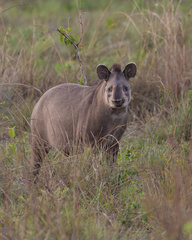
South American Tapir

South American Tapir

Tapirus terrestris

Silhouette: J. N. Wiegers · PhyloPic

LCNTVUVulnerableENCR
Daily sighting probability ~10% · With luck
at Iguaçu National Park

In 3 days ~20% in a week ~40%

12 Verified sightings at Iguaçu National Park From 2019 to 2026
424 In all 9 parks
July Best month
☀️ Diurnal When it's spotted

About the South American Tapir

The South American tapir (Tapirus terrestris), also commonly called the Brazilian tapir (from the Tupi tapi'ira), the Amazonian tapir, the maned tapir, the lowland tapir, anta (Brazilian Portuguese), and sachavaca (literally "bushcow", in mixed Quechua and Spanish), is one of the four recognized species in the tapir family (of the order Perissodactyla, with the mountain tapir, the Malayan tapir, and the Baird's tapir). It is the largest surviving native terrestrial mammal in the Amazon.

Most classifications also include Tapirus kabomani (also known as the dwarf black tapir or the kabomani tapir) as also belonging to the species Tapirus terrestris (Brazilian tapir), despite its questionable existence and the overall lack of information on its habits and distribution. The specific epithet derives from arabo kabomani, the word for tapir in the local Paumarí language. The formal description of this tapir did not suggest a common name for the species. The Karitiana people call it the little black tapir. It is, purportedly, the smallest tapir species, even smaller than the mountain tapir (T. pinchaque), which had been considered the smallest. T. kabomani is allegedly also found in the Amazon rainforest, where it appears to be sympatric with the well-known South American tapir (T. terrestris). When it was described in December of 2013, T. kabomani was the first odd-toed ungulate discovered in over 100 years. However, T. kabomani has not been officially recognized by the Tapir Specialist Group as a distinct species; recent genetic evidence further suggests it is likely a subspecies of T. terrestris. In 2024, the International Commission on Zoological Nomenclature (ICZN) has officially ruled that the binomen Tapirus pygmaeus has priority over Tapirus kabomani given that they are synonyms after a 2014 petition. Wikipedia →

Sounds

Call0:38

Ecuador · 2025

© Marc Anderson · XC983493 · CC BY-NC-ND 4.0

Global Distribution

Parks Where Found

# Park Country Daily sighting probability
1 Emas National Park 🇧🇷 Brazil
~70%
2 El Impenetrable National Park 🇦🇷 Argentina
~60%
3 Parque Estadual Encontro das Águas 🇧🇷 Brazil
~40%
4 Yasuní National Park 🇪🇨 Ecuador
~30%
5 Manu National Park 🇵🇪 Peru
~30%
6 Chapada dos Guimarães National Park 🇧🇷 Brazil
~20%
7 Iguazú National Park 🇦🇷 Argentina
~20%
8 Tambopata National Reserve 🇵🇪 Peru
~20%
9 Iguaçu National Park 🇧🇷 Brazil
~10%

Zoos & Centres Where Found

# Zoo / Centre Country
1 Pairi Daiza 🇧🇪 Belgium In captivity
2 ZooParc de Beauval 🇫🇷 France In captivity
3 Dublin Zoo 🇮🇪 Ireland In captivity
4 Lisbon Oceanarium 🇵🇹 Portugal In captivity
5 Parque das Aves 🇧🇷 Brazil In captivity
6 Le Pal 🇫🇷 France In captivity
7 Zlín-Lešná Zoo 🇨🇿 Czechia In captivity
8 Kolmården Wildlife Park 🇸🇪 Sweden In captivity
9 Fota Wildlife Park 🇮🇪 Ireland In captivity
10 Jihlava Zoo 🇨🇿 Czechia In captivity
11 Zoologic park de Lille 🇫🇷 France In captivity
12 Kaliningrad Zoo 🇷🇺 Russia In captivity
13 Aquarium du palais de la Porte Dorée 🇫🇷 France In captivity
14 Zoobotánico Jerez 🇪🇸 Spain In captivity
15 Zoo d'Amiens 🇫🇷 France In captivity
16 Zoobotanic Park of Brusque 🇧🇷 Brazil In captivity
17 Parque Temático Hacienda Nápoles 🇨🇴 Colombia In captivity
18 Lion Country Safari 🇺🇸 United States In captivity
19 Beijing Wildlife Park 🇨🇳 China In captivity
20 Port Lympne Wild Animal Park 🇬🇧 United Kingdom In captivity
21 Poznań Nowe Zoo 🇵🇱 Poland In captivity
22 Zoológico de Brasília 🇧🇷 Brazil In captivity
23 Planète Sauvage 🇫🇷 France In captivity
24 Bioparque da Amazônia 🇧🇷 Brazil In captivity
25 Brookfield Zoo 🇺🇸 United States In captivity
26 Parc zoologique de Montpellier 🇫🇷 France In captivity
27 Curitiba Zoo 🇧🇷 Brazil In captivity
28 Shanghai Zoo 🇨🇳 China In captivity
29 Yorkshire Wildlife Park 🇬🇧 United Kingdom In captivity
30 Cotswold Wildlife Park 🇬🇧 United Kingdom In captivity
31 Wildlife World Zoo 🇺🇸 United States In captivity
32 São Paulo Zoo 🇧🇷 Brazil In captivity
33 La Torbiera 🇮🇹 Italy In captivity
34 Deer Tracks Junction Adventure Park 🇺🇸 United States In captivity
35 Parque Natural de Pucallpa 🇵🇪 Peru In captivity
36 Novosibirsk Zoo 🇷🇺 Russia In captivity
37 Parque Zoologico Guátika 🇨🇴 Colombia In captivity
38 Ukumarí Biopark 🇨🇴 Colombia In captivity
39 Zoo La Barben 🇫🇷 France In captivity
40 Southwick's Zoo 🇺🇸 United States In captivity
41 Zoológico de Goiânia 🇧🇷 Brazil In captivity
42 Temaikén 🇦🇷 Argentina In captivity
43 Darling Downs Zoo 🇦🇺 Australia In captivity
44 Gramado Zoo 🇧🇷 Brazil In captivity
45 Parque Zoobotânico Getúlio Vargas 🇧🇷 Brazil In captivity
46 Twycross Zoo 🇬🇧 United Kingdom In captivity
47 Biocentro Güembé 🇧🇴 Bolivia In captivity
48 Parque Zoobotânico Arruda Câmara (BICA) 🇧🇷 Brazil In captivity
49 Hamilton Zoo 🇳🇿 New Zealand In captivity
50 Tierpark Ströhen 🇩🇪 Germany In captivity

Before you go

What are the chances of seeing a South American Tapir in Iguaçu National Park?

With luck

About 10% of wildlife watchers report a South American Tapir sighting in Iguaçu National Park on a given day, based on 12 verified sightings from GBIF citizen-science data from 2019 to 2026. It is the 10th most-seen of the 13 mammals we can rate there. Over three days the chance rises to about 20%, and over a week to about 40%, if each day is a fresh chance.

When is the best time to see a South American Tapir in Iguaçu National Park?

July

In that month about 20% of wildlife watchers report a South American Tapir in Iguaçu National Park on a given day, against under 5% in February, May, September and November–December, the lowest months.

What time of day is best to see a South American Tapir?

Between 8 and 11 am

Across all the parks we cover, that three-hour window holds the most South American Tapir sightings with a recorded time, and about 7 in 10 of them come between 6 am and 6 pm: it is a daytime animal.

Where does the South American Tapir sighting chance come from?

GBIF citizen-science records

It is estimated from how often the South American Tapir is recorded against all the mammals logged in Iguaçu National Park (12 verified sightings from 2019 to 2026), calibrated against known sighting rates. Figures are rounded to the nearest 10% because citizen-science data supports honest approximations, not decimals, and months with records from fewer than five people show "—". How it works.

← Back to Iguaçu National Park