Leafy Spurge Hawkmoth

Leafy Spurge Hawkmoth

Hyles euphorbiae

Daily sighting probability ~10% · With luck
at Doñana National Park

In 3 days ~20% in a week ~50%

5 Verified sightings at Doñana National Park From 2019 to 2026
343 In all 11 parks
September Best month
☀️ Diurnal When it's spotted

About the Leafy Spurge Hawkmoth

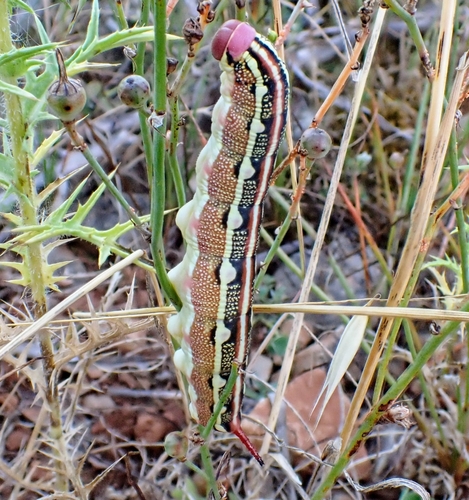
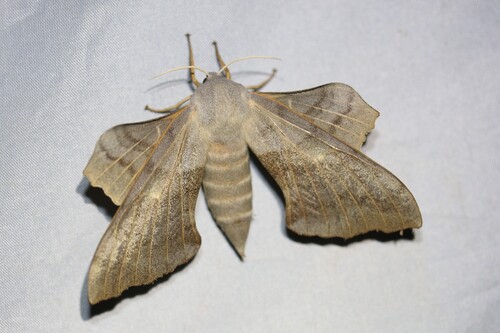
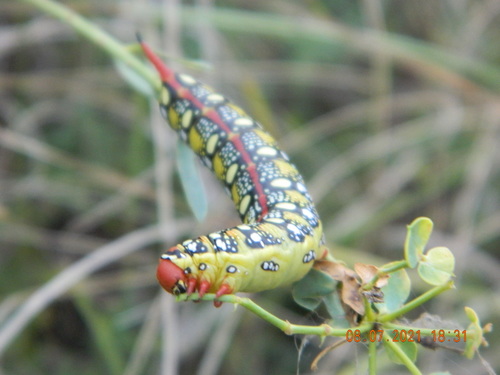
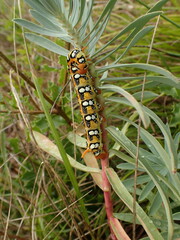
Hyles euphorbiae, the spurge hawk-moth, is a European moth of the family Sphingidae. This hawk moth is used as an agent of biological pest control against the noxious weed leafy spurge (Euphorbia virgata), but usually only in conjunction with other agents. The larvae consume the leaves and bracts of the plant. The species was first described by Carl Linnaeus in his 1758 10th edition of Systema Naturae.

The Spurge Hawk-Moth - Fore wings grey, with an almost square olive-brown blotch; at the base another olive-brown blotch near the middle, and a long oblique band of the same colour, commencing in a point at the extreme apex of the wing, and gradually growing wider until it reaches the margin, where it is very broad: hind wings pink, with a black blotch at the base, and a black band half-way between this black blotch and the margin, and a snowy-white blotch at the anal angle: thorax and body olive-brown, with a white line on each side of the thorax just at the base of the wings; this line runs on each side along the head just above the eye, and the two meet at the nose; the body has on each side at the base two square black spots and two square white spots, and beyond... Wikipedia →
Global Distribution

Parks Where Found

# Park Country Daily sighting probability
1 Vanoise National Park 🇫🇷 France
~40%
2 Kiskunság National Park 🇭🇺 Hungary
~30%
3 Ecrins National Park 🇫🇷 France
~30%
4 Ordesa y Monte Perdido National Park 🇪🇸 Spain
~30%
5 Mercantour National Park 🇫🇷 France
~20%
6 Aigüestortes National Park 🇪🇸 Spain
~20%
7 Cévennes National Park 🇫🇷 France
~10%
8 Hohe Tauern National Park 🇦🇹 Austria
~10%
9 Sierra Nevada National Park 🇪🇸 Spain
~10%
10 Pyrénées National Park 🇫🇷 France
~10%
11 Doñana National Park 🇪🇸 Spain
~10%

Cities Where Found

# City Country Daily sighting probability
1 Calgary 🇨🇦 Canada
~10%
2 Barcelona 🇪🇸 Spain
~10%
3 Edmonton 🇨🇦 Canada
~10%
4 Denver 🇺🇸 United States
~10%
5 Berlin 🇩🇪 Germany
<5%
6 Prague 🇨🇿 Czechia
<5%
7 Minneapolis [Saint Paul] 🇺🇸 United States
<5%

Before you go

What are the chances of seeing a Leafy Spurge Hawkmoth in Doñana National Park?

With luck

About 10% of wildlife watchers report a Leafy Spurge Hawkmoth sighting in Doñana National Park on a given day, based on 5 verified sightings from GBIF citizen-science data from 2019 to 2026. It is the 66th most-seen of the 87 insects we can rate there. Over three days the chance rises to about 20%, and over a week to about 50%, if each day is a fresh chance.

When is the best time to see a Leafy Spurge Hawkmoth in Doñana National Park?

September

In that month about 20% of wildlife watchers report a Leafy Spurge Hawkmoth in Doñana National Park on a given day, against under 5% in May–August and November–March, the lowest months. That is one of Doñana National Park's driest months, with about 20 mm of rain against 90 mm in October.

What time of day is best to see a Leafy Spurge Hawkmoth?

Between 10 am and 1 pm

Across all the parks we cover, that three-hour window holds the most Leafy Spurge Hawkmoth sightings with a recorded time, and about 8 in 10 of them come between 6 am and 6 pm: it is a daytime animal.

Is Doñana National Park the best place to see a Leafy Spurge Hawkmoth?

11th of 11

Of the 11 parks where we can rate Leafy Spurge Hawkmoth sightings, Doñana National Park ranks 11th at about 10%. The best odds are in Vanoise National Park (France, about 40%), Kiskunság National Park (Hungary, about 30%) and Ecrins National Park (France, about 30%).

Where does the Leafy Spurge Hawkmoth sighting chance come from?

GBIF citizen-science records

It is estimated from how often the Leafy Spurge Hawkmoth is recorded against all the insects logged in Doñana National Park (5 verified sightings from 2019 to 2026), calibrated against known sighting rates. Figures are rounded to the nearest 10% because citizen-science data supports honest approximations, not decimals, and months with records from fewer than five people show "—". How it works.

← Back to Doñana National Park