About the New Zealand Red Admiral
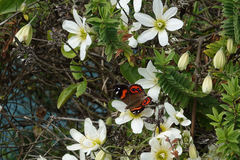
The New Zealand red admiral (Vanessa gonerilla) is a species of butterfly native to New Zealand, where it is relatively widespread. In the Māori language, which is spoken by the people indigenous to New Zealand, the butterfly is referred to as kahukura, which means 'red cloak'. There are two subspecies of red admiral, which occur on the mainland and on the Chatham Islands, respectively. As an adult, the red admiral has a wingspan of around 50–60 mm (2.0–2.4 in). The wings are blackish and have distinctive red and white markings. The Chatham Islands subspecies is nearly identical to the mainland subspecies, but has slightly different red markings.
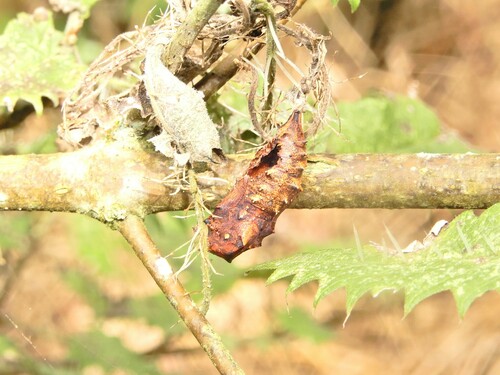
As a caterpillar, the red admiral is blackish with green markings. It is sometimes mistaken for the yellow admiral (Vanessa itea), which is also common in New Zealand. The caterpillar feeds on the leaves of Urtica (stinging nettles), especially Urtica ferox (ongaonga). Egg laying begins in September and proceeds until late May (early spring to late autumn in the Southern Hemisphere). After hatching, it takes five to six weeks for the caterpillar to begin to enter the pupal stage, where the caterpillar forms a cocoon and transitions into an adult. After two to three weeks, the adult emerges from the chrysalis. The red admiral is a strong flier that tends to move in an erratic pattern. The Chatham Islands subspecies is reported to be more timid and flighty than the mainland subspecies.
The red admiral was first scientifically described in 1775 by Danish zoologist Johan Christian Fabricius from specimens collected during the first voyage of James Cook. It has been proposed that the red admiral is in decline, but this is difficult to assess due to an absence of historical population records. Under the New Zealand Threat Classification System, it is listed as "Not Threatened". The red admiral is heavily parasitised by the exotic (non-native) wasps Echthromorpha intricatoria (cream-spotted ichneumon) and Pteromalus puparum, which lay eggs in the red admiral pupa. In one survey, P. puparum and E. intricatoria were present in many pupae. It has been suggested that the perceived decline of the red admiral is due to the high level of parasitism by E. intricatoria. Wikipedia →