Prairie Falcon

Prairie Falcon

Falco mexicanus

Silhouette: Shyamal · PhyloPic

LCLeast ConcernNTVUENCR
Daily sighting probability <5% · Rare
at El Vizcaíno Biosphere Reserve

In 3 days <5% in a week ~10%

16 Verified sightings at El Vizcaíno Biosphere Reserve From 2019 to 2026
918 In all 16 parks
November Best month
☀️ Diurnal When it's spotted

About the Prairie Falcon

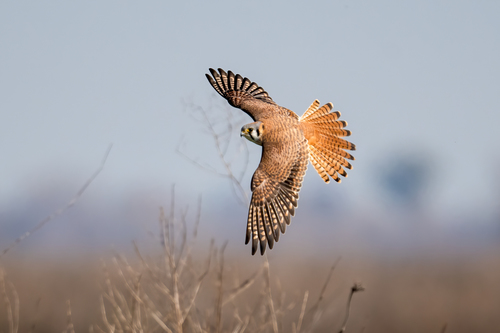
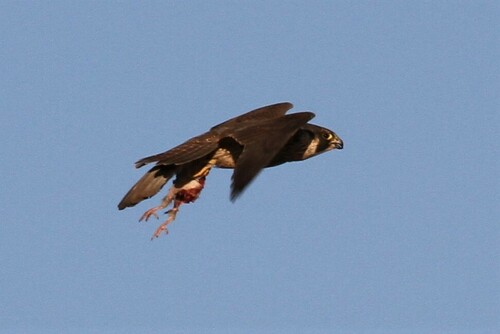
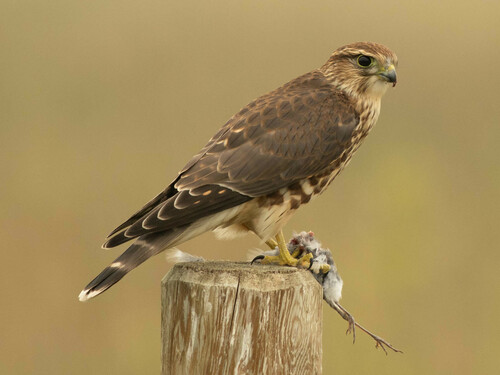
The prairie falcon (Falco mexicanus) is a medium-sized falcon found in Western North America. A separate species from the peregrine falcon, with which it shares some visual similarities, the prairie falcon is, essentially, an arid-climate divergence of earlier peregrine falcon lineage. It is thus able to thrive on a more meager, opportunistic diet compared to that of the peregrine, and is generally lighter in weight than a peregrine of similar wingspan. Having evolved in harsher and desert environments, often with low prey density, the prairie falcon has developed into an aggressive and opportunistic hunter of a wide range of both mammalian and avian prey, as well as occasional reptiles. It will regularly take prey from the size of sparrows or finches to birds approximately its own weight, and occasionally much larger.

The prairie falcon is the only larger falcon species native strictly to North America (others are found throughout the Americas and beyond, such as the peregrine falcon with its cosmopolitan distribution). The prairie falcon is resident from Canada (mainly Alberta, British Columbia and Saskatchewan) through the Western United States (west of the Mississippi) and south into Northern Mexico.

Like many raptors and falconiformes, the prairie falcon is popular in falconry; with proper training and care, it is regarded as being equally as skilled as the more well-known peregrine, among others. Wikipedia →

Sounds

Alarm call0:18

United States · 2017

© Bobby Wilcox · XC375912 · CC BY-NC-SA 4.0

Duet0:24

United States · 2010

© Nathan Pieplow · XC109298 · CC BY-NC-ND 2.5

Call1:11

United States · 2016

© Bruce Lagerquist · XC318021 · CC BY-NC-SA 4.0

Global Distribution

Parks Where Found

# Park Country Daily sighting probability
1 Badlands National Park 🇺🇸 United States
~10%
2 Death Valley National Park 🇺🇸 United States
<5%
3 Joshua Tree National Park 🇺🇸 United States
<5%
4 Rocky Mountain National Park 🇺🇸 United States
<5%
5 Yellowstone National Park 🇺🇸 United States
<5%
6 El Vizcaíno Biosphere Reserve 🇲🇽 Mexico
<5%
7 Grand Teton National Park 🇺🇸 United States
<5%
8 Grand Canyon National Park 🇺🇸 United States
<5%
9 Guadalupe Mountains National Park 🇺🇸 United States
<5%
10 Glacier National Park 🇺🇸 United States
<5%
11 Banff National Park 🇨🇦 Canada
<5%
12 Yosemite National Park 🇺🇸 United States
<5%
13 Zion National Park 🇺🇸 United States
<5%
14 Saguaro National Park 🇺🇸 United States
<5%
15 Sequoia and Kings Canyon National Parks 🇺🇸 United States
<5%
16 Big Bend National Park 🇺🇸 United States
<5%

Cities Where Found

# City Country Daily sighting probability
1 Las Vegas 🇺🇸 United States
<5%
2 Phoenix 🇺🇸 United States
<5%
3 Denver 🇺🇸 United States
<5%
4 Mesa 🇺🇸 United States
<5%
5 Calgary 🇨🇦 Canada
<5%
6 Salt Lake City 🇺🇸 United States
<5%
7 Sacramento 🇺🇸 United States
<5%
8 San Diego 🇺🇸 United States
<5%
9 Los Angeles 🇺🇸 United States
<5%
10 San Francisco 🇺🇸 United States
<5%

Zoos & Centres Where Found

# Zoo / Centre Country
1 ZooParc de Beauval 🇫🇷 France In captivity
2 Birds of prey 🇨🇦 Canada In captivity
3 Arizona-Sonora Desert Museum 🇺🇸 United States In captivity
4 Ørnereservatet 🇩🇰 Denmark In captivity
5 Cascades Raptor Center 🇺🇸 United States In captivity

Before you go

What are the chances of seeing a Prairie Falcon in El Vizcaíno Biosphere Reserve?

Rare

Under 5% of wildlife watchers report a Prairie Falcon sighting in El Vizcaíno Biosphere Reserve on a given day, based on 16 verified sightings from GBIF citizen-science data from 2019 to 2026. It is the 185th most-seen of the 237 birds we can rate there. Over three days the chance rises to under 5%, and over a week to about 10%, if each day is a fresh chance.

When is the best time to see a Prairie Falcon in El Vizcaíno Biosphere Reserve?

November

In that month about 10% of wildlife watchers report a Prairie Falcon in El Vizcaíno Biosphere Reserve on a given day, against under 5% in December to October, the lowest months.

What time of day is best to see a Prairie Falcon?

Between 9 am and noon

Across all the parks we cover, that three-hour window holds the most Prairie Falcon sightings with a recorded time, and about 9 in 10 of them come between 6 am and 6 pm: it is a daytime animal.

Is El Vizcaíno Biosphere Reserve the best place to see a Prairie Falcon?

6th of 16

Of the 16 parks where we can rate Prairie Falcon sightings, El Vizcaíno Biosphere Reserve ranks 6th at under 5%. The best odds are in Badlands National Park (United States, about 10%), Death Valley National Park (United States, under 5%) and Joshua Tree National Park (United States, under 5%).

Which relatives of the Prairie Falcon live in El Vizcaíno Biosphere Reserve?

Same genus: Falco

The closest relatives of the Prairie Falcon that you can see in El Vizcaíno Biosphere Reserve (genus Falco, Typical Falcons) are American Kestrel (about 20%) and Peregrine Falcon (about 20%), with each one's daily chance of a sighting.

Where does the Prairie Falcon sighting chance come from?

GBIF citizen-science records

It is estimated from how often the Prairie Falcon is recorded against all the birds logged in El Vizcaíno Biosphere Reserve (16 verified sightings from 2019 to 2026), calibrated against known sighting rates. Figures are rounded to the nearest 10% because citizen-science data supports honest approximations, not decimals, and months with records from fewer than five people show "—". How it works.

← Back to El Vizcaíno Biosphere Reserve