Pearl Crescent

Pearl Crescent

Phyciodes tharos

Daily sighting probability ~40% · Likely
at Elk Island National Park

In 3 days ~80% in a week >90%

120 Verified sightings at Elk Island National Park From 2019 to 2026
1,926 In all 27 parks
July Best month
☀️ Diurnal When it's spotted

About the Pearl Crescent

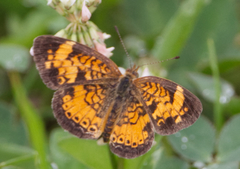
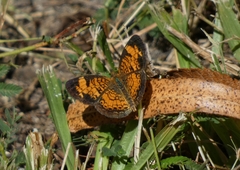
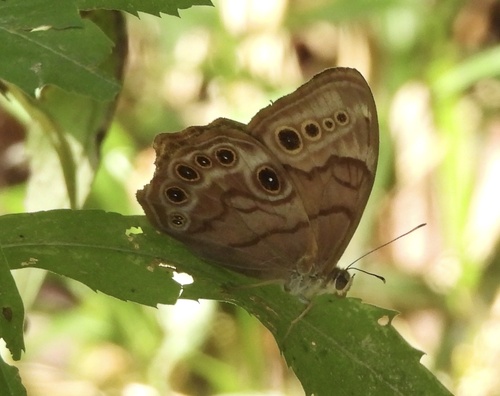
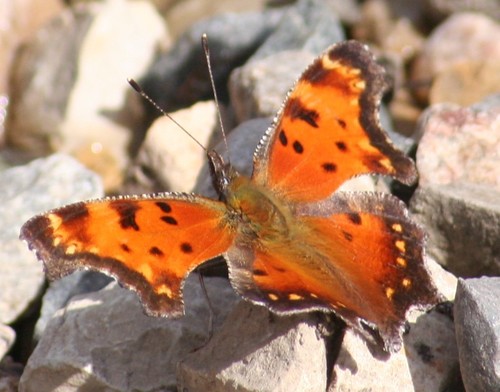
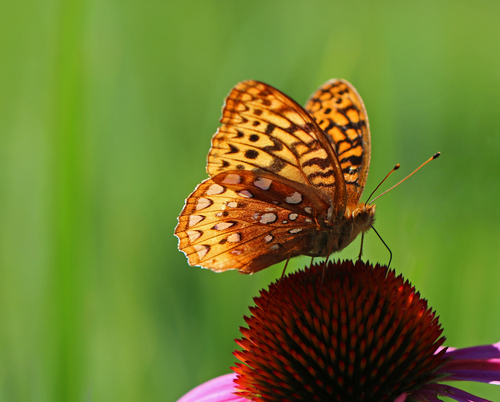
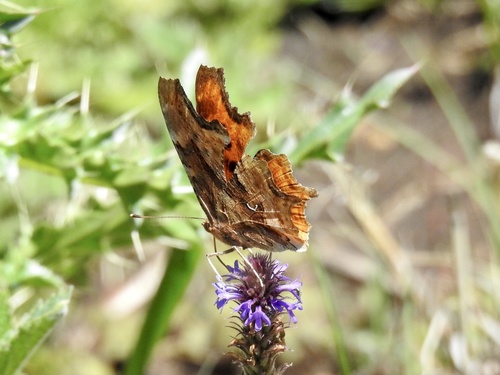
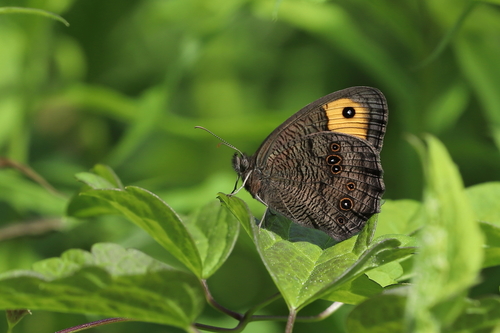
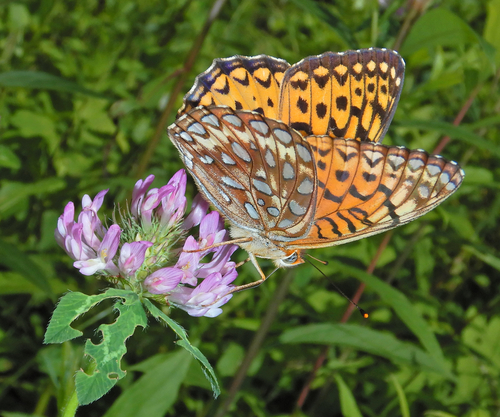
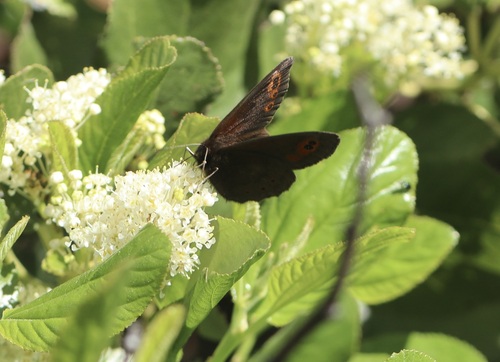
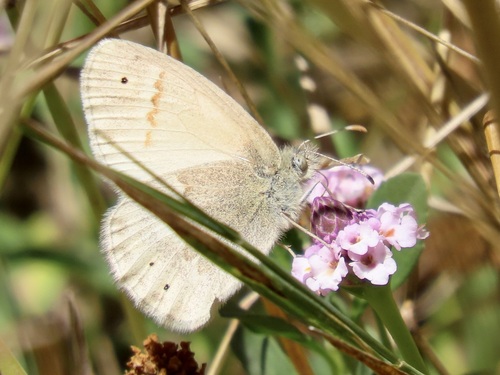
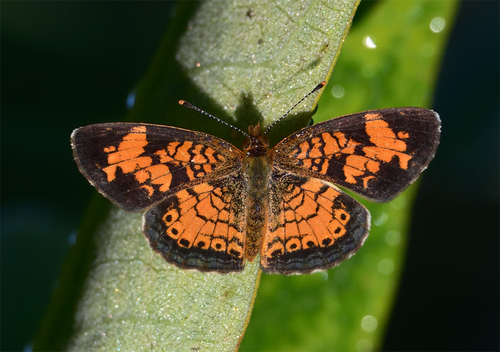
The pearl crescent (Phyciodes tharos) is a species of butterfly from North America. It is found in all parts of the United States except the west coast, and throughout Mexico and parts of southern Canada, in particular Ontario. Its habitat is open areas such as pastures, road edges, vacant lots, fields, open pine woods. Its pattern is quite variable. Males usually have black antenna knobs. Its upper side is orange with black borders; postmedian and submarginal areas are crossed by fine black marks. The underside of the hindwing has a dark marginal patch containing a light-colored crescent.

The wingspan is from 21 to 34 mm. The species has several broods throughout the year, from April–November in the north, and throughout the year in the deep south and Mexico. Adults find nectar from a great variety of flowers including dogbane, swamp milkweed, shepherd's needle, asters, and winter cress. Males patrol open areas for females. The eggs are laid in small batches on the underside of host plant leaves of aster species (family Asteraceae). Caterpillars eat the leaves and are gregarious when young. Hibernation is by third-stage caterpillars.

Hybridization between Phyciodes... Wikipedia →
Global Distribution

Parks Where Found

# Park Country Daily sighting probability
1 Elk Island National Park 🇨🇦 Canada
~40%
2 Congaree National Park 🇺🇸 United States
~40%
3 Wood Buffalo National Park 🇨🇦 Canada
~40%
4 Jasper National Park 🇨🇦 Canada
~30%
5 Banff National Park 🇨🇦 Canada
~30%
6 Glacier National Park 🇺🇸 United States
~30%
7 Great Smoky Mountains National Park 🇺🇸 United States
~30%
8 Cape Breton Highlands National Park 🇨🇦 Canada
~20%
9 Shenandoah National Park 🇺🇸 United States
~20%
10 Kluane National Park 🇨🇦 Canada
~20%
11 Big Cypress National Preserve 🇺🇸 United States
~20%
12 Isle Royale National Park 🇺🇸 United States
~20%
13 Riding Mountain National Park 🇨🇦 Canada
~20%
14 Olympic National Park 🇺🇸 United States
~20%
15 Point Pelee National Park 🇨🇦 Canada
~20%
16 Gros Morne National Park 🇨🇦 Canada
~20%
17 Acadia National Park 🇺🇸 United States
~10%
18 Rocky Mountain National Park 🇺🇸 United States
~10%
19 Grand Teton National Park 🇺🇸 United States
~10%
20 Yellowstone National Park 🇺🇸 United States
~10%
21 Grand Canyon National Park 🇺🇸 United States
~10%
22 Zion National Park 🇺🇸 United States
~10%
23 Sequoia and Kings Canyon National Parks 🇺🇸 United States
~10%
24 Merritt Island National Wildlife Refuge 🇺🇸 United States
~10%
25 Cumbres de Monterrey National Park 🇲🇽 Mexico
~10%
26 Yosemite National Park 🇺🇸 United States
~10%
27 Everglades National Park 🇺🇸 United States
<5%

Cities Where Found

# City Country Daily sighting probability
1 Dallas 🇺🇸 United States
~20%
2 Washington 🇺🇸 United States
~20%
3 Baltimore 🇺🇸 United States
~10%
4 Chicago 🇺🇸 United States
~10%
5 Austin 🇺🇸 United States
~10%
6 Houston 🇺🇸 United States
~10%
7 Philadelphia 🇺🇸 United States
~10%
8 New York City 🇺🇸 United States
~10%
9 Edmonton 🇨🇦 Canada
~10%
10 Toronto 🇨🇦 Canada
~10%

Before you go

What are the chances of seeing a Pearl Crescent in Elk Island National Park?

Likely

About 40% of wildlife watchers report a Pearl Crescent sighting in Elk Island National Park on a given day, based on 120 verified sightings from GBIF citizen-science data from 2019 to 2026. It is the 2nd most-seen of the 112 insects we can rate there. Over three days the chance rises to about 80%, and over a week to over 90%, if each day is a fresh chance.

When is the best time to see a Pearl Crescent in Elk Island National Park?

June and July

In those months about 70% of wildlife watchers report a Pearl Crescent in Elk Island National Park on a given day, against under 5% in September to April, the lowest months. Those are among Elk Island National Park's wettest months, with about 110 mm of rain a month against 20 mm in December.

What time of day is best to see a Pearl Crescent?

Between 11 am and 2 pm

Across all the parks we cover, that three-hour window holds the most Pearl Crescent sightings with a recorded time, and nearly all of them come between 6 am and 6 pm: it is a daytime animal.

Is Elk Island National Park the best place to see a Pearl Crescent?

Yes

Of the 27 parks where we can rate Pearl Crescent sightings, Elk Island National Park has the highest daily chance: about 40%. Next come Congaree National Park (United States, about 40%) and Wood Buffalo National Park (Canada, about 40%). All parks ranked.

Which relatives of the Pearl Crescent live in Elk Island National Park?

Same family: Nymphalidae

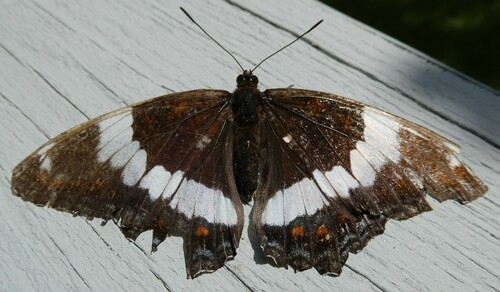
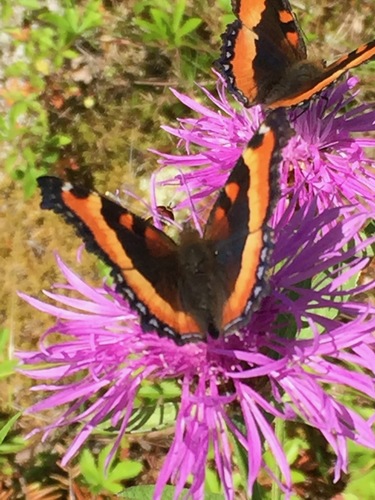
The closest relatives of the Pearl Crescent that you can see in Elk Island National Park (family Nymphalidae, Brush-footed Butterflies) are Red-Spotted Admiral (about 40%), Milbert's Tortoiseshell (about 40%) and Northern Pearly-Eye (about 30%), with each one's daily chance of a sighting.

Where does the Pearl Crescent sighting chance come from?

GBIF citizen-science records

It is estimated from how often the Pearl Crescent is recorded against all the insects logged in Elk Island National Park (120 verified sightings from 2019 to 2026), calibrated against known sighting rates. Figures are rounded to the nearest 10% because citizen-science data supports honest approximations, not decimals, and months with records from fewer than five people show "—". How it works.

← Back to Elk Island National Park