Northern Gannet

Northern Gannet

Morus bassanus

Silhouette: Andy Wilson · PhyloPic

LCLeast ConcernNTVUENCR
Daily sighting probability <5% · Rare
at Everglades National Park

In 3 days <5%

10 Verified sightings at Everglades National Park From 2019 to 2026
2,537 In all 11 parks
November Best month
☀️ Diurnal When it's spotted

About the Northern Gannet

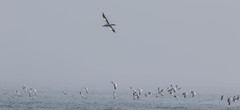
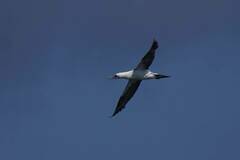
The northern gannet (Morus bassanus) is a seabird, the largest species of the gannet family, Sulidae. It is native to the coasts of the North Atlantic Ocean, breeding in Western Europe and Northeastern North America. It is the largest seabird in the northern Atlantic. The sexes are similar in appearance. The adult northern gannet has a mainly white streamlined body with a long neck, and long and slender wings. It is 87–100 cm (34+1⁄2–39+1⁄2 in) long with a 170–180 cm (67–71 in) wingspan. The head and nape have a buff tinge that is more prominent in breeding season, and the wings are edged with dark brown-black feathers. The long, pointed bill is blue-grey, contrasting with black, bare skin around the mouth and eyes. Juveniles are mostly grey-brown, becoming increasingly white in the five years it takes them to reach maturity.

Nesting takes place in colonies on both sides of the North Atlantic, the largest of which are at the Bass Rock (75,000 pairs as of 2014), St. Kilda (60,000 pairs as of 2013) and Ailsa Craig (33,000 pairs as of 2014) in Scotland, in Ireland (Sceilg Bheag; little Skellig, 35,000 pairs in 2011), Grassholm in Wales, and Bonaventure Island (60,000 pairs in 2009) off the coast of Quebec. Its breeding range has extended northward and eastward, with colonies being established on Russia's Kola Peninsula in 1995 and Bear Island (the southernmost island of Svalbard), in 2011. Colonies are mostly located on offshore islands with cliffs, from which the birds can more easily launch into the air. The northern gannet undertakes seasonal migrations and catches fish (which are the mainstay of its diet) by making high-speed dives into the sea up to 60 mph.

The northern gannet was previously hunted for food in certain parts of its range, and although that practice still continues in the Outer Hebrides of Scotland and the Faroe Islands, the bird faces few other natural or man-made threats. Since its population is growing, the International Union for Conservation of Nature considers it a least-concern species. Because it is both a conspicuous and a common bird, it is referred to in several ancient myths and legends. Wikipedia →

Sounds

Call0:43

Belgium · 2026

© Kelle Moreau · XC1076664 · CC BY-NC-SA 4.0

Begging call0:30

Canada · 2024

© Denis Provencher · XC929260 · CC BY-NC-SA 4.0

Recording0:21

Ireland · 2022

© Mr Mark Shorten · XC721180 · CC BY-NC-ND 4.0

Global Distribution

Parks Where Found

# Park Country Daily sighting probability
1 Cape Breton Highlands National Park 🇨🇦 Canada
~30%
2 Vatnajokull National Park 🇮🇸 Iceland
~10%
3 Gros Morne National Park 🇨🇦 Canada
~10%
4 Wadden Sea National Park 🇩🇪 Germany
~10%
5 Acadia National Park 🇺🇸 United States
~10%
6 Merritt Island National Wildlife Refuge 🇺🇸 United States
<5%
7 Snowdonia National Park 🇬🇧 United Kingdom
<5%
8 Doñana National Park 🇪🇸 Spain
<5%
9 Svalbard 🇳🇴 Norway
<5%
10 Padre Island National Seashore 🇺🇸 United States
<5%
11 Everglades National Park 🇺🇸 United States
<5%

Cities Where Found

# City Country Daily sighting probability
1 Algiers 🇩🇿 Algeria
~20%
2 Dakar 🇸🇳 Senegal
~20%
3 Casablanca 🇲🇦 Morocco
~10%
4 Dublin 🇮🇪 Ireland
~10%
5 Rabat 🇲🇦 Morocco
<5%
6 Rotterdam [The Hague] 🇳🇱 Netherlands
<5%
7 Porto 🇵🇹 Portugal
<5%
8 Miami 🇺🇸 United States
<5%
9 Barcelona 🇪🇸 Spain
<5%
10 Liverpool 🇬🇧 United Kingdom
<5%

Zoos & Centres Where Found

# Zoo / Centre Country
1 Natura Artis Magistra 🇳🇱 Netherlands In captivity
2 Wilhelma 🇩🇪 Germany In captivity
3 Westküstenpark & Robbarium St. Peter-Ording 🇩🇪 Germany In captivity
4 Bremerhaven Zoo 🇩🇪 Germany In captivity
5 Ecomare 🇳🇱 Netherlands In captivity

Before you go

What are the chances of seeing a Northern Gannet in Everglades National Park?

Rare

Under 5% of wildlife watchers report a Northern Gannet sighting in Everglades National Park on a given day, based on 10 verified sightings from GBIF citizen-science data from 2019 to 2026. It is the 266th most-seen of the 273 birds we can rate there. Over three days the chance rises to under 5%, if each day is a fresh chance.

When is the best time to see a Northern Gannet in Everglades National Park?

Any time of year

In every month with enough records, under 5% of wildlife watchers report a Northern Gannet in Everglades National Park on a given day, so our monthly data shows no clear season.

What time of day is best to see a Northern Gannet?

Between 9 am and noon

Across all the parks we cover, that three-hour window holds the most Northern Gannet sightings with a recorded time, and about 8 in 10 of them come between 6 am and 6 pm: it is a daytime animal.

Which relatives of the Northern Gannet live in Everglades National Park?

Same order: Suliformes

The closest relatives of the Northern Gannet that you can see in Everglades National Park (order Suliformes, Gannets, Cormorants, and Allies) are Anhinga (about 50%), Double-crested Cormorant (about 50%) and Magnificent Frigatebird (about 10%), with each one's daily chance of a sighting.

Where does the Northern Gannet sighting chance come from?

GBIF citizen-science records

It is estimated from how often the Northern Gannet is recorded against all the birds logged in Everglades National Park (10 verified sightings from 2019 to 2026), calibrated against known sighting rates. Figures are rounded to the nearest 10% because citizen-science data supports honest approximations, not decimals, and months with records from fewer than five people show "—". How it works.

← Back to Everglades National Park