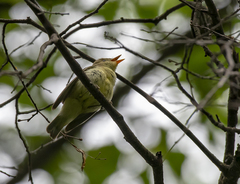
Icterine Warbler

Icterine Warbler

Hippolais icterina

Silhouette: John Gerrard Keulemans · PhyloPic

LCLeast ConcernNTVUENCR
Daily sighting probability ~10% · With luck
at Fertő-Hanság National Park

In 3 days ~20% in a week ~40%

63 Verified sightings at Fertő-Hanság National Park From 2019 to 2026
835 In all 14 parks
May Best month
☀️ Diurnal When it's spotted

About the Icterine Warbler

The icterine warbler (Hippolais icterina) is an Old World warbler in the tree warbler genus Hippolais. It breeds in mainland Europe except the southwest, where it is replaced by its western counterpart, the melodious warbler. It is migratory, wintering in sub-Saharan Africa.

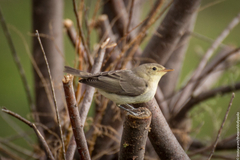
A fairly big warbler with a large head, broad-based bill and long wings with a quite short square-ended tail. The upperparts are greyish-green and the underparts are uniformly light yellow. It has pale lores and a rather vague yellowish supercilium with a pale eye ring. Other distinguishing features include a panel on the folded wings formed by pale edges to the secondary feathers and tertiary feathers and the grey, sometimes bluish legs.

The icterine warbler is a bird of woodland rather than forest, preferring woodland edge or glades, favouring the crowns of well-spaced trees with tall undergrowth. It prefers broad-leafed trees, but may be found in conifers mixed with broad-leafed trees. It will use copses, orchards, parks, gardens, shelterbelts and tall hedges interspersed with trees.

The song is a fast nasal babbling incorporating mimicry of other species. The call... Wikipedia →

Sounds

Song0:27

Poland · 2026

© Radek Grochowski · XC1136574 · CC BY-NC-SA 4.0

Alarm call0:55

Germany · 2025

© Bodo Sonnenburg · XC1011627 · CC BY-NC-ND 4.0

Call1:24

Sweden · 2024

© Thomas Bergman · XC923001 · CC BY-NC-SA 4.0

Global Distribution

Parks Where Found

# Park Country Daily sighting probability
1 Białowieża National Park 🇵🇱 Poland
~20%
2 Biebrza National Park 🇵🇱 Poland
~10%
3 Fertő-Hanság National Park 🇭🇺 Hungary
~10%
4 Bavarian Forest National Park 🇩🇪 Germany
<5%
5 Kiskunság National Park 🇭🇺 Hungary
<5%
6 Hortobágy National Park 🇭🇺 Hungary
<5%
7 Gauja National Park 🇱🇻 Latvia
<5%
8 Wadden Sea National Park 🇩🇪 Germany
<5%
9 Hwange National Park 🇿🇼 Zimbabwe
<5%
10 Etosha National Park 🇳🇦 Namibia
<5%
11 Camargue 🇫🇷 France
<5%
12 Kruger National Park 🇿🇦 South Africa
<5%
13 Chobe National Park 🇧🇼 Botswana
<5%
14 Nairobi National Park 🇰🇪 Kenya
<5%

Cities Where Found

# City Country Daily sighting probability
1 Essen 🇩🇪 Germany
~10%
2 Saint Petersburg 🇷🇺 Russia
~10%
3 Moscow 🇷🇺 Russia
~10%
4 Minsk 🇧🇾 Belarus
~10%
5 Helsinki 🇫🇮 Finland
<5%
6 Berlin 🇩🇪 Germany
<5%
7 Yekaterinburg 🇷🇺 Russia
<5%
8 Warsaw 🇵🇱 Poland
<5%
9 Budapest 🇭🇺 Hungary
<5%
10 Kyiv 🇺🇦 Ukraine
<5%

Before you go

What are the chances of seeing an Icterine Warbler in Fertő-Hanság National Park?

With luck

About 10% of wildlife watchers report an Icterine Warbler sighting in Fertő-Hanság National Park on a given day, based on 63 verified sightings from GBIF citizen-science data from 2019 to 2026. It is the 135th most-seen of the 207 birds we can rate there. Over three days the chance rises to about 20%, and over a week to about 40%, if each day is a fresh chance.

When is the best time to see an Icterine Warbler in Fertő-Hanság National Park?

May

In that month about 20% of wildlife watchers report an Icterine Warbler in Fertő-Hanság National Park on a given day, against under 5% in July to April, the lowest months. That is one of Fertő-Hanság National Park's wettest months, with about 80 mm of rain against 30 mm in March.

What time of day is best to see an Icterine Warbler?

Between 7 and 10 am

Across all the parks we cover, that three-hour window holds the most Icterine Warbler sightings with a recorded time, and about 9 in 10 of them come between 6 am and 6 pm: it is a daytime animal.

Is Fertő-Hanság National Park the best place to see an Icterine Warbler?

3rd of 14

Of the 14 parks where we can rate Icterine Warbler sightings, Fertő-Hanság National Park ranks 3rd at about 10%. The best odds are in Białowieża National Park (Poland, about 20%) and Biebrza National Park (Poland, about 10%).

Which relatives of the Icterine Warbler live in Fertő-Hanság National Park?

Same family: Acrocephalidae

The closest relatives of the Icterine Warbler that you can see in Fertő-Hanság National Park (family Acrocephalidae, Reed Warblers and Allies) are Great Reed-Warbler (about 40%), Sedge Warbler (about 40%) and Eurasian Reed-Warbler (about 30%), with each one's daily chance of a sighting.

Where does the Icterine Warbler sighting chance come from?

GBIF citizen-science records

It is estimated from how often the Icterine Warbler is recorded against all the birds logged in Fertő-Hanság National Park (63 verified sightings from 2019 to 2026), calibrated against known sighting rates. Figures are rounded to the nearest 10% because citizen-science data supports honest approximations, not decimals, and months with records from fewer than five people show "—". How it works.

← Back to Fertő-Hanság National Park