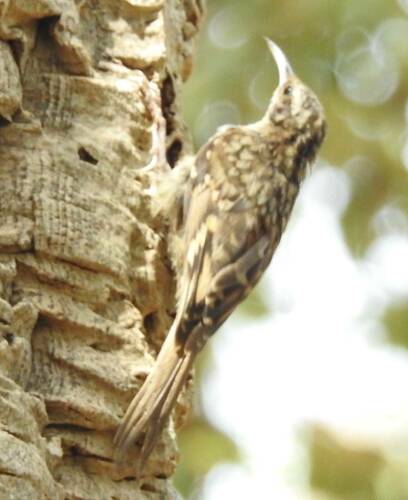
Treecreeper

Treecreeper

Certhia familiaris

Silhouette: Paweł Kuźniar · PhyloPic

LCLeast ConcernNTVUENCR
Daily sighting probability <5% · Rare
at Fertő-Hanság National Park

In 3 days <5% in a week ~10%

10 Verified sightings at Fertő-Hanság National Park From 2019 to 2026
3,235 In all 21 parks
November Best month
☀️ Diurnal When it's spotted

About the Treecreeper

The Eurasian treecreeper or common treecreeper (Certhia familiaris) is a small passerine bird also known in the British Isles, where it is the only living member of its genus, simply as treecreeper. It is similar to other treecreepers, and has a curved bill, patterned brown upperparts, whitish underparts, and long stiff tail feathers which help it creep up tree trunks. It can be most easily distinguished from the similar short-toed treecreeper, which shares much of its European range, by its different song.

The Eurasian treecreeper has nine or more subspecies which breed in different parts of its range in the Palearctic. This species is found in woodlands of all kinds, but where it overlaps with the short-toed treecreeper in western Europe it is more likely to be found in coniferous forests or at higher altitudes. It nests in tree crevices or behind bark flakes, and favours introduced giant sequoia as nest sites where they are available. The female typically lays five or six pink-speckled white eggs in the lined nest, but eggs and chicks are vulnerable to attack by woodpeckers and mammals, including squirrels.

The Eurasian treecreeper is insectivorous and climbs up tree trunks like a mouse, to search for insects which it picks from crevices in the bark with its fine curved bill. It then flies to the base of another tree with a distinctive erratic flight. This bird is solitary in winter, but may form communal roosts in cold weather. Wikipedia →

Sounds

Song0:38

Germany · 2026

© Bodo Sonnenburg · XC1107503 · CC BY-NC-ND 4.0

Call0:09

Sweden · 2025

© Lars Edenius · XC1061243 · CC BY-NC-SA 4.0

Alarm call0:12

France · 2022

© Stanislas Wroza · XC708696 · CC BY-NC-SA 4.0

Global Distribution

Parks Where Found

# Park Country Daily sighting probability
1 Cairngorms National Park 🇬🇧 United Kingdom
~40%
2 Białowieża National Park 🇵🇱 Poland
~40%
3 Tatra National Park 🇸🇰 Slovakia
~30%
4 Plitvice Lakes National Park 🇭🇷 Croatia
~30%
5 Mercantour National Park 🇫🇷 France
~20%
6 Nikko National Park 🇯🇵 Japan
~20%
7 Triglav National Park 🇸🇮 Slovenia
~20%
8 Bavarian Forest National Park 🇩🇪 Germany
~20%
9 Biebrza National Park 🇵🇱 Poland
~20%
10 Vanoise National Park 🇫🇷 France
~10%
11 Hohe Tauern National Park 🇦🇹 Austria
~10%
12 Snowdonia National Park 🇬🇧 United Kingdom
~10%
13 Ecrins National Park 🇫🇷 France
~10%
14 Gauja National Park 🇱🇻 Latvia
~10%
15 Pyrénées National Park 🇫🇷 France
~10%
16 Aigüestortes National Park 🇪🇸 Spain
~10%
17 Ordesa y Monte Perdido National Park 🇪🇸 Spain
~10%
18 Picos de Europa National Park 🇪🇸 Spain
<5%
19 Fertő-Hanság National Park 🇭🇺 Hungary
<5%
20 Wadden Sea National Park 🇩🇪 Germany
<5%
21 Kiskunság National Park 🇭🇺 Hungary
<5%

Cities Where Found

# City Country Daily sighting probability
1 Moscow 🇷🇺 Russia
~30%
2 Minsk 🇧🇾 Belarus
~30%
3 Kyiv 🇺🇦 Ukraine
~20%
4 Kharkiv 🇺🇦 Ukraine
~20%
5 Saint Petersburg 🇷🇺 Russia
~20%
6 Stockholm 🇸🇪 Sweden
~10%
7 Yekaterinburg 🇷🇺 Russia
~10%
8 Helsinki 🇫🇮 Finland
~10%
9 Harbin 🇨🇳 China
~10%
10 Liverpool 🇬🇧 United Kingdom
~10%

Zoos & Centres Where Found

# Zoo / Centre Country
1 AQUA Akvarium & Dyrepark 🇩🇰 Denmark In captivity

Before you go

What are the chances of seeing a Treecreeper in Fertő-Hanság National Park?

Rare

Under 5% of wildlife watchers report a Treecreeper sighting in Fertő-Hanság National Park on a given day, based on 10 verified sightings from GBIF citizen-science data from 2019 to 2026. It is the 190th most-seen of the 207 birds we can rate there. Over three days the chance rises to under 5%, and over a week to about 10%, if each day is a fresh chance.

When is the best time to see a Treecreeper in Fertő-Hanság National Park?

Any time of year

In every month with enough records, under 5% of wildlife watchers report a Treecreeper in Fertő-Hanság National Park on a given day, so our monthly data shows no clear season.

What time of day is best to see a Treecreeper?

Between 9 am and noon

Across all the parks we cover, that three-hour window holds the most Treecreeper sightings with a recorded time, and about 9 in 10 of them come between 6 am and 6 pm: it is a daytime animal.

Where does the Treecreeper sighting chance come from?

GBIF citizen-science records

It is estimated from how often the Treecreeper is recorded against all the birds logged in Fertő-Hanság National Park (10 verified sightings from 2019 to 2026), calibrated against known sighting rates. Figures are rounded to the nearest 10% because citizen-science data supports honest approximations, not decimals, and months with records from fewer than five people show "—". How it works.

← Back to Fertő-Hanság National Park