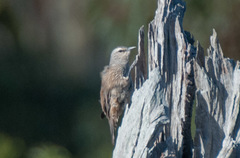
Brown Treecreeper

Brown Treecreeper

Climacteris picumnus

Silhouette: Ferran Sayol · PhyloPic

LCLeast ConcernNTVUENCR Endemic
Daily sighting probability <5% · Rare
at Flinders Ranges National Park

In 3 days ~10% in a week ~20%

18 Verified sightings at Flinders Ranges National Park From 2019 to 2026
264 In all 5 parks
June Best month
☀️ Diurnal When it's spotted

About the Brown Treecreeper

The brown treecreeper (Climacteris picumnus) is the largest Australasian treecreeper. The bird, endemic to eastern Australia, has a broad distribution, occupying areas from Cape York, Queensland, throughout New South Wales and Victoria to Port Augusta and the Flinders Ranges, South Australia. Prevalent nowadays between 16˚S and 38˚S, the population has contracted from the edges of its pre-European range, declining in Adelaide and Cape York. Found in a diverse range of habitats varying from coastal forests to mallee shrub-lands, the brown treecreeper often occupies eucalypt-dominated woodland habitats up to 1,000 metres (3,300 ft), avoiding areas with a dense shrubby understorey.

Coenraad Jacob Temminck and Meiffren Laugier de Chartrouse described the brown treecreeper in 1824, and it still bears its original name today. It is one of six species of treecreeper found in Australia, and is most closely related to the rufous treecreeper (Climacteris rufus) of Western and Southern Australia, and the black-tailed treecreeper (C. melanurus). All three occupy similar savannah and open woodland habitat, and have a sexually dimorphic marking on the upper breast or throat (black... Wikipedia →

Sounds

Song0:04

Australia · 2025

© Étienne Leroy · XC1097706 · CC BY-NC-SA 4.0

Call0:21

Australia · 2023

© Peter Boesman · XC859787 · CC BY-NC-ND 4.0

Alarm call0:12

Australia · 2019

© Liam Murphy · XC660504 · CC BY-NC-SA 4.0

Global Distribution

Parks Where Found

# Park Country Daily sighting probability
1 Hattah-Kulkyne National Park 🇦🇺 Australia
~10%
2 Kosciuszko National Park 🇦🇺 Australia
~10%
3 Grampians National Park 🇦🇺 Australia
~10%
4 Flinders Ranges National Park 🇦🇺 Australia
<5%
5 Blue Mountains National Park 🇦🇺 Australia
<5%

Before you go

What are the chances of seeing a Brown Treecreeper in Flinders Ranges National Park?

Rare

Under 5% of wildlife watchers report a Brown Treecreeper sighting in Flinders Ranges National Park on a given day, based on 18 verified sightings from GBIF citizen-science data from 2019 to 2026. It is the 77th most-seen of the 94 birds we can rate there. Over three days the chance rises to about 10%, and over a week to about 20%, if each day is a fresh chance.

When is the best time to see a Brown Treecreeper in Flinders Ranges National Park?

March–April, June and November

In those months about 10% of wildlife watchers report a Brown Treecreeper in Flinders Ranges National Park on a given day, against under 5% in January–February, May and July–October, the lowest months. December has too few records to rate.

What time of day is best to see a Brown Treecreeper?

Between 10 am and 1 pm

Across all the parks we cover, that three-hour window holds the most Brown Treecreeper sightings with a recorded time, and about 9 in 10 of them come between 6 am and 6 pm: it is a daytime animal.

Which relatives of the Brown Treecreeper live in Flinders Ranges National Park?

Same order: Passeriformes

The closest relatives of the Brown Treecreeper that you can see in Flinders Ranges National Park (order Passeriformes, Perching Birds) are Australian Raven (about 80%), Australian Magpie (about 80%) and Yellow-throated Miner (about 80%), with each one's daily chance of a sighting.

Where does the Brown Treecreeper sighting chance come from?

GBIF citizen-science records

It is estimated from how often the Brown Treecreeper is recorded against all the birds logged in Flinders Ranges National Park (18 verified sightings from 2019 to 2026), calibrated against known sighting rates. Figures are rounded to the nearest 10% because citizen-science data supports honest approximations, not decimals, and months with records from fewer than five people show "—". How it works.

← Back to Flinders Ranges National Park