Australian Shelduck

Australian Shelduck

Tadorna tadornoides

Silhouette: Rebecca Groom · PhyloPic

LCLeast ConcernNTVUENCR
Daily sighting probability ~10% · With luck
at Freycinet National Park

In 3 days ~20% in a week ~40%

28 Verified sightings at Freycinet National Park From 2019 to 2026
1,158 In all 6 parks
August Best month
☀️ Diurnal When it's spotted

About the Australian Shelduck

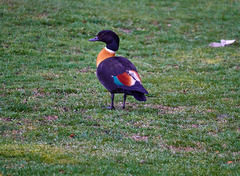
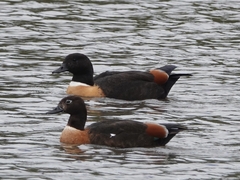
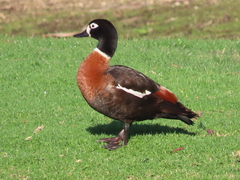
The Australian shelduck (Tadorna tadornoides), also known as the chestnut-breasted shelduck or mountain duck, is a shelduck, a group of large goose-like ducks part of the bird family Anatidae. The genus name Tadorna comes from Celtic roots and means "pied waterfowl". They have a striking chestnut-coloured breast and black body. They are protected under the National Parks and Wildlife Act 1974.

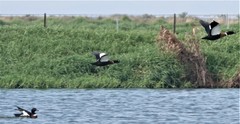
William Jardine and Prideaux John Selby described the Australian shelduck in 1828. The males are mostly dark, with a chestnut breast. They have white neck collars and dark green heads. The females are similar, but they have white around the eyes and are smaller. Both males and females have chestnut and black wings with a green speculum, and show some white on their wings during flight.

The downy young are white with a brown crown and brown stripes from crown to tail. Juvenile males are duller than the adults and also lack a white collar, while juvenile females have a lot more white on their excluding their crown.

The vocal calls of the male are a deep honk similar to a goose, while the female's call is a high pitched and penetrating "zeek, zeek". The... Wikipedia →

Sounds

Uncertain0:25

Australia · 2025

© Nick Talbot · XC1033572 · CC BY-NC-SA 4.0

Call1:13

Australia · 2020

© Ramit Singal · XC567416 · CC BY-NC-SA 4.0

Flight call0:23

Australia · 2017

© Marc Anderson · XC382776 · CC BY-NC-ND 4.0

Global Distribution

Parks Where Found

# Park Country Daily sighting probability
1 Rottnest Island 🇦🇺 Australia
~90%
2 Freycinet National Park 🇦🇺 Australia
~10%
3 Great Otway National Park 🇦🇺 Australia
~10%
4 Grampians National Park 🇦🇺 Australia
~10%
5 Hattah-Kulkyne National Park 🇦🇺 Australia
~10%
6 Wilsons Promontory National Park 🇦🇺 Australia
<5%

Cities Where Found

# City Country Daily sighting probability
1 Perth 🇦🇺 Australia
~40%
2 Melbourne 🇦🇺 Australia
<5%
3 Auckland 🇳🇿 New Zealand
<5%

Zoos & Centres Where Found

# Zoo / Centre Country
1 Busch Gardens Tampa 🇺🇸 United States In captivity
2 Moscow Zoo 🇷🇺 Russia In captivity
3 Prague Zoo 🇨🇿 Czechia In captivity
4 Zoo Pilsen 🇨🇿 Czechia In captivity
5 Parc des oiseaux 🇫🇷 France In captivity
6 Parc zoologique de Lisieux 🇫🇷 France In captivity
7 Cheyenne Mountain Zoo 🇺🇸 United States In captivity
8 Slimbridge Wetland Centre 🇬🇧 United Kingdom In captivity
9 Oasis Park 🇪🇸 Spain In captivity
10 Healesville Sanctuary 🇦🇺 Australia In captivity
11 Taronga Zoo 🇦🇺 Australia In captivity
12 Hamilton Zoo 🇳🇿 New Zealand In captivity
13 Cleland Wildlife Park 🇦🇺 Australia In captivity
14 Budapest Zoo & Botanical Garden 🇭🇺 Hungary In captivity
15 Rio de Janeiro Zoological Garden 🇧🇷 Brazil In captivity
16 Moonlit Sanctuary Wildlife Conservation Park 🇦🇺 Australia In captivity
17 Santillana Zoo 🇪🇸 Spain In captivity
18 Featherdale Sydney Wildlife Park 🇦🇺 Australia In captivity
19 Tralaga Wildlife park 🇦🇺 Australia In captivity
20 Greenough Wildlife & Bird Park 🇦🇺 Australia In captivity
21 Rákosův pavilon 🇨🇿 Czechia In captivity
22 Velemlokárium 🇨🇿 Czechia In captivity
23 Caversham Wildlife Park 🇦🇺 Australia In captivity
24 The Lair 🇦🇺 Australia In captivity
25 Trowunna Wildlife Park 🇦🇺 Australia In captivity

Before you go

What are the chances of seeing an Australian Shelduck in Freycinet National Park?

With luck

About 10% of wildlife watchers report an Australian Shelduck sighting in Freycinet National Park on a given day, based on 28 verified sightings from GBIF citizen-science data from 2019 to 2026. It is the 54th most-seen of the 72 birds we can rate there. Over three days the chance rises to about 20%, and over a week to about 40%, if each day is a fresh chance.

When is the best time to see an Australian Shelduck in Freycinet National Park?

May, July–August, October and December–February

In those months about 10% of wildlife watchers report an Australian Shelduck in Freycinet National Park on a given day, against under 5% in March–April, June, September and November, the lowest months.

What time of day is best to see an Australian Shelduck?

Between 11 am and 2 pm

Across all the parks we cover, that three-hour window holds the most Australian Shelduck sightings with a recorded time, and nearly all of them come between 6 am and 6 pm: it is a daytime animal.

Is Freycinet National Park the best place to see an Australian Shelduck?

2nd of 6

Of the 6 parks where we can rate Australian Shelduck sightings, Freycinet National Park ranks 2nd at about 10%. The best odds are in Rottnest Island (Australia, about 90%).

Which relatives of the Australian Shelduck live in Freycinet National Park?

Same family: Anatidae

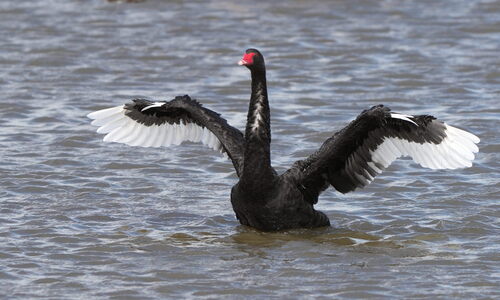
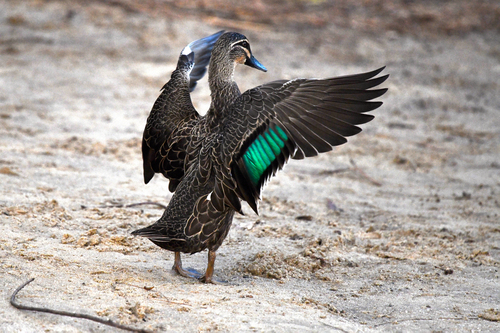
The closest relatives of the Australian Shelduck that you can see in Freycinet National Park (family Anatidae, Ducks, Geese, and Swans) are Chestnut Teal (about 10%) and Black Swan (about 10%), with each one's daily chance of a sighting.

Where does the Australian Shelduck sighting chance come from?

GBIF citizen-science records

It is estimated from how often the Australian Shelduck is recorded against all the birds logged in Freycinet National Park (28 verified sightings from 2019 to 2026), calibrated against known sighting rates. Figures are rounded to the nearest 10% because citizen-science data supports honest approximations, not decimals, and months with records from fewer than five people show "—". How it works.

← Back to Freycinet National Park