




Completed


Scalloped Hammerhead
Sphyrna lewini
Silhouette: PhyloPic
- KingdomAnimalia (Animals)
- PhylumChordata (Chordates)
- ClassElasmobranchii
- OrderCarcharhiniformes (Ground Sharks)
- FamilySphyrnidae (Hammerhead and Winghead Sharks)
- GenusSphyrna (Hammerhead Sharks)
- SpeciesSphyrna lewini (Scalloped Hammerhead)
In 3 days ~80% in a week >90%
215 Verified sightings at Galápagos Islands From 2019 to 2026
243 In all 2 parks
March Best month
☀️ Diurnal When it's spotted
About the Scalloped Hammerhead
The scalloped hammerhead (Sphyrna lewini) is a species of hammerhead shark in the family Sphyrnidae. It was originally known as Zygaena lewini. The Greek word sphyrna translates into "hammer" in English, referring to the shape of this shark's head, which is its most distinguishing characteristic. The shark's eyes and nostrils are at the tips of the extensions. It is a fairly large hammerhead, but is still smaller than both the great and smooth hammerheads.
This shark is also known as the bronze, kinky-headed, or southern hammerhead. It primarily lives in warm, temperate, and tropical coastal waters all around the globe between latitudes 46°N and 36°S, down to a depth of 500 m (1,600 ft). It is the most common of all hammerheads.
The scalloped hammerhead was first named Zygaena lewini and then renamed Sphyrna lewini by Edward Griffith and Hamilton Smith in 1834. It has also been named Cestracion leeuwenii by Day in 1865, Zygaena erythraea by Klunzinger in 1871, Cestracion oceanica by Garman in 1913, and Sphyrna diplana by Springer in 1941. Sphyrna comes from the Greek and translates to hammer.
It is a sister species to Sphyrna gilberti, differing by the number of vertebrae... Wikipedia →
Recent sightings of Scalloped Hammerhead in Galápagos Islands
LIVEiNaturalistGlobal Distribution
Parks Where Found
| # | Park | Country | Daily sighting probability |
|---|---|---|---|
| 1 | Isla del Coco National Park | 🇨🇷 Costa Rica | |
| 2 | Galápagos Islands | 🇪🇨 Ecuador |
Zoos & Centres Where Found
Closest Relatives at Galápagos Islands


Before you go
What are the chances of seeing a Scalloped Hammerhead in Galápagos Islands?
Likely
About 40% of wildlife watchers report a Scalloped Hammerhead sighting in Galápagos Islands on a given day, based on 215 verified sightings from GBIF citizen-science data from 2019 to 2026. It is the 6th most-seen of the 16 sharks and rays we can rate there. Over three days the chance rises to about 80%, and over a week to over 90%, if each day is a fresh chance.
When is the best time to see a Scalloped Hammerhead in Galápagos Islands?
February and March
In those months about 70% of wildlife watchers report a Scalloped Hammerhead in Galápagos Islands on a given day, against about 40% in September, the lowest month. Those are among Galápagos Islands's wettest months, with about 50 mm of rain a month against almost none in August.
What time of day is best to see a Scalloped Hammerhead?
Between 10 am and 1 pm
Across all the parks we cover, that three-hour window holds the most Scalloped Hammerhead sightings with a recorded time, and about 8 in 10 of them come between 6 am and 6 pm: it is a daytime animal.
Is Galápagos Islands the best place to see a Scalloped Hammerhead?
2nd of 2
Of the 2 parks where we can rate Scalloped Hammerhead sightings, Galápagos Islands ranks 2nd at about 40%. The best odds are in Isla del Coco National Park (Costa Rica, about 80%).
Which relatives of the Scalloped Hammerhead live in Galápagos Islands?
Same order: Carcharhiniformes
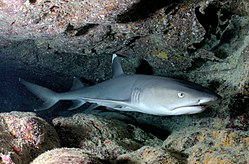
The closest relatives of the Scalloped Hammerhead that you can see in Galápagos Islands (order Carcharhiniformes, Ground Sharks) are Whitetip Reef Shark (about 70%), Requiem shark (about 70%) and Galápagos Shark (about 30%), with each one's daily chance of a sighting.
Where does the Scalloped Hammerhead sighting chance come from?
GBIF citizen-science records
It is estimated from how often the Scalloped Hammerhead is recorded against all the sharks and rays logged in Galápagos Islands (215 verified sightings from 2019 to 2026), calibrated against known sighting rates. Figures are rounded to the nearest 10% because citizen-science data supports honest approximations, not decimals, and months with records from fewer than five people show "—". How it works.
