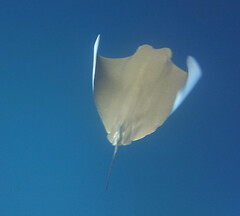
Golden Cownose Ray

Golden Cownose Ray

Rhinoptera steindachneri

Silhouette: M Kolmann · PhyloPic

Daily sighting probability ~50% · Likely
at Galápagos Islands

In 3 days ~80% in a week >90%

183 Verified sightings at Galápagos Islands From 2019 to 2026
183 In 1 park
February Best month
☀️🌙 Day & Night When it's spotted

About the Golden Cownose Ray

The golden cownose ray or Pacific cownose ray (Rhinoptera steindachneri) is a species of ray. It is found in the East Pacific along the coast of Colombia, Costa Rica, Ecuador, El Salvador, Guatemala, Honduras, Mexico, Nicaragua, Panama, and Peru. Its natural habitats are open seas, shallow seas, subtidal aquatic beds, estuarine waters, intertidal marshes, and coastal saline lagoons. They are often in schools, and sometimes associated with the spotted eagle ray.

Like all members of eagle rays, they demonstrate ovoviviparity. Ovulation and birth occurred in May, June and July, with a low fecundity, large size at maturity and birth and a continuous and synchronous annual reproductive cycle.

According to Joseph Bizzarro, Wade Smith, J. Fernando Márquez-Farías, and Robert E. Hueter, these rays are not of much value within fisheries and are harmless to humans, however one of the main threats to this species is overexploitation and habitat destruction.

The parasites that inhabit this species are most influenced by body size, diet, and feeding behavior. Photos of mass migration Wikipedia →

Global Distribution

Parks Where Found

# Park Country Daily sighting probability
1 Galápagos Islands 🇪🇨 Ecuador
~50%

More parks will be added in future updates.

Zoos & Centres Where Found

# Zoo / Centre Country
1 Moody Gardens 🇺🇸 United States In captivity
2 Mystic Aquarium & Institute for Exploration 🇺🇸 United States In captivity
3 Safari Masai Mara 🇲🇽 Mexico In captivity
4 Downtown Aquarium, Denver 🇺🇸 United States In captivity
5 Gran Acuario de Mazatlán "Mar de Cortés" 🇲🇽 Mexico In captivity

Before you go

What are the chances of seeing a Golden Cownose Ray in Galápagos Islands?

Likely

About 50% of wildlife watchers report a Golden Cownose Ray sighting in Galápagos Islands on a given day, based on 183 verified sightings from GBIF citizen-science data from 2019 to 2026. It is the 5th most-seen of the 16 sharks and rays we can rate there. Over three days the chance rises to about 80%, and over a week to over 90%, if each day is a fresh chance.

When is the best time to see a Golden Cownose Ray in Galápagos Islands?

February, April and December

In those months about 70% of wildlife watchers report a Golden Cownose Ray in Galápagos Islands on a given day, against about 60% in January, March and May–November, the lowest months. Those are among Galápagos Islands's wettest months, with about 30 mm of rain a month against almost none in August.

What time of day is best to see a Golden Cownose Ray?

Between 9 am and noon

Across all the parks we cover, that three-hour window holds the most Golden Cownose Ray sightings with a recorded time, and about 6 in 10 of them come between 6 am and 6 pm: it is seen both by day and at night.

Where else can you see a Golden Cownose Ray?

Only Galápagos Islands, in our data

Galápagos Islands is the only park on Wallace's Line with enough records to rate Golden Cownose Ray sightings: about 50% of wildlife watchers there report one on a given day.

Which relatives of the Golden Cownose Ray live in Galápagos Islands?

Same family: Myliobatidae

The closest relatives of the Golden Cownose Ray that you can see in Galápagos Islands (family Myliobatidae, Eagle Rays) are White-spotted Eagle Ray (about 60%), Oceanic Manta Ray (about 30%) and Lesser Devil Ray (about 20%), with each one's daily chance of a sighting.

Where does the Golden Cownose Ray sighting chance come from?

GBIF citizen-science records

It is estimated from how often the Golden Cownose Ray is recorded against all the sharks and rays logged in Galápagos Islands (183 verified sightings from 2019 to 2026), calibrated against known sighting rates. Figures are rounded to the nearest 10% because citizen-science data supports honest approximations, not decimals, and months with records from fewer than five people show "—". How it works.

← Back to Galápagos Islands