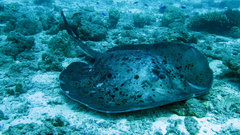
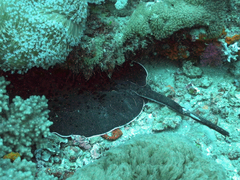
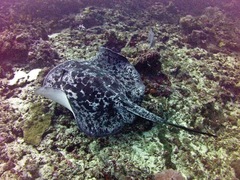
Blotched Fantail Ray

Blotched Fantail Ray

Taeniurops meyeni

Silhouette: Roberto Díaz Sibaja · PhyloPic

Daily sighting probability ~40% · Likely
at Galápagos Islands

In 3 days ~80% in a week >90%

126 Verified sightings at Galápagos Islands From 2019 to 2026
175 In all 3 parks
September Best month
☀️ Diurnal When it's spotted

About the Blotched Fantail Ray

The round ribbontail ray, blotched fantail ray, marble ray, or marbled ray (Taeniurops meyeni) is a species of stingray in the family Dasyatidae, found throughout the nearshore waters of the tropical Indo-Pacific, as well as off islands in the eastern Pacific. It is a bottom-dwelling inhabitant of lagoons, estuaries, and reefs, generally at a depth of 20–60 m (66–197 ft). Reaching 1.8 m (5.9 ft) across, this large ray is characterized by a thick, rounded pectoral fin disc covered by small tubercles on top, and a relatively short tail bearing a deep ventral fin fold. In addition, it has a variable but distinctive light and dark mottled pattern on its upper surface, and a black tail.

Generally nocturnal, the round ribbontail ray can be solitary or gregarious, and is an active predator of small, benthic molluscs, crustaceans, and bony fishes. It is aplacental viviparous, with the embryos sustained by yolk, and later histotroph ("uterine milk") secreted by the mother; up to seven pups are born at a time. Although not aggressive, if provoked the round ribbontail ray will defend itself with its venomous tail spine, and it has been responsible for at least one fatality. It is valued by ecotourist divers and recreational anglers. This slow-reproducing species is threatened by commercial fishing, both targeted and bycatch, and habitat degradation across much of its range. As a result, the International Union for Conservation of Nature (IUCN) has assessed it as Vulnerable. Wikipedia →

Global Distribution

Parks Where Found

# Park Country Daily sighting probability
1 Isla del Coco National Park 🇨🇷 Costa Rica
~80%
2 Galápagos Islands 🇪🇨 Ecuador
~40%
3 Ningaloo Marine Park 🇦🇺 Australia
~30%

Zoos & Centres Where Found

# Zoo / Centre Country
1 Disney's Animal Kingdom 🇺🇸 United States In captivity
2 Zhuhai Chimelong Ocean Kingdom 🇨🇳 China In captivity
3 Chimelong Spaceship 🇨🇳 China In captivity
4 The Blue Planet 🇩🇰 Denmark In captivity
5 Nausicaà Centre National de la Mer 🇫🇷 France In captivity
6 Beijing Zoo 🇨🇳 China In captivity
7 Shenzhen Safari Park 🇨🇳 China In captivity
8 The Maryland Zoo 🇺🇸 United States In captivity
9 Gatorland 🇺🇸 United States In captivity
10 Sea World 🇦🇺 Australia In captivity
11 Zoo Atlanta 🇺🇸 United States In captivity
12 L'Oceanogràfic 🇪🇸 Spain In captivity
13 Hong Kong Zoological and Botanical Gardens 🇨🇳 China In captivity
14 King's Garden 🇻🇳 Vietnam In captivity
15 Mitchell Park Zoo 🇿🇦 South Africa In captivity
16 Penang Bird Park 🇲🇾 Malaysia In captivity
17 Downtown Aquarium, Denver 🇺🇸 United States In captivity
18 Nature's Harvest Organic Farm and Leisure Getaway 🇭🇰 Hong Kong SAR China In captivity
19 SEA LIFE Orlando Aquarium 🇺🇸 United States In captivity
20 Marine Life Park 🇸🇬 Singapore In captivity
21 Singapore Oceanarium 🇸🇬 Singapore In captivity
22 Cairns Aquarium 🇦🇺 Australia In captivity
23 Penghu Aquarium 🇹🇼 Taiwan In captivity
24 Aviary 🇭🇰 Hong Kong SAR China In captivity
25 Bangsaen Aquarium 🇹🇭 Thailand In captivity
26 National Museum of Marine Biology and Aquarium 🇹🇼 Taiwan In captivity
27 Ocean Park Hong Kong 🇨🇳 China In captivity

Before you go

What are the chances of seeing a Blotched Fantail Ray in Galápagos Islands?

Likely

About 40% of wildlife watchers report a Blotched Fantail Ray sighting in Galápagos Islands on a given day, based on 126 verified sightings from GBIF citizen-science data from 2019 to 2026. It is the 7th most-seen of the 16 sharks and rays we can rate there. Over three days the chance rises to about 80%, and over a week to over 90%, if each day is a fresh chance.

When is the best time to see a Blotched Fantail Ray in Galápagos Islands?

September

In that month about 70% of wildlife watchers report a Blotched Fantail Ray in Galápagos Islands on a given day, against about 40% in February, April–May and July, the lowest months. That is one of Galápagos Islands's driest months, with almost no rain against 50 mm in March.

What time of day is best to see a Blotched Fantail Ray?

Between 9 am and noon

Across all the parks we cover, that three-hour window holds the most Blotched Fantail Ray sightings with a recorded time, and about 8 in 10 of them come between 6 am and 6 pm: it is a daytime animal.

Is Galápagos Islands the best place to see a Blotched Fantail Ray?

2nd of 3

Of the 3 parks where we can rate Blotched Fantail Ray sightings, Galápagos Islands ranks 2nd at about 40%. The best odds are in Isla del Coco National Park (Costa Rica, about 80%).

Where does the Blotched Fantail Ray sighting chance come from?

GBIF citizen-science records

It is estimated from how often the Blotched Fantail Ray is recorded against all the sharks and rays logged in Galápagos Islands (126 verified sightings from 2019 to 2026), calibrated against known sighting rates. Figures are rounded to the nearest 10% because citizen-science data supports honest approximations, not decimals, and months with records from fewer than five people show "—". How it works.

← Back to Galápagos Islands