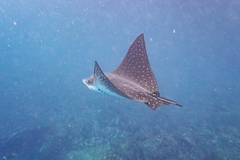
White-spotted Eagle Ray

White-spotted Eagle Ray

Aetobatus ocellatus

Silhouette: M Kolmann · PhyloPic

Daily sighting probability ~60% · Likely
at Galápagos Islands

In 3 days >90%

393 Verified sightings at Galápagos Islands From 2019 to 2026
411 In all 3 parks
January Best month
☀️ Diurnal When it's spotted

About the White-spotted Eagle Ray

The ocellated eagle ray or the whitespotted eagle ray, Aetobatus ocellatus, is a species of cartilaginous fish in the eagle ray family Myliobatidae. It is found in the tropical Indo-West Pacific region. In the past it was included in the spotted eagle ray (A. narinari), a species restricted to the Atlantic after the split.

Compared to the spotted eagle ray, A. ocellatus has a longer tail (mean total length 281 vs. 263% DW) and a longer stinging spine (mean length 9.7 vs. 8.9% DW). The background coloration of the dorsal surface in A. ocellatus is dark greenish/greying to almost blackish whereas A. narinari is much paler, medium yellowish to brownish. Their foraging range is based on anthropogenic noises with populations structured according to ontogenetic stage.

The ocellated eagle ray exhibits ovoviviparity with embryos feeding on yolk initially, then receiving additional nutrients from the mother through indirect absorption of enriched uterine fluid. The gestation period lasts over 12 months and only produces a few pups.

The ocellated eagle ray feeds primarily on gastropod, bivalve molluscs, crustaceans, worms, octopuses... Wikipedia →

Global Distribution

Parks Where Found

# Park Country Daily sighting probability
1 Galápagos Islands 🇪🇨 Ecuador
~60%
2 Komodo National Park 🇮🇩 Indonesia
~40%
3 Raja Ampat 🇮🇩 Indonesia
~20%

Zoos & Centres Where Found

# Zoo / Centre Country
1 Zhuhai Chimelong Ocean Kingdom 🇨🇳 China In captivity
2 SeaWorld Abu Dhabi 🇦🇪 United Arab Emirates In captivity
3 Nausicaà Centre National de la Mer 🇫🇷 France In captivity
4 Beijing Zoo 🇨🇳 China In captivity
5 Wrocław Zoological Garden 🇵🇱 Poland In captivity
6 无锡动物园 🇨🇳 China In captivity
7 Sea World 🇦🇺 Australia In captivity
8 Łódź Zoo 🇵🇱 Poland In captivity
9 Point Defiance Zoo & Aquarium 🇺🇸 United States In captivity
10 Discovery Cove 🇺🇸 United States In captivity
11 Sea Life Park Hawaii 🇺🇸 United States In captivity
12 L'Oceanogràfic 🇪🇸 Spain In captivity
13 Georgia Aquarium 🇺🇸 United States In captivity
14 Beijing Aquarium 🇨🇳 China In captivity
15 The Seas with Nemo & Friends 🇺🇸 United States In captivity
16 Aqua Park Shinagawa 🇯🇵 Japan In captivity
17 Marine World Uminonakamichi 🇯🇵 Japan In captivity
18 Melbourne Aquarium 🇦🇺 Australia In captivity
19 Okinawa Churaumi Aquarium 🇯🇵 Japan In captivity
20 Osaka Aquarium Kaiyukan 🇯🇵 Japan In captivity
21 Sea Life Sydney Aquarium 🇦🇺 Australia In captivity
22 Seattle Aquarium 🇺🇸 United States In captivity
23 The Underwater Observatory Marine Park 🇮🇱 Israel In captivity
24 Africarium 🇵🇱 Poland In captivity
25 Marine Life Park 🇸🇬 Singapore In captivity
26 Singapore Oceanarium 🇸🇬 Singapore In captivity
27 DMM Kariyushi Aquarium 🇯🇵 Japan In captivity
28 Xpark 🇹🇼 Taiwan In captivity
29 Cairns Aquarium 🇦🇺 Australia In captivity
30 Planet Ocean Montpellier 🇫🇷 France In captivity
31 Sea Life Sunshine Coast 🇦🇺 Australia In captivity
32 Shanghai Ocean Aquarium 🇨🇳 China In captivity
33 Wild Life Sydney 🇦🇺 Australia In captivity
34 Sharjah Aquarium 🇦🇪 United Arab Emirates In captivity
35 Great Aquarium Saint-Malo 🇫🇷 France In captivity
36 Aquarium Paradise 🇮🇳 India In captivity
37 Bangsaen Aquarium 🇹🇭 Thailand In captivity
38 Busan Aquarium 🇰🇷 South Korea In captivity
39 Dubai Aquarium and Underwater Zoo 🇦🇪 United Arab Emirates In captivity
40 Grandview Mall Aquarium 🇨🇳 China In captivity
41 hipopotamiarnia i akwarium morskie warszawskiego ZOO 🇵🇱 Poland In captivity
42 Jakarta Aquarium 🇮🇩 Indonesia In captivity
43 National Museum of Marine Biology and Aquarium 🇹🇼 Taiwan In captivity
44 Ocean Park Hong Kong 🇨🇳 China In captivity
45 Oceanarium 🇺🇦 Ukraine In captivity
46 Seattle Marine Aquarium 🇺🇸 United States In captivity
47 terrarium ogrodu zoologicznego we Wrocławiu 🇵🇱 Poland In captivity
48 The Lost Chambers aquarium 🇦🇪 United Arab Emirates In captivity
49 Underwater World, Singapore 🇸🇬 Singapore In captivity

Before you go

What are the chances of seeing a White-spotted Eagle Ray in Galápagos Islands?

Likely

About 60% of wildlife watchers report a White-spotted Eagle Ray sighting in Galápagos Islands on a given day, based on 393 verified sightings from GBIF citizen-science data from 2019 to 2026. It is the 3rd most-seen of the 16 sharks and rays we can rate there. Over three days the chance rises to over 90%, if each day is a fresh chance.

When is the best time to see a White-spotted Eagle Ray in Galápagos Islands?

March to January

In those months about 80% of wildlife watchers report a White-spotted Eagle Ray in Galápagos Islands on a given day, against about 70% in February, the lowest month.

What time of day is best to see a White-spotted Eagle Ray?

Between 7 and 10 am

Across all the parks we cover, that three-hour window holds the most White-spotted Eagle Ray sightings with a recorded time, and about 8 in 10 of them come between 6 am and 6 pm: it is a daytime animal.

Is Galápagos Islands the best place to see a White-spotted Eagle Ray?

Yes

Of the 3 parks where we can rate White-spotted Eagle Ray sightings, Galápagos Islands has the highest daily chance: about 60%. Next come Komodo National Park (Indonesia, about 40%) and Raja Ampat (Indonesia, about 20%).

Which relatives of the White-spotted Eagle Ray live in Galápagos Islands?

Same family: Myliobatidae

The closest relatives of the White-spotted Eagle Ray that you can see in Galápagos Islands (family Myliobatidae, Eagle Rays) are Golden Cownose Ray (about 50%), Oceanic Manta Ray (about 30%) and Lesser Devil Ray (about 20%), with each one's daily chance of a sighting.

Where does the White-spotted Eagle Ray sighting chance come from?

GBIF citizen-science records

It is estimated from how often the White-spotted Eagle Ray is recorded against all the sharks and rays logged in Galápagos Islands (393 verified sightings from 2019 to 2026), calibrated against known sighting rates. Figures are rounded to the nearest 10% because citizen-science data supports honest approximations, not decimals, and months with records from fewer than five people show "—". How it works.

← Back to Galápagos Islands