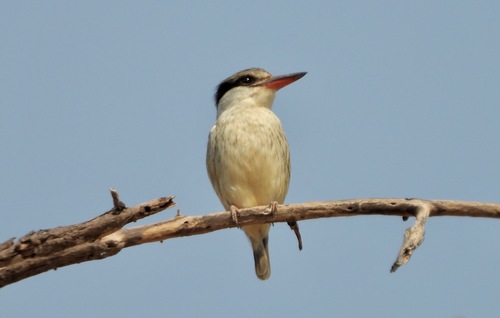
Swallow-tailed Bee-eater

Swallow-tailed Bee-eater

Merops hirundineus

Silhouette: Sheatherius · PhyloPic

LCLeast ConcernNTVUENCR
Daily sighting probability ~10% · With luck
at Gorongosa National Park

In 3 days ~10% in a week ~30%

18 Verified sightings at Gorongosa National Park From 2019 to 2026
2,159 In all 18 parks
April Best month
☀️ Diurnal When it's spotted

About the Swallow-tailed Bee-eater

The swallow-tailed bee-eater (Merops hirundineus) is a species of bee-eater native to sub-Saharan Africa. It feeds predominantly on insects, especially bees and their relatives, which are caught in flight from an open perch. Its vivid colors and forked tail are distinctive.

Like other bee-eaters, this is a richly coloured, slender bird. Its colours and readily visible forked tail make it unmistakable. It is mainly green with a yellow throat, blue gorget and black eye stripe and beak. Swallow-tailed bee-eaters can reach a length of 20–22 cm, including the long forked green or blue feathers. Sexes are alike.

It breeds in savannah woodlands of sub-Saharan Africa. It is partially migratory, moving in response to rainfall patterns. This is a species which prefers somewhat more wooded country than most bee-eaters. This attractive bird is readily approached. Just as the name suggests, bee-eaters predominantly eat insects, especially bees, wasps and hornets, which are caught in the air by sorties from an open perch. The swallowtail has a preference for honeybees.

These bee-eaters nest as pairs or in very small colonies in sandy... Wikipedia →

Sounds

Call0:06

Senegal · 2019

© Bram Piot · XC475304 · CC BY-NC-SA 4.0

Song0:07

Namibia · 2007

© Keith Blomerley · XC206060 · CC BY-NC-SA 4.0

Recording0:06

South Africa · 2015

© Daniel Danckwerts · XC246361 · CC BY-NC-SA 4.0

Global Distribution

Parks Where Found

# Park Country Daily sighting probability
1 Kgalagadi Transfrontier Park 🇿🇦 South Africa
~30%
2 Murchison Falls National Park 🇺🇬 Uganda
~30%
3 Waterberg Plateau Park 🇳🇦 Namibia
~30%
4 Hwange National Park 🇿🇼 Zimbabwe
~30%
5 Liwonde National Park 🇲🇼 Malawi
~30%
6 Moremi Game Reserve 🇧🇼 Botswana
~20%
7 Kidepo Valley National Park 🇺🇬 Uganda
~20%
8 Namib-Naukluft National Park 🇳🇦 Namibia
~20%
9 Etosha National Park 🇳🇦 Namibia
~20%
10 Chobe National Park 🇧🇼 Botswana
~10%
11 Lower Zambezi National Park 🇿🇲 Zambia
~10%
12 Kafue National Park 🇿🇲 Zambia
~10%
13 Ruaha National Park 🇹🇿 Tanzania
~10%
14 Gonarezhou National Park 🇿🇼 Zimbabwe
~10%
15 Mana Pools National Park 🇿🇼 Zimbabwe
~10%
16 South Luangwa National Park 🇿🇲 Zambia
~10%
17 Gorongosa National Park 🇲🇿 Mozambique
~10%
18 Bwindi Impenetrable National Park 🇺🇬 Uganda
<5%

Cities Where Found

# City Country Daily sighting probability
1 Serrekunda 🇬🇲 Gambia
~10%
2 Harare 🇿🇼 Zimbabwe
<5%

Before you go

What are the chances of seeing a Swallow-tailed Bee-eater in Gorongosa National Park?

With luck

About 10% of wildlife watchers report a Swallow-tailed Bee-eater sighting in Gorongosa National Park on a given day, based on 18 verified sightings from GBIF citizen-science data from 2019 to 2026. It is the 171st most-seen of the 250 birds we can rate there. Over three days the chance rises to about 10%, and over a week to about 30%, if each day is a fresh chance.

When is the best time to see a Swallow-tailed Bee-eater in Gorongosa National Park?

April–May and September

In those months about 10% of wildlife watchers report a Swallow-tailed Bee-eater in Gorongosa National Park on a given day, against under 5% in February, June–August and October–November, the lowest months. Those are among Gorongosa National Park's driest months, with about 30 mm of rain a month against 210 mm in January. March and December–January have too few records to rate.

What time of day is best to see a Swallow-tailed Bee-eater?

Between 9 am and noon

Across all the parks we cover, that three-hour window holds the most Swallow-tailed Bee-eater sightings with a recorded time, and about 9 in 10 of them come between 6 am and 6 pm: it is a daytime animal.

Which relatives of the Swallow-tailed Bee-eater live in Gorongosa National Park?

Same genus: Merops

The closest relatives of the Swallow-tailed Bee-eater that you can see in Gorongosa National Park (genus Merops, Typical Bee-eaters) are Little Bee-eater (about 20%), Southern Carmine Bee-eater (about 20%) and European Bee-eater (about 10%), with each one's daily chance of a sighting.

Where does the Swallow-tailed Bee-eater sighting chance come from?

GBIF citizen-science records

It is estimated from how often the Swallow-tailed Bee-eater is recorded against all the birds logged in Gorongosa National Park (18 verified sightings from 2019 to 2026), calibrated against known sighting rates. Figures are rounded to the nearest 10% because citizen-science data supports honest approximations, not decimals, and months with records from fewer than five people show "—". How it works.

← Back to Gorongosa National Park