Green Grocer

Green Grocer

Cyclochila australasiae

Endemic
Daily sighting probability ~30% · Possible
at Grampians National Park

In 3 days ~60% in a week ~90%

45 Verified sightings at Grampians National Park From 2019 to 2026
783 In all 8 parks
November Best month
☀️ Diurnal When it's spotted

About the Green Grocer

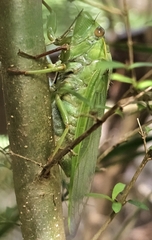
Cyclochila australasiae is a species of cicada and one of Australia's most familiar insects. It is distributed through coastal regions of southeastern Australia. Green specimens are commonly known as green grocers and yellow ones as yellow mondays.

It is one of the loudest insects in the world. Cyclochila australasiae was first described as Tettigonia australasiae in 1805 by amateur zoologist Edward Donovan, who reported that it was common in New South Wales and many specimens had been collected and sent to England. Ernst Friedrich Germar named it Cicada olivacea in 1830. It was the second Australian species of cicada described after the double drummer (Thopha saccata).

It was formerly commonly known as the Great Green Cicada; in addition, the various colour forms have different vernacular names, including Yellow Monday for a common yellow morph; Chocolate Soldier for a rare dark tan form; Blue Moon for a rare turquoise form; and Masked Devil for its red-orange form. The names for the green and yellow forms have been recorded since at least 1896. Australian entomologist Walter Wilson Froggatt reported that the green form was known as green Monday (alongside yellow... Wikipedia →

Global Distribution

Parks Where Found

# Park Country Daily sighting probability
1 Blue Mountains National Park 🇦🇺 Australia
~40%
2 Grampians National Park 🇦🇺 Australia
~30%
3 Wilsons Promontory National Park 🇦🇺 Australia
~20%
4 Lamington National Park 🇦🇺 Australia
~10%
5 Springbrook National Park 🇦🇺 Australia
~10%
6 Royal National Park 🇦🇺 Australia
~10%
7 Kosciuszko National Park 🇦🇺 Australia
~10%
8 Great Otway National Park 🇦🇺 Australia
<5%

Cities Where Found

# City Country Daily sighting probability
1 Sydney 🇦🇺 Australia
~10%
2 Melbourne 🇦🇺 Australia
~10%

Before you go

What are the chances of seeing a Green Grocer in Grampians National Park?

Possible

About 30% of wildlife watchers report a Green Grocer sighting in Grampians National Park on a given day, based on 45 verified sightings from GBIF citizen-science data from 2019 to 2026. It is the 11th most-seen of the 148 insects we can rate there. Over three days the chance rises to about 60%, and over a week to about 90%, if each day is a fresh chance.

When is the best time to see a Green Grocer in Grampians National Park?

November

In that month about 60% of wildlife watchers report a Green Grocer in Grampians National Park on a given day, against under 5% in January to September, the lowest months.

What time of day is best to see a Green Grocer?

Between 10 am and 1 pm

Across all the parks we cover, that three-hour window holds the most Green Grocer sightings with a recorded time, and about 8 in 10 of them come between 6 am and 6 pm: it is a daytime animal.

Is Grampians National Park the best place to see a Green Grocer?

2nd of 8

Of the 8 parks where we can rate Green Grocer sightings, Grampians National Park ranks 2nd at about 30%. The best odds are in Blue Mountains National Park (Australia, about 40%).

Which relatives of the Green Grocer live in Grampians National Park?

Same family: Cicadidae

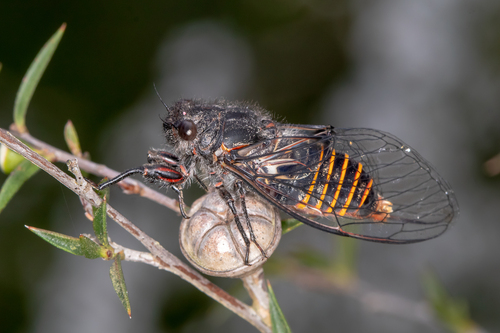
The closest relatives of the Green Grocer that you can see in Grampians National Park (family Cicadidae, Typical Cicadas) are Redeye Cicada (about 20%), Alarm Clock Squawker (about 10%) and Grampians Firetail (about 10%), with each one's daily chance of a sighting.

Where does the Green Grocer sighting chance come from?

GBIF citizen-science records

It is estimated from how often the Green Grocer is recorded against all the insects logged in Grampians National Park (45 verified sightings from 2019 to 2026), calibrated against known sighting rates. Figures are rounded to the nearest 10% because citizen-science data supports honest approximations, not decimals, and months with records from fewer than five people show "—". How it works.

← Back to Grampians National Park