Musk Duck

Musk Duck

Biziura lobata

Silhouette: Sheatherius · PhyloPic

LCLeast ConcernNTVUENCR Endemic
Daily sighting probability <5% · Rare
at Grampians National Park

In 3 days ~10% in a week ~20%

31 Verified sightings at Grampians National Park From 2019 to 2026
126 In all 5 parks
January Best month
☀️ Diurnal When it's spotted

About the Musk Duck

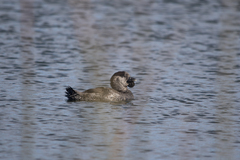
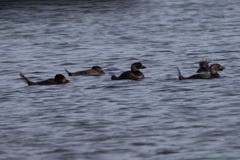
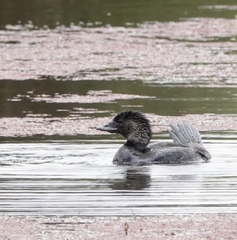
The musk duck (Biziura lobata) is a highly aquatic, stiff-tailed duck native to southern Australia. It is the only living member of the genus Biziura. An extinct relative, the New Zealand musk duck or de Lautour's duck (B. delautouri), once occurred on New Zealand, but is only known from prehistoric subfossil bones. It was about 8% longer than the living species, with a particularly large head.

This animal derives its common name from the peculiar musky odour it emanates during the breeding season. Musk ducks are moderately common through the Murray-Darling and Cooper Creek basins, and in the wetter, fertile areas in the south of the continent: the southwest corner of Western Australia, Victoria, and Tasmania.

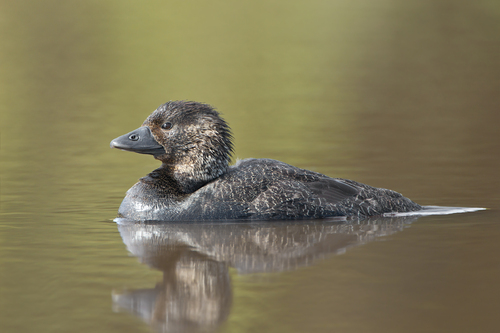
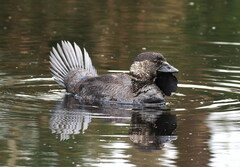
Adult males are 60 to 70 cm (24 to 28 in) long and have a distinctive large, leathery lobe underneath the bill; females are 47 to 55 cm (19 to 22 in) long and unadorned. Their drab dark grey-brown, slightly pin-striped plumage is inconspicuous and does not differ between the sexes. This species weighs an average of 2,398 g (5.287 lb) in males and 1,551 g (3.419 lb) in females, with the smallest females weighing only 993 g (2.189 lb) and the largest males weighing... Wikipedia →
Sounds

Recording0:31

Australia · 2022

© nick talbot · XC739288 · CC BY-NC-SA 4.0

Call0:08

Australia · 2021

© Drew Davison · XC677296 · CC BY-NC-ND 4.0

Song1:19

Australia · 2016

© Marc Anderson · XC340996 · CC BY-NC-ND 4.0

Global Distribution

Parks Where Found

# Park Country Daily sighting probability
1 Flinders Chase 🇦🇺 Australia
~10%
2 Grampians National Park 🇦🇺 Australia
<5%
3 Hattah-Kulkyne National Park 🇦🇺 Australia
<5%
4 Great Otway National Park 🇦🇺 Australia
<5%
5 Blue Mountains National Park 🇦🇺 Australia
<5%

Cities Where Found

# City Country Daily sighting probability
1 Perth 🇦🇺 Australia
~20%
2 Melbourne 🇦🇺 Australia
<5%
3 Sydney 🇦🇺 Australia
<5%

Zoos & Centres Where Found

# Zoo / Centre Country
1 Taronga Zoo 🇦🇺 Australia In captivity
2 Featherdale Sydney Wildlife Park 🇦🇺 Australia In captivity

Before you go

What are the chances of seeing a Musk Duck in Grampians National Park?

Rare

Under 5% of wildlife watchers report a Musk Duck sighting in Grampians National Park on a given day, based on 31 verified sightings from GBIF citizen-science data from 2019 to 2026. It is the 95th most-seen of the 145 birds we can rate there. Over three days the chance rises to about 10%, and over a week to about 20%, if each day is a fresh chance.

When is the best time to see a Musk Duck in Grampians National Park?

January and February

In those months about 10% of wildlife watchers report a Musk Duck in Grampians National Park on a given day, against under 5% in March to December, the lowest months.

What time of day is best to see a Musk Duck?

Between 1 and 4 pm

Across all the parks we cover, that three-hour window holds the most Musk Duck sightings with a recorded time, and about 9 in 10 of them come between 6 am and 6 pm: it is a daytime animal.

Is Grampians National Park the best place to see a Musk Duck?

2nd of 5

Of the 5 parks where we can rate Musk Duck sightings, Grampians National Park ranks 2nd at under 5%. The best odds are in Flinders Chase (Australia, about 10%).

Which relatives of the Musk Duck live in Grampians National Park?

Same family: Anatidae

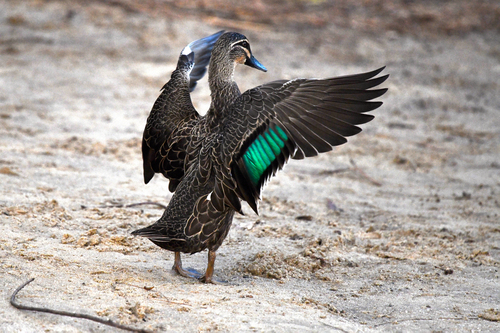
The closest relatives of the Musk Duck that you can see in Grampians National Park (family Anatidae, Ducks, Geese, and Swans) are Australian Wood Duck (about 40%), Pacific Black Duck (about 20%) and Grey Teal (about 10%), with each one's daily chance of a sighting.

Where does the Musk Duck sighting chance come from?

GBIF citizen-science records

It is estimated from how often the Musk Duck is recorded against all the birds logged in Grampians National Park (31 verified sightings from 2019 to 2026), calibrated against known sighting rates. Figures are rounded to the nearest 10% because citizen-science data supports honest approximations, not decimals, and months with records from fewer than five people show "—". How it works.

← Back to Grampians National Park