Pink-eared Duck

Pink-eared Duck

Malacorhynchus membranaceus

Silhouette: Sheatherius · PhyloPic

LCLeast ConcernNTVUENCR Endemic
Daily sighting probability <5% · Rare
at Grampians National Park

In 3 days <5% in a week ~10%

6 Verified sightings at Grampians National Park From 2019 to 2026
58 In all 5 parks
May Best month
☀️ Diurnal When it's spotted

About the Pink-eared Duck

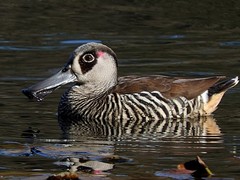
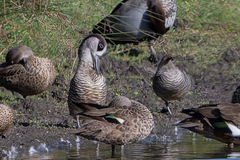
The pink-eared duck (Malacorhynchus membranaceus) is a species of duck found in Australia. The pink-eared duck has a large spatulate bill like the Australasian shoveler, but is smaller at 38–40 cm length. Its brown back and crown, black and white barred sides and black eye patches on its otherwise white face make this bird unmistakable. Juveniles are slightly duller, but otherwise all plumages are similar. Its vernacular name refers to a pink spot in the corner formed by the black head pattern; it is only noticeable at close distance however, making the origin of the seldom-used Australian name of zebra duck more readily apparent.

The pink-eared duck was first described by the English ornithologist John Latham in 1801 under the binomial name Anas membranacea. It is the only living member of the genus Malacorhynchus; a closely related, but slightly larger extinct form from New Zealand was described as Scarlett's duck (Malacorhynchus scarletti). This peculiar duck may be most closely related to the shelducks but its relationships are enigmatic. It may be closer to the musk duck and the stiff-tails and, formerly placed in the paraphyletic... Wikipedia →

Sounds

Call0:56

Australia · 2025

© Nick Talbot · XC1063968 · CC BY-NC-SA 4.0

Flight call0:22

Australia · 2020

© Marc Anderson · XC634715 · CC BY-NC-ND 4.0

Call0:29

Australia · 2021

© Drew Davison · XC614562 · CC BY-NC-SA 4.0

Global Distribution

Parks Where Found

# Park Country Daily sighting probability
1 Flinders Ranges National Park 🇦🇺 Australia
<5%
2 Hattah-Kulkyne National Park 🇦🇺 Australia
<5%
3 Uluru-Kata Tjuta National Park 🇦🇺 Australia
<5%
4 Grampians National Park 🇦🇺 Australia
<5%
5 Great Otway National Park 🇦🇺 Australia
<5%

Cities Where Found

# City Country Daily sighting probability
1 Perth 🇦🇺 Australia
~20%
2 Melbourne 🇦🇺 Australia
<5%
3 Brisbane 🇦🇺 Australia
<5%
4 Sydney 🇦🇺 Australia
<5%

Zoos & Centres Where Found

# Zoo / Centre Country
1 Disney's Animal Kingdom 🇺🇸 United States In captivity
2 Pairi Daiza 🇧🇪 Belgium In captivity
3 Prague Zoo 🇨🇿 Czechia In captivity
4 Bronx Zoo 🇺🇸 United States In captivity
5 Healesville Sanctuary 🇦🇺 Australia In captivity
6 Centro Cicogne e Anatidi 🇮🇹 Italy In captivity
7 Cologne Zoological Garden 🇩🇪 Germany In captivity
8 Bird Paradise 🇸🇬 Singapore In captivity
9 Rainforest Wild Asia 🇸🇬 Singapore In captivity
10 Central Park Zoo 🇺🇸 United States In captivity
11 Rákosův pavilon 🇨🇿 Czechia In captivity
12 Velemlokárium 🇨🇿 Czechia In captivity
13 Cologne Zoo Aquarium 🇩🇪 Germany In captivity

Before you go

What are the chances of seeing a Pink-eared Duck in Grampians National Park?

Rare

Under 5% of wildlife watchers report a Pink-eared Duck sighting in Grampians National Park on a given day, based on 6 verified sightings from GBIF citizen-science data from 2019 to 2026. It is the 137th most-seen of the 145 birds we can rate there. Over three days the chance rises to under 5%, and over a week to about 10%, if each day is a fresh chance.

When is the best time to see a Pink-eared Duck in Grampians National Park?

Any time of year

In every month with enough records, under 5% of wildlife watchers report a Pink-eared Duck in Grampians National Park on a given day, so our monthly data shows no clear season.

What time of day is best to see a Pink-eared Duck?

Between 10 am and 1 pm

Across all the parks we cover, that three-hour window holds the most Pink-eared Duck sightings with a recorded time, and about 9 in 10 of them come between 6 am and 6 pm: it is a daytime animal.

Which relatives of the Pink-eared Duck live in Grampians National Park?

Same family: Anatidae

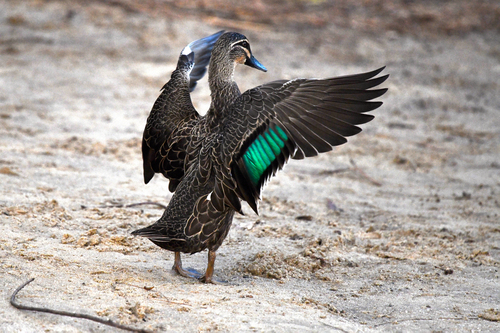
The closest relatives of the Pink-eared Duck that you can see in Grampians National Park (family Anatidae, Ducks, Geese, and Swans) are Australian Wood Duck (about 40%), Pacific Black Duck (about 20%) and Grey Teal (about 10%), with each one's daily chance of a sighting.

Where does the Pink-eared Duck sighting chance come from?

GBIF citizen-science records

It is estimated from how often the Pink-eared Duck is recorded against all the birds logged in Grampians National Park (6 verified sightings from 2019 to 2026), calibrated against known sighting rates. Figures are rounded to the nearest 10% because citizen-science data supports honest approximations, not decimals, and months with records from fewer than five people show "—". How it works.

← Back to Grampians National Park