
Beautiful Firetail

Beautiful Firetail

Stagonopleura bella

Silhouette: Sheatherius · PhyloPic

LCLeast ConcernNTVUENCR Endemic
Daily sighting probability <5% · Rare
at Great Otway National Park

In 3 days ~10% in a week ~30%

156 Verified sightings at Great Otway National Park From 2019 to 2026
738 In all 8 parks
February Best month
☀️ Diurnal When it's spotted

About the Beautiful Firetail

The beautiful firetail (Stagonopleura bella) is a common species of estrildid finch found in Australia. It has an estimated global extent of occurrence of 1,000,000 km2 (390,000 sq mi). The species inhabits temperate shrubland habitats in Australia. The IUCN has classified the species as being of least concern.

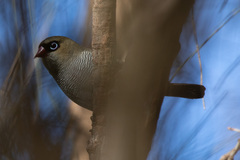
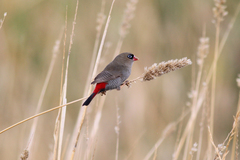
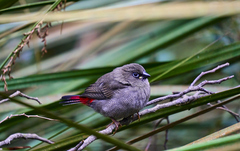
At 10 to 13 cm (3.9 to 5.1 in) long and weighing 14 g (1⁄2 oz) the beautiful firetail is a small plump bird, slightly smaller than the diamond firetail. Its plumage is mostly olive-brown. The white chest has a fine pattern of dark lines. The head has a black mask with pale blue rings around the eyes and a thick red beak. Its rump is a deep red, its legs and feet are creamy pink. The wings and tail are short and rounded. Juvenile birds are less colourful with a smaller face mask and a blackish beak. The male has a black abdomen.

The beautiful firetail is endemic to Southeastern Australia. Its distribution range extends from Newcastle to Kangaroo Island, however, the bird is most prolific in Tasmania and off-shore islands. It lives in coastal heathland, forests and shrubbery, never far from water. Its preference for near water habitats... Wikipedia →

Sounds

Call0:24

Australia · 2019

© Marc Anderson · XC490797 · CC BY-NC-ND 4.0

Call0:44

Australia · 2017

© Greg McLachlan · XC370022 · CC BY-NC-SA 4.0

Call0:57

Australia · 2011

© Patrik Åberg · XC96889 · CC BY-NC-ND 2.5

Global Distribution

Parks Where Found

# Park Country Daily sighting probability
1 Royal National Park 🇦🇺 Australia
~10%
2 Maria Island National Park 🇦🇺 Australia
~10%
3 Freycinet National Park 🇦🇺 Australia
~10%
4 Flinders Chase 🇦🇺 Australia
~10%
5 Great Otway National Park 🇦🇺 Australia
<5%
6 Wilsons Promontory National Park 🇦🇺 Australia
<5%
7 Blue Mountains National Park 🇦🇺 Australia
<5%
8 Booderee National Park 🇦🇺 Australia
<5%

Before you go

What are the chances of seeing a Beautiful Firetail in Great Otway National Park?

Rare

Under 5% of wildlife watchers report a Beautiful Firetail sighting in Great Otway National Park on a given day, based on 156 verified sightings from GBIF citizen-science data from 2019 to 2026. It is the 101st most-seen of the 175 birds we can rate there. Over three days the chance rises to about 10%, and over a week to about 30%, if each day is a fresh chance.

When is the best time to see a Beautiful Firetail in Great Otway National Park?

February–May, August and October

In those months about 10% of wildlife watchers report a Beautiful Firetail in Great Otway National Park on a given day, against under 5% in June–July, September and November–January, the lowest months.

What time of day is best to see a Beautiful Firetail?

Between 9 am and noon

Across all the parks we cover, that three-hour window holds the most Beautiful Firetail sightings with a recorded time, and about 9 in 10 of them come between 6 am and 6 pm: it is a daytime animal.

Is Great Otway National Park the best place to see a Beautiful Firetail?

5th of 8

Of the 8 parks where we can rate Beautiful Firetail sightings, Great Otway National Park ranks 5th at under 5%. The best odds are in Royal National Park (Australia, about 10%), Maria Island National Park (Australia, about 10%) and Freycinet National Park (Australia, about 10%).

Where does the Beautiful Firetail sighting chance come from?

GBIF citizen-science records

It is estimated from how often the Beautiful Firetail is recorded against all the birds logged in Great Otway National Park (156 verified sightings from 2019 to 2026), calibrated against known sighting rates. Figures are rounded to the nearest 10% because citizen-science data supports honest approximations, not decimals, and months with records from fewer than five people show "—". How it works.

← Back to Great Otway National Park