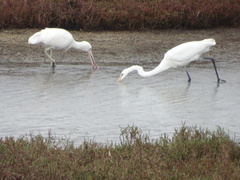
Yellow-billed Spoonbill

Yellow-billed Spoonbill

Platalea flavipes

Silhouette: Andy Wilson · PhyloPic

LCLeast ConcernNTVUENCR Endemic
Daily sighting probability <5% · Rare
at Great Otway National Park

In 3 days <5% in a week ~10%

31 Verified sightings at Great Otway National Park From 2019 to 2026
218 In all 5 parks
August Best month
☀️ Diurnal When it's spotted

About the Yellow-billed Spoonbill

The yellow-billed spoonbill (Platalea flavipes) is a gregarious wading bird of the ibis and spoonbill family, Threskiornithidae. It is native to Australia, and is a vagrant to New Zealand, Lord Howe Island and Norfolk Island.

The renowned ornithologist John Gould first described the yellow-billed spoonbill, naming it Platalea flavipes although noting its distinctness from other members of the genus. Bonaparte erected the genus Platibis in 1856, and Gould followed this classification in his later work. He noted the species appeared in great numbers across New South Wales in 1839, particularly in the north between the Hunter and lower Namoi Rivers. The year had been wet, in contrast to droughts in previous years.

A 2010 study of mitochondrial DNA of the spoonbills by Chesser and colleagues found that the yellow-billed and roseate spoonbills were each other's closest relative, and the two were descended from an early offshoot from the ancestors of the other four spoonbill species. They felt the genetic evidence meant it was equally valid to consider all six to be classified within the genus Platalea or alternatively the two placed in the monotypic genera Platibis and Ajaia... Wikipedia →

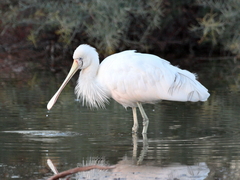
Sounds

Call1:14

Australia · 2024

© nick talbot · XC896224 · CC BY-NC-SA 4.0

Wing noise0:07

Australia · 2020

© Marc Anderson · XC574691 · CC BY-NC-ND 4.0

Global Distribution

Parks Where Found

# Park Country Daily sighting probability
1 Hattah-Kulkyne National Park 🇦🇺 Australia
~10%
2 Grampians National Park 🇦🇺 Australia
<5%
3 Great Otway National Park 🇦🇺 Australia
<5%
4 Daintree National Park 🇦🇺 Australia
<5%
5 Blue Mountains National Park 🇦🇺 Australia
<5%

Cities Where Found

# City Country Daily sighting probability
1 Perth 🇦🇺 Australia
~20%
2 Melbourne 🇦🇺 Australia
<5%
3 Brisbane 🇦🇺 Australia
<5%
4 Sydney 🇦🇺 Australia
<5%

Zoos & Centres Where Found

# Zoo / Centre Country
1 Parc des oiseaux 🇫🇷 France In captivity
2 Gorge Wildlife Park 🇦🇺 Australia In captivity

Before you go

What are the chances of seeing a Yellow-billed Spoonbill in Great Otway National Park?

Rare

Under 5% of wildlife watchers report a Yellow-billed Spoonbill sighting in Great Otway National Park on a given day, based on 31 verified sightings from GBIF citizen-science data from 2019 to 2026. It is the 141st most-seen of the 175 birds we can rate there. Over three days the chance rises to under 5%, and over a week to about 10%, if each day is a fresh chance.

When is the best time to see a Yellow-billed Spoonbill in Great Otway National Park?

Any time of year

In every month with enough records, under 5% of wildlife watchers report a Yellow-billed Spoonbill in Great Otway National Park on a given day, so our monthly data shows no clear season.

What time of day is best to see a Yellow-billed Spoonbill?

Between 2 and 5 pm

Across all the parks we cover, that three-hour window holds the most Yellow-billed Spoonbill sightings with a recorded time, and nearly all of them come between 6 am and 6 pm: it is a daytime animal.

Is Great Otway National Park the best place to see a Yellow-billed Spoonbill?

3rd of 5

Of the 5 parks where we can rate Yellow-billed Spoonbill sightings, Great Otway National Park ranks 3rd at under 5%. The best odds are in Hattah-Kulkyne National Park (Australia, about 10%) and Grampians National Park (Australia, under 5%).

Where does the Yellow-billed Spoonbill sighting chance come from?

GBIF citizen-science records

It is estimated from how often the Yellow-billed Spoonbill is recorded against all the birds logged in Great Otway National Park (31 verified sightings from 2019 to 2026), calibrated against known sighting rates. Figures are rounded to the nearest 10% because citizen-science data supports honest approximations, not decimals, and months with records from fewer than five people show "—". How it works.

← Back to Great Otway National Park