

Southern Appalachian Salamander

Southern Appalachian Salamander

Plethodon teyahalee

Silhouette: Beth Reinke · PhyloPic

LCLeast ConcernNTVUENCR Endemic
Daily sighting probability ~10% · With luck
at Great Smoky Mountains National Park

In 3 days ~40% in a week ~60%

146 Verified sightings at Great Smoky Mountains National Park From 2019 to 2026
146 In 1 park
March Best month
☀️🌙 Day & Night When it's spotted

About the Southern Appalachian Salamander

The southern Appalachian salamander (Plethodon teyahalee) is a species of salamander in the family Plethodontidae. This species also belongs in the Plethodon Glutinosus complex, which is also known as the group of Lungless Slimy Salamanders in the Eastern United States.

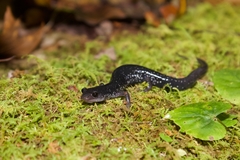
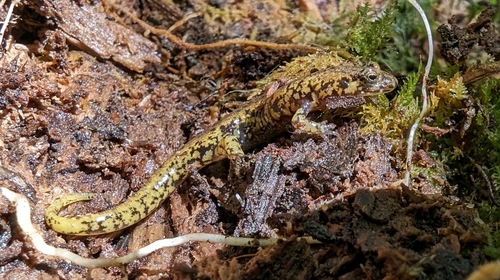
The Southern Appalachian Salamander, P. teyahalee, is a large black salamander with very small dorsal white spots and larger lateral white spots. Females also tend to be larger than males, which assists them in carrying eggs. The belly of this species is usually a slate gray, and the chin is usually a lighter coloration than the belly. They can reach sizes between 7 and 17 cm (4.75 in to 6.75 in). They have about 16 costal grooves on their lateral side.

P. teyahalee is endemic to the southern Appalachian Mountains in the southeastern United States, where it is found in small portions of North Georgia, northwestern South Carolina, west of the French Broad River in western North Carolina, and smaller areas of eastern Tennessee, including parts of the Great Smoky Mountains. The salamander's altitudinal range extends to 1,550 m. Its natural habitat is temperate Appalachian forests.... Wikipedia →

Global Distribution

Parks Where Found

# Park Country Daily sighting probability
1 Great Smoky Mountains National Park 🇺🇸 United States
~10%

More parks will be added in future updates.

Closest Relatives at Great Smoky Mountains National Park

Before you go

What are the chances of seeing a Southern Appalachian Salamander in Great Smoky Mountains National Park?

With luck

About 10% of wildlife watchers report a Southern Appalachian Salamander sighting in Great Smoky Mountains National Park on a given day, based on 146 verified sightings from GBIF citizen-science data from 2019 to 2026. It is the 21st most-seen of the 36 amphibians we can rate there. Over three days the chance rises to about 40%, and over a week to about 60%, if each day is a fresh chance.

When is the best time to see a Southern Appalachian Salamander in Great Smoky Mountains National Park?

March, May and August–September

In those months about 20% of wildlife watchers report a Southern Appalachian Salamander in Great Smoky Mountains National Park on a given day, against under 5% in December to February, the lowest months.

What time of day is best to see a Southern Appalachian Salamander?

Between 9 pm and midnight

Across all the parks we cover, that three-hour window holds the most Southern Appalachian Salamander sightings with a recorded time, and about half of them come between 6 am and 6 pm: it is seen both by day and at night.

Where else can you see a Southern Appalachian Salamander?

Only Great Smoky Mountains National Park, in our data

Great Smoky Mountains National Park is the only park on Wallace's Line with enough records to rate Southern Appalachian Salamander sightings: about 10% of wildlife watchers there report one on a given day.

Which relatives of the Southern Appalachian Salamander live in Great Smoky Mountains National Park?

Same genus: Plethodon

The closest relatives of the Southern Appalachian Salamander that you can see in Great Smoky Mountains National Park (genus Plethodon, Woodland Salamanders) are Red-cheeked Salamander (about 50%), Southern Red-backed Salamander (about 40%) and Northern Slimy Salamander (about 20%), with each one's daily chance of a sighting.

Where does the Southern Appalachian Salamander sighting chance come from?

GBIF citizen-science records

It is estimated from how often the Southern Appalachian Salamander is recorded against all the amphibians logged in Great Smoky Mountains National Park (146 verified sightings from 2019 to 2026), calibrated against known sighting rates. Figures are rounded to the nearest 10% because citizen-science data supports honest approximations, not decimals, and months with records from fewer than five people show "—". How it works.

← Back to Great Smoky Mountains National Park