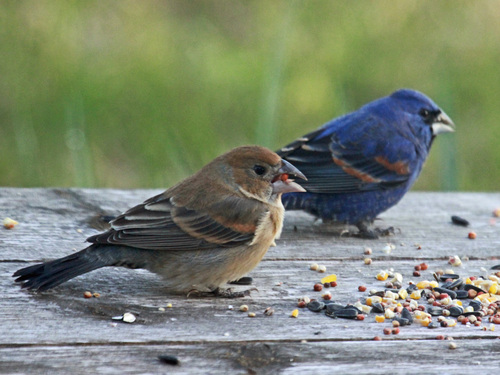
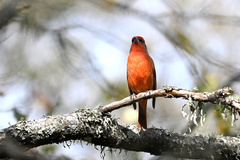
Hepatic Tanager

Hepatic Tanager

Piranga hepatica

LCLeast ConcernNTVUENCR
Daily sighting probability ~10% · With luck
at Guadalupe Mountains National Park

In 3 days ~40% in a week ~60%

103 Verified sightings at Guadalupe Mountains National Park From 2019 to 2026
1,475 In all 11 parks
June Best month

About the Hepatic Tanager

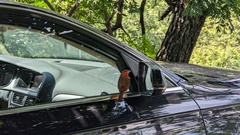
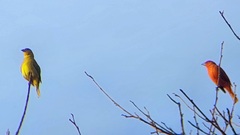
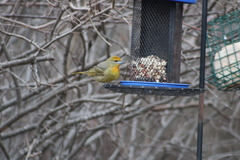
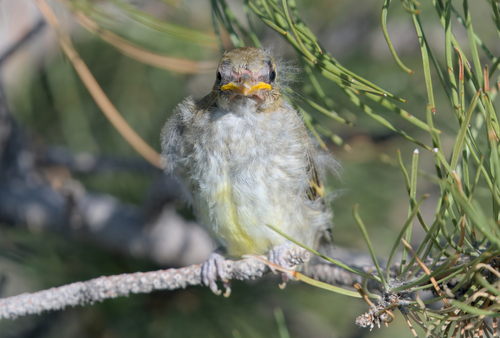
The hepatic tanager (Piranga hepatica) is a medium-sized American songbird. Formerly placed in the tanager family (Thraupidae), it and other members of the genus Piranga are now classified in the cardinal family (Cardinalidae).

The common name hepatic means "liver-coloured", namely, brownish-red. The IOC World Bird List recognises five subspecies of Piranga hepatica, found in North and Central America. Piranga hepatica hepatica Swainson, 1827 (California, Arizona, and New Mexico in the United States and Oaxaca in western Mexico)

Piranga hepatica dextra Bangs, 1907 (New Mexico and western Texas in the United States, Chiapas in eastern Mexico (to Chiapas), and western Guatemala) Piranga hepatica figlina Salvin & Godman, 1883 (eastern Guatemala and Belize

Piranga hepatica savannarum T.R. Howell, 1965 (eastern Honduras and northeast Nicaragua) Piranga hepatica albifacies J.T. Zimmer, 1929 (highlands of eastern Guatemala and Nicaragua) Other taxonomic authorities don't recognise Piranga hepatica as a distinct species and include it in Piranga flava, a more broadly defined hepatic tanager, with a range from the United States to Argentina. These authorities... Wikipedia →

Sounds

Call0:43

Mexico · 2023

© Matthew L. Brady · XC977898 · CC BY-NC-SA 4.0

Song0:43

United States · 2019

© Paul Marvin · XC501842 · CC BY-NC-SA 4.0

Begging call0:28

Honduras · 2014

© John van Dort · XC185645 · CC BY-NC-SA 4.0

Global Distribution

Parks Where Found

# Park Country Daily sighting probability
1 Cumbres de Monterrey National Park 🇲🇽 Mexico
~30%
2 Reserva de la Biosfera Mariposa Monarca 🇲🇽 Mexico
~30%
3 Celaque National Park 🇭🇳 Honduras
~30%
4 Guadalupe Mountains National Park 🇺🇸 United States
~10%
5 La Tigra National Park 🇭🇳 Honduras
~10%
6 Big Bend National Park 🇺🇸 United States
~10%
7 Cusuco National Park 🇭🇳 Honduras
<5%
8 Cockscomb Basin Wildlife Sanctuary 🇧🇿 Belize
<5%
9 Cerro Azul Meámbar National Park 🇭🇳 Honduras
<5%
10 Grand Canyon National Park 🇺🇸 United States
<5%
11 Saguaro National Park 🇺🇸 United States
<5%

Cities Where Found

# City Country Daily sighting probability
1 Guadalajara 🇲🇽 México
<5%
2 Mexico City 🇲🇽 México
<5%
3 Puebla 🇲🇽 México
<5%
4 Tegucigalpa 🇭🇳 Honduras
<5%
5 Monterrey 🇲🇽 México
<5%
6 Salt Lake City 🇺🇸 United States
<5%
7 San Diego 🇺🇸 United States
<5%
8 Guatemala City 🇬🇹 Guatemala
<5%
9 Los Angeles 🇺🇸 United States
<5%
10 Phoenix 🇺🇸 United States
<5%

Before you go

What are the chances of seeing a Hepatic Tanager in Guadalupe Mountains National Park?

With luck

About 10% of wildlife watchers report a Hepatic Tanager sighting in Guadalupe Mountains National Park on a given day, based on 103 verified sightings from GBIF citizen-science data from 2019 to 2026. It is the 51st most-seen of the 141 birds we can rate there. Over three days the chance rises to about 40%, and over a week to about 60%, if each day is a fresh chance.

When is the best time to see a Hepatic Tanager in Guadalupe Mountains National Park?

June

In that month about 40% of wildlife watchers report a Hepatic Tanager in Guadalupe Mountains National Park on a given day, against under 5% in November to April, the lowest months.

Which relatives of the Hepatic Tanager live in Guadalupe Mountains National Park?

Same genus: Piranga

The closest relatives of the Hepatic Tanager that you can see in Guadalupe Mountains National Park (genus Piranga, Piranga Tanagers) are Western Tanager (about 30%) and Summer Tanager (about 10%), with each one's daily chance of a sighting.

Where does the Hepatic Tanager sighting chance come from?

GBIF citizen-science records

It is estimated from how often the Hepatic Tanager is recorded against all the birds logged in Guadalupe Mountains National Park (103 verified sightings from 2019 to 2026), calibrated against known sighting rates. Figures are rounded to the nearest 10% because citizen-science data supports honest approximations, not decimals, and months with records from fewer than five people show "—". How it works.

← Back to Guadalupe Mountains National Park