Western Bluebird

Western Bluebird

Sialia mexicana

Silhouette: Andy Wilson · PhyloPic

LCLeast ConcernNTVUENCR
Daily sighting probability ~20% · Possible
at Guadalupe Mountains National Park

In 3 days ~60% in a week ~90%

348 Verified sightings at Guadalupe Mountains National Park From 2019 to 2026
6,265 In all 15 parks
November Best month
☀️ Diurnal When it's spotted

About the Western Bluebird

The western bluebird (Sialia mexicana) is a small North American thrush. The western bluebird was formally described by the English naturalist William Swainson in 1832 and given the binomial name Sialia mexicana. Six subspecies are recognized:

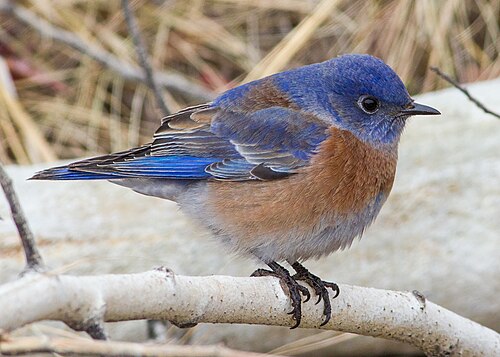
The western bluebird is a small stocky bird with a length of 15 to 18 cm (5.9 to 7.1 in). The adult male is bright blue on top and on the throat with an orange breast and sides, a brownish patch on back, and a gray belly and undertail coverts. The adult female has a duller blue body, wings, and tail, a gray throat, a dull orange breast, and a gray belly and undertail coverts. Both sexes have a thin straight bill with a fairly short tail. Immature birds have duller colors than the adults, and have... Wikipedia →

Sounds

Flight call0:33

United States · 2022

© Paul Marvin · XC703748 · CC BY-NC-SA 4.0

Call0:25

United States · 2021

© Brad Banner · XC685078 · CC BY-NC-SA 4.0

Song0:48

United States · 2013

© Eric DeFonso · XC172425 · CC BY-NC-SA 4.0

Global Distribution

Parks Where Found

# Park Country Daily sighting probability
1 Grand Canyon National Park 🇺🇸 United States
~50%
2 Sequoia and Kings Canyon National Parks 🇺🇸 United States
~40%
3 Zion National Park 🇺🇸 United States
~30%
4 Guadalupe Mountains National Park 🇺🇸 United States
~20%
5 Yosemite National Park 🇺🇸 United States
~10%
6 Reserva de la Biosfera Mariposa Monarca 🇲🇽 Mexico
~10%
7 Death Valley National Park 🇺🇸 United States
~10%
8 Redwood National Park 🇺🇸 United States
~10%
9 Rocky Mountain National Park 🇺🇸 United States
~10%
10 Joshua Tree National Park 🇺🇸 United States
<5%
11 Saguaro National Park 🇺🇸 United States
<5%
12 Big Bend National Park 🇺🇸 United States
<5%
13 Channel Islands National Park 🇺🇸 United States
<5%
14 Olympic National Park 🇺🇸 United States
<5%
15 Cumbres de Monterrey National Park 🇲🇽 Mexico
<5%

Cities Where Found

# City Country Daily sighting probability
1 Sacramento 🇺🇸 United States
~40%
2 Los Angeles 🇺🇸 United States
~30%
3 San Francisco 🇺🇸 United States
~20%
4 San Diego 🇺🇸 United States
~20%
5 Mesa 🇺🇸 United States
<5%
6 Calgary 🇨🇦 Canada
<5%
7 Phoenix 🇺🇸 United States
<5%
8 Austin 🇺🇸 United States
<5%
9 Portland 🇺🇸 United States
<5%
10 Las Vegas 🇺🇸 United States
<5%

Zoos & Centres Where Found

# Zoo / Centre Country
1 Denver Zoo 🇺🇸 United States In captivity

Before you go

What are the chances of seeing a Western Bluebird in Guadalupe Mountains National Park?

Possible

About 20% of wildlife watchers report a Western Bluebird sighting in Guadalupe Mountains National Park on a given day, based on 348 verified sightings from GBIF citizen-science data from 2019 to 2026. It is the 35th most-seen of the 141 birds we can rate there. Over three days the chance rises to about 60%, and over a week to about 90%, if each day is a fresh chance.

When is the best time to see a Western Bluebird in Guadalupe Mountains National Park?

November

In that month about 70% of wildlife watchers report a Western Bluebird in Guadalupe Mountains National Park on a given day, against under 5% in April and June, the lowest months.

What time of day is best to see a Western Bluebird?

Between 8 and 11 am

Across all the parks we cover, that three-hour window holds the most Western Bluebird sightings with a recorded time, and about 8 in 10 of them come between 6 am and 6 pm: it is a daytime animal.

Where does the Western Bluebird sighting chance come from?

GBIF citizen-science records

It is estimated from how often the Western Bluebird is recorded against all the birds logged in Guadalupe Mountains National Park (348 verified sightings from 2019 to 2026), calibrated against known sighting rates. Figures are rounded to the nearest 10% because citizen-science data supports honest approximations, not decimals, and months with records from fewer than five people show "—". How it works.
← Back to Guadalupe Mountains National Park

