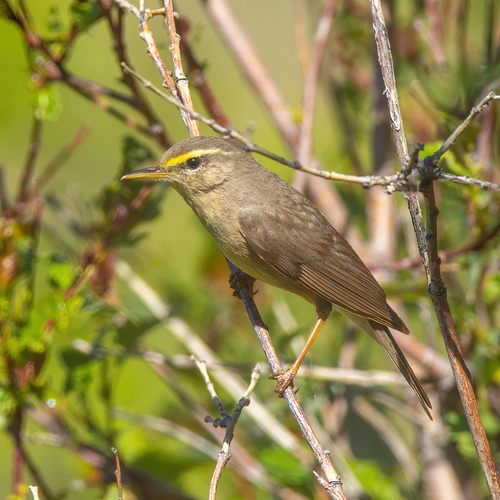
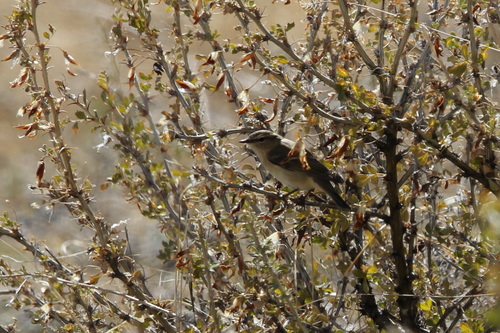
Sulphur-bellied Warbler

Sulphur-bellied Warbler

Phylloscopus griseolus

Silhouette: Jiekun He · PhyloPic

LCLeast ConcernNTVUENCR
Daily sighting probability ~10% · With luck
at Hemis National Park

In 3 days ~30% in a week ~60%

12 Verified sightings at Hemis National Park From 2019 to 2026
241 In all 8 parks
June Best month
☀️ Diurnal When it's spotted

About the Sulphur-bellied Warbler

The sulphur-bellied warbler (Phylloscopus griseolus) is a species of leaf-warbler found in the Palearctic region (Afghanistan, Kazakhstan, Kyrgyzstan, Mongolia, Russian Federation [Central Asian Russia], Tajikistan and Turkmenistan). It was earlier also known by the name of olivaceous leaf-warbler.

Like other leaf-warblers, it gleans insects from small branches and leaves. It is found in rocky hill and scrub forest habitats. The species is found in small groups and has a tendency to forage low in the vegetation, sometimes even hopping on the ground. It has a single note cheep call. Wikipedia →

Sounds

Song1:03

Kyrgyzstan · 2023

© Peter Boesman · XC813606 · CC BY-NC-ND 4.0

Call0:10

Mongolia · 2013

© Patrick Franke · XC162609 · CC BY-NC-SA 3.0

Song1:17

China · 2016

© Paul Holt · XC681021 · CC BY-NC-SA 4.0

Global Distribution

Parks Where Found

# Park Country Daily sighting probability
1 Hemis National Park 🇮🇳 India
~10%
2 Gobi Gurvansaikhan National Park 🇲🇳 Mongolia
~10%
3 Satpura National Park 🇮🇳 India
<5%
4 Bandhavgarh National Park 🇮🇳 India
<5%
5 Ranthambore National Park 🇮🇳 India
<5%
6 Keoladeo National Park 🇮🇳 India
<5%
7 Kanha National Park 🇮🇳 India
<5%
8 Jim Corbett National Park 🇮🇳 India
<5%

Cities Where Found

# City Country Daily sighting probability
1 Jabalpur 🇮🇳 India
~30%
2 Jaipur 🇮🇳 India
~10%
3 Jodhpur 🇮🇳 India
<5%
4 Bhopal 🇮🇳 India
<5%
5 Nagpur 🇮🇳 India
<5%
6 Lucknow 🇮🇳 India
<5%
7 Mumbai 🇮🇳 India
<5%
8 New Delhi 🇮🇳 India
<5%
9 Kalyan-Dombivli 🇮🇳 India
<5%
10 Indore 🇮🇳 India
<5%

Before you go

What are the chances of seeing a Sulphur-bellied Warbler in Hemis National Park?

With luck

About 10% of wildlife watchers report a Sulphur-bellied Warbler sighting in Hemis National Park on a given day, based on 12 verified sightings from GBIF citizen-science data from 2019 to 2026. It is the 34th most-seen of the 52 birds we can rate there. Over three days the chance rises to about 30%, and over a week to about 60%, if each day is a fresh chance.

When is the best time to see a Sulphur-bellied Warbler in Hemis National Park?

June to August

In those months about 20% of wildlife watchers report a Sulphur-bellied Warbler in Hemis National Park on a given day, against under 5% in March and December, the lowest months. Those are among Hemis National Park's wettest months, with about 50 mm of rain a month against 10 mm in October. January has too few records to rate.

What time of day is best to see a Sulphur-bellied Warbler?

Between 7 and 10 am

Across all the parks we cover, that three-hour window holds the most Sulphur-bellied Warbler sightings with a recorded time, and about 9 in 10 of them come between 6 am and 6 pm: it is a daytime animal.

Is Hemis National Park the best place to see a Sulphur-bellied Warbler?

Yes

Of the 8 parks where we can rate Sulphur-bellied Warbler sightings, Hemis National Park has the highest daily chance: about 10%. Next come Gobi Gurvansaikhan National Park (Mongolia, about 10%) and Satpura National Park (India, under 5%).

Which relatives of the Sulphur-bellied Warbler live in Hemis National Park?

Same genus: Phylloscopus

The closest relatives of the Sulphur-bellied Warbler that you can see in Hemis National Park (genus Phylloscopus, Leaf Warblers) are Mountain Chiffchaff (about 40%), Greenish Warbler (about 10%) and Tickell's Leaf Warbler (about 10%), with each one's daily chance of a sighting.

Where does the Sulphur-bellied Warbler sighting chance come from?

GBIF citizen-science records

It is estimated from how often the Sulphur-bellied Warbler is recorded against all the birds logged in Hemis National Park (12 verified sightings from 2019 to 2026), calibrated against known sighting rates. Figures are rounded to the nearest 10% because citizen-science data supports honest approximations, not decimals, and months with records from fewer than five people show "—". How it works.

← Back to Hemis National Park