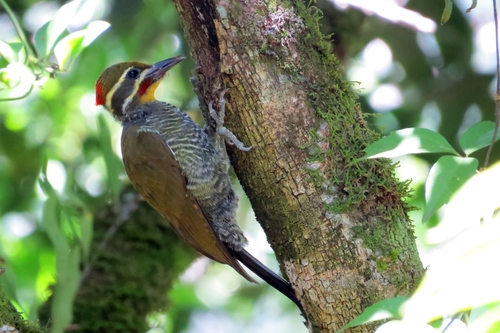
White-eared Puffbird

White-eared Puffbird

Nystalus chacuru

Silhouette: Matt Wilkins (Photo by Len Blumin) · PhyloPic

LCLeast ConcernNTVUENCR
Daily sighting probability <5% · Rare
at Itatiaia National Park

In 3 days <5% in a week ~10%

16 Verified sightings at Itatiaia National Park From 2019 to 2026
849 In all 8 parks
August Best month
☀️ Diurnal When it's spotted

About the White-eared Puffbird

The white-eared puffbird (Nystalus chacuru) is a species of bird in the Bucconidae family, the puffbirds. It is found in Argentina, Bolivia, Brazil, Paraguay and Peru, where it inhabits tropical and subtropical dry forests, subtropical and tropical moist forests, gallery forests, tropical savanna, and heavily degraded former forest.

Like some other puffbirds, the white-eared puffbird is a round, plump bird with a very narrow tail. The head is relatively large, with a dark brown barred crown, and an orange, black-tipped bill. The sit-and-wait feeding strategy, for insects or opportunistic prey, may explain this body shape.

The bird has a medium-brown back and wings, with dark rufous speckles and bars; white and black flecked on the breast. The upper breast is white, extending to a narrow-to-medium white collar around the neck. There is a distinctive, medium-sized white ear patch, which gives the species its common name, and that is surrounded by a dark ear patch. It has a medium-sized tail in dark brown and slightly graduated, with narrow, widely spaced buffy bars, and a pale tip. It measures about 21–22 cm (8.3–8.7 in) in length and weighs between 48–64 g. Wikipedia →

Sounds

Song0:21

Brazil · 2025

© Fabrício Grigolin · XC1008365 · CC BY-NC-SA 4.0

Duet0:11

Brazil · 2024

© JAYRSON ARAUJO DE OLIVEIRA · XC933910 · CC BY-NC-SA 4.0

?0:22

Brazil · 2011

© Robson Silva e Silva · XC96272 · CC BY-NC-ND 2.5

Global Distribution

Parks Where Found

# Park Country Daily sighting probability
1 Emas National Park 🇧🇷 Brazil
~50%
2 Serra da Canastra National Park 🇧🇷 Brazil
~30%
3 Chapada dos Guimarães National Park 🇧🇷 Brazil
~10%
4 Chapada Diamantina National Park 🇧🇷 Brazil
~10%
5 Iguaçu National Park 🇧🇷 Brazil
<5%
6 Iguazú National Park 🇦🇷 Argentina
<5%
7 Itatiaia National Park 🇧🇷 Brazil
<5%
8 Serra dos Órgãos National Park 🇧🇷 Brazil
<5%

Zoos & Centres Where Found

# Zoo / Centre Country
1 GüiráOga 🇦🇷 Argentina In captivity

Before you go

What are the chances of seeing a White-eared Puffbird in Itatiaia National Park?

Rare

Under 5% of wildlife watchers report a White-eared Puffbird sighting in Itatiaia National Park on a given day, based on 16 verified sightings from GBIF citizen-science data from 2019 to 2026. It is the 291st most-seen of the 352 birds we can rate there. Over three days the chance rises to under 5%, and over a week to about 10%, if each day is a fresh chance.

When is the best time to see a White-eared Puffbird in Itatiaia National Park?

Any time of year

In every month with enough records, under 5% of wildlife watchers report a White-eared Puffbird in Itatiaia National Park on a given day, so our monthly data shows no clear season.

What time of day is best to see a White-eared Puffbird?

Between 9 am and noon

Across all the parks we cover, that three-hour window holds the most White-eared Puffbird sightings with a recorded time, and about 9 in 10 of them come between 6 am and 6 pm: it is a daytime animal.

Which relatives of the White-eared Puffbird live in Itatiaia National Park?

Same order: Piciformes

The closest relatives of the White-eared Puffbird that you can see in Itatiaia National Park (order Piciformes, Woodpeckers and Allies) are Red-breasted Toucan (about 50%), White-barred Piculet (about 40%) and White-spotted Woodpecker (about 30%), with each one's daily chance of a sighting.

Where does the White-eared Puffbird sighting chance come from?

GBIF citizen-science records

It is estimated from how often the White-eared Puffbird is recorded against all the birds logged in Itatiaia National Park (16 verified sightings from 2019 to 2026), calibrated against known sighting rates. Figures are rounded to the nearest 10% because citizen-science data supports honest approximations, not decimals, and months with records from fewer than five people show "—". How it works.

← Back to Itatiaia National Park