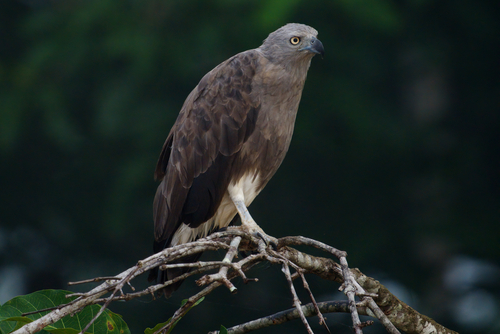
Red-headed Vulture

Red-headed Vulture

Sarcogyps calvus

Silhouette: Andy Wilson · PhyloPic

LCNTVUENCRCritically Endangered
Daily sighting probability ~10% · With luck
at Jim Corbett National Park

In 3 days ~30% in a week ~60%

273 Verified sightings at Jim Corbett National Park From 2019 to 2026
1,853 In all 12 parks
January Best month
🌅 Crepuscular When it's spotted

About the Red-headed Vulture

The red-headed vulture (Sarcogyps calvus), also known as the Asian king vulture, Indian black vulture or Pondicherry vulture, is an Old World vulture mainly found in the Indian subcontinent, with small disjunct populations in some parts of Southeast Asia.

This is a species of Old World vulture, and the only member of the genus Sarcogyps. The generic name Sarcogyps is a combination of the Greek words sarx, meaning "flesh", and gups, meaning "vulture". The specific epithet calvus is Latin for "bald". The red-headed vulture is monotypic; it has no accepted subspecies.

This gaudy-faced vulture was historically abundant, range widely across the Indian subcontinent, and also eastwards to south-central and south-eastern Asia, extending from India to Singapore. Today the range of the red-headed vulture is localized primarily to northern India. It is usually in open country and in cultivated and semi-desert areas. It is also found in deciduous forests and foothills and river valleys. It is usually found up to an altitude of 3000m from sea level.

It is a medium-sized vulture of 76 to 86 cm (30 to 34 in) in length... Wikipedia →

Global Distribution

Parks Where Found

# Park Country Daily sighting probability
1 Bandhavgarh National Park 🇮🇳 India
~20%
2 Bandipur National Park 🇮🇳 India
~20%
3 Mudumalai National Park 🇮🇳 India
~20%
4 Nagarhole National Park 🇮🇳 India
~20%
5 Jim Corbett National Park 🇮🇳 India
~10%
6 Chitwan National Park 🇳🇵 Nepal
~10%
7 Gir National Park 🇮🇳 India
~10%
8 Ranthambore National Park 🇮🇳 India
<5%
9 Kanha National Park 🇮🇳 India
<5%
10 Kaziranga National Park 🇮🇳 India
<5%
11 Keoladeo National Park 🇮🇳 India
<5%
12 Satpura National Park 🇮🇳 India
<5%

Zoos & Centres Where Found

# Zoo / Centre Country
1 Parco Natura Viva 🇮🇹 Italy In captivity

Before you go

What are the chances of seeing a Red-headed Vulture in Jim Corbett National Park?

With luck

About 10% of wildlife watchers report a Red-headed Vulture sighting in Jim Corbett National Park on a given day, based on 273 verified sightings from GBIF citizen-science data from 2019 to 2026. It is the 110th most-seen of the 368 birds we can rate there. Over three days the chance rises to about 30%, and over a week to about 60%, if each day is a fresh chance.

When is the best time to see a Red-headed Vulture in Jim Corbett National Park?

January–February and April

In those months about 20% of wildlife watchers report a Red-headed Vulture in Jim Corbett National Park on a given day, against under 5% in June–July and September, the lowest months. Those are among Jim Corbett National Park's driest months, with about 30 mm of rain a month against 360 mm in July.

What time of day is best to see a Red-headed Vulture?

Between 5 and 8 am

Across all the parks we cover, that three-hour window holds the most Red-headed Vulture sightings with a recorded time, and about 6 in 10 of them come between 6 am and 6 pm: it is most active around dawn and dusk.

Is Jim Corbett National Park the best place to see a Red-headed Vulture?

5th of 12

Of the 12 parks where we can rate Red-headed Vulture sightings, Jim Corbett National Park ranks 5th at about 10%. The best odds are in Bandhavgarh National Park (India, about 20%), Bandipur National Park (India, about 20%) and Mudumalai National Park (India, about 20%).

Which relatives of the Red-headed Vulture live in Jim Corbett National Park?

Same family: Accipitridae

The closest relatives of the Red-headed Vulture that you can see in Jim Corbett National Park (family Accipitridae, Hawks, Eagles, and Kites) are Crested Hawk-Eagle (about 40%), Crested Serpent Eagle (about 30%) and Black-winged Kite (about 20%), with each one's daily chance of a sighting.

Where does the Red-headed Vulture sighting chance come from?

GBIF citizen-science records

It is estimated from how often the Red-headed Vulture is recorded against all the birds logged in Jim Corbett National Park (273 verified sightings from 2019 to 2026), calibrated against known sighting rates. Figures are rounded to the nearest 10% because citizen-science data supports honest approximations, not decimals, and months with records from fewer than five people show "—". How it works.

← Back to Jim Corbett National Park