Himalayan Vulture

Himalayan Vulture

Gyps himalayensis

Silhouette: Shyamal · PhyloPic

LCNTNear ThreatenedVUENCR
Daily sighting probability ~20% · Possible
at Jim Corbett National Park

In 3 days ~40% in a week ~70%

398 Verified sightings at Jim Corbett National Park From 2019 to 2026
1,875 In all 14 parks
February Best month
🌅 Crepuscular When it's spotted

About the Himalayan Vulture

The Himalayan vulture (Gyps himalayensis) or Himalayan griffon vulture is an Old World vulture native to the Himalayas and foothills in North and Northeastern India, as well as the adjacent Tibetan Plateau. After the cinereous vulture (Aegypius monachus), it is the second-largest Old World vulture species, and among the world's largest true raptors. It is listed as Near Threatened on the IUCN Red List. It is not to be confused with the Eurasian griffon vulture (Gyps fulvus), which is a visually similar, sympatric species.

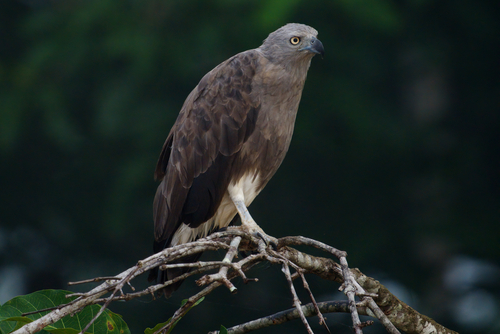
The Himalayan vulture has dark brown greater covert feathers, tail and wing quills, but a pale buff uniform upperside and paler tipped inner secondaries; its legs are covered with buffy feathers and vary in colour from greenish grey to pale brown. The underside and under-wing coverts are pale brown or buff, almost white in some individuals. The whitish down on the head of immatures changes to yellowish in adults who have a long and pale brown ruff with white streaks and long and spiky ruff feathers.

The pale blue facial skin is lighter than the dark blue in Gyps fulvus with this species having a yellowish bill. In flight the long fingers are splayed... Wikipedia →

Sounds

Call0:27

China · 2013

© Tomas Carlberg · XC175964 · CC BY-NC-SA 4.0

Global Distribution

Parks Where Found

# Park Country Daily sighting probability
1 Gobi Gurvansaikhan National Park 🇲🇳 Mongolia
~60%
2 Jiuzhaigou National Park 🇨🇳 China
~50%
3 Kaziranga National Park 🇮🇳 India
~30%
4 Hemis National Park 🇮🇳 India
~30%
5 Langtang National Park 🇳🇵 Nepal
~20%
6 Jim Corbett National Park 🇮🇳 India
~20%
7 Chitwan National Park 🇳🇵 Nepal
~10%
8 Manas National Park 🇮🇳 India
~10%
9 Royal Bardia National Park 🇳🇵 Nepal
~10%
10 Royal Manas National Park 🇧🇹 Bhutan
<5%
11 Namdapha National Park 🇮🇳 India
<5%
12 Bandhavgarh National Park 🇮🇳 India
<5%
13 Kanha National Park 🇮🇳 India
<5%
14 Keoladeo National Park 🇮🇳 India
<5%

Cities Where Found

# City Country Daily sighting probability
1 Jodhpur 🇮🇳 India
<5%
2 Dehradun 🇮🇳 India
<5%
3 Kathmandu 🇳🇵 Nepal
<5%

Zoos & Centres Where Found

# Zoo / Centre Country
1 ZooParc de Beauval 🇫🇷 France In captivity
2 Zlín-Lešná Zoo 🇨🇿 Czechia In captivity
3 Parc des oiseaux 🇫🇷 France In captivity
4 Xinjiang Tianshan Safari Park 🇨🇳 China In captivity
5 Arignar Anna Zoological Park 🇮🇳 India In captivity
6 Beijing Wildlife Park 🇨🇳 China In captivity
7 Nehru Zoological Park 🇮🇳 India In captivity
8 Ningbo Wildlife Park 🇨🇳 China In captivity
9 Sanjay Gandhi Biological Park 🇮🇳 India In captivity
10 Guangzhou Zoo 🇨🇳 China In captivity
11 National Zoo of Malaysia 🇲🇾 Malaysia In captivity
12 Almaty Zoo 🇰🇿 Kazakhstan In captivity
13 Thiruvananthapuram Zoo 🇮🇳 India In captivity
14 Himalayan Zoological Park 🇮🇳 India In captivity
15 Gopalpur Zoo 🇮🇳 India In captivity
16 Penza Zoo 🇷🇺 Russia In captivity
17 Зоопарк Каракол 🇰🇬 Kyrgyzstan In captivity
18 Chittagong Zoo 🇧🇩 Bangladesh In captivity
19 Farm in the City 🇲🇾 Malaysia In captivity
20 Donjon des aigles 🇫🇷 France In captivity

Before you go

What are the chances of seeing a Himalayan Vulture in Jim Corbett National Park?

Possible

About 20% of wildlife watchers report a Himalayan Vulture sighting in Jim Corbett National Park on a given day, based on 398 verified sightings from GBIF citizen-science data from 2019 to 2026. It is the 88th most-seen of the 368 birds we can rate there. Over three days the chance rises to about 40%, and over a week to about 70%, if each day is a fresh chance.

When is the best time to see a Himalayan Vulture in Jim Corbett National Park?

February

In that month about 30% of wildlife watchers report a Himalayan Vulture in Jim Corbett National Park on a given day, against under 5% in June to October, the lowest months. That is one of Jim Corbett National Park's driest months, with about 30 mm of rain against 360 mm in July.

What time of day is best to see a Himalayan Vulture?

Between 7 and 10 am

Across all the parks we cover, that three-hour window holds the most Himalayan Vulture sightings with a recorded time, and about 7 in 10 of them come between 6 am and 6 pm: it is most active around dawn and dusk.

Where does the Himalayan Vulture sighting chance come from?

GBIF citizen-science records

It is estimated from how often the Himalayan Vulture is recorded against all the birds logged in Jim Corbett National Park (398 verified sightings from 2019 to 2026), calibrated against known sighting rates. Figures are rounded to the nearest 10% because citizen-science data supports honest approximations, not decimals, and months with records from fewer than five people show "—". How it works.

← Back to Jim Corbett National Park