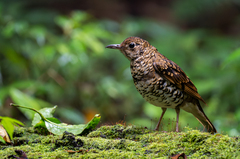
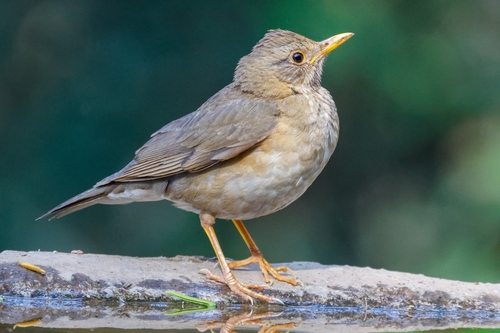
Scaly Thrush

Scaly Thrush

Zoothera dauma

Silhouette: Francesco "Architetto" Rollandin · PhyloPic

LCLeast ConcernNTVUENCR
Daily sighting probability <5% · Rare
at Jim Corbett National Park

In 3 days <5% in a week ~10%

21 Verified sightings at Jim Corbett National Park From 2019 to 2026
219 In all 10 parks
February Best month
☀️ Diurnal When it's spotted

About the Scaly Thrush

The scaly thrush (Zoothera dauma) is a member of the thrush family Turdidae. It breeds in dense wet forests in the Himalayas east through southwestern China to northern Indochina, and with disjunct populations (but possibly separate species) on Iriomote Island off southern Japan, and on Sumatra and Java in Indonesia.

The sexes are similar, 27–31 cm long, with black scaling on a paler white or yellowish background. The most striking identification feature in flight is the black band on the white underwings, a feature shared with most other species in the genus Zoothera, and also Siberian thrush in the genus Geokichla. The male has a song which is a loud, far-carrying mechanical whistle, with 5-10 second pauses between each one second long phrase twee...tuuu....tuuu....tuuu.

Three subspecies are currently accepted: Z. d. dauma — Himalayas east to southwest China, south to northern Thailand; a short-distance altitudinal migrant, dropping to foothills in winter Z. d. horsfieldi — Sumatra, Java, Bali, Lombok and Sumbawa; resident

Several other similar thrushes which were formerly... Wikipedia →

Sounds

Call0:35

Indonesia · 2025

© Untung Sarmawi · XC1166769 · CC BY 4.0

Call0:28

Indonesia · 2022

© Geoff Carey · XC737843 · CC BY-NC-SA 4.0

Call1:01

Bhutan · 2019

© Rolf A. de By · XC516289 · CC BY-NC-SA 4.0

Global Distribution

Parks Where Found

# Park Country Daily sighting probability
1 Doi Inthanon National Park 🇹🇭 Thailand
<5%
2 Manas National Park 🇮🇳 India
<5%
3 Chitwan National Park 🇳🇵 Nepal
<5%
4 Royal Manas National Park 🇧🇹 Bhutan
<5%
5 Jim Corbett National Park 🇮🇳 India
<5%
6 Kerinci Seblat National Park 🇮🇩 Indonesia
<5%
7 Namdapha National Park 🇮🇳 India
<5%
8 Bandhavgarh National Park 🇮🇳 India
<5%
9 Taroko National Park 🇹🇼 Taiwan
<5%
10 Kaziranga National Park 🇮🇳 India
<5%

Cities Where Found

# City Country Daily sighting probability
1 Dhaka 🇧🇩 Bangladesh
<5%
2 Kathmandu 🇳🇵 Nepal
<5%
3 Dehradun 🇮🇳 India
<5%
4 Kolkata 🇮🇳 India
<5%

Before you go

What are the chances of seeing a Scaly Thrush in Jim Corbett National Park?

Rare

Under 5% of wildlife watchers report a Scaly Thrush sighting in Jim Corbett National Park on a given day, based on 21 verified sightings from GBIF citizen-science data from 2019 to 2026. It is the 285th most-seen of the 368 birds we can rate there. Over three days the chance rises to under 5%, and over a week to about 10%, if each day is a fresh chance.

When is the best time to see a Scaly Thrush in Jim Corbett National Park?

Any time of year

In every month with enough records, under 5% of wildlife watchers report a Scaly Thrush in Jim Corbett National Park on a given day, so our monthly data shows no clear season.

What time of day is best to see a Scaly Thrush?

Between 10 am and 1 pm

Across all the parks we cover, that three-hour window holds the most Scaly Thrush sightings with a recorded time, and about 9 in 10 of them come between 6 am and 6 pm: it is a daytime animal.

Is Jim Corbett National Park the best place to see a Scaly Thrush?

Among the best

Of the 10 parks where we can rate Scaly Thrush sightings, Jim Corbett National Park ranks 5th at under 5%, level with the leaders once rounded. The best odds are in Doi Inthanon National Park (Thailand, under 5%), Manas National Park (India, under 5%) and Chitwan National Park (Nepal, under 5%).

Where does the Scaly Thrush sighting chance come from?

GBIF citizen-science records

It is estimated from how often the Scaly Thrush is recorded against all the birds logged in Jim Corbett National Park (21 verified sightings from 2019 to 2026), calibrated against known sighting rates. Figures are rounded to the nearest 10% because citizen-science data supports honest approximations, not decimals, and months with records from fewer than five people show "—". How it works.

← Back to Jim Corbett National Park