Great Bowerbird

Great Bowerbird

Chlamydera nuchalis

Silhouette: Ferran Sayol · PhyloPic

LCLeast ConcernNTVUENCR Endemic
Daily sighting probability ~40% · Likely
at Kakadu National Park

In 3 days ~80% in a week >90%

684 Verified sightings at Kakadu National Park From 2019 to 2026
1,307 In all 3 parks
June Best month
☀️ Diurnal When it's spotted

About the Great Bowerbird

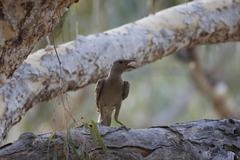
The great bowerbird (Chlamydera nuchalis) is a common and conspicuous resident of northern Australia, from the area around Broome across the Top End to Cape York Peninsula and as far south as Mount Isa and Townsville. Favoured habitat is a broad range of forest and woodland, and the margins of vine forests, monsoon forest, and mangrove swamps.

As with most members of the bowerbird family, breeding considerations dominate the lifecycle: females nest inconspicuously and raise their young alone, while the males spend most of the year building, maintaining, improving, defending, and above all displaying from their bowers. Only a male with a successful bower can attract mates.

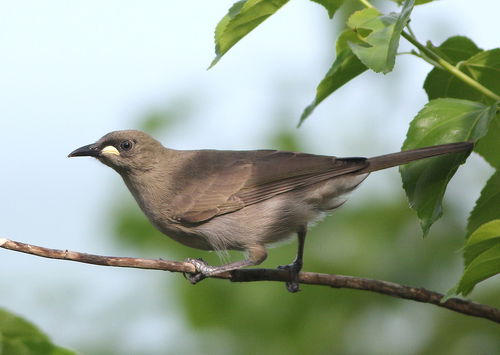
The great bowerbird is the largest of the bowerbird family and is 33 to 38 cm long and fawny grey in colour. Males have a small but conspicuous pink crest on the nape of the neck. The bower is a twin-walled avenue-type bower approximately 1 metre long and 45 cm high. It is typically located under a shrub or leafy branch. The ends of the bower are scattered with white and green objects - stones, bones, shells and leaves and small man-made objects such as plastic and bottle caps. Within the bower itself... Wikipedia →

Sounds

Call0:42

Australia · 2025

© Peter Boesman · XC1066445 · CC BY-NC-ND 4.0

Song0:21

Australia · 2022

© nick talbot · XC756159 · CC BY-NC-SA 4.0

Recording0:22

Australia · 2021

© James Lambert · XC671009 · CC BY-NC-ND 4.0

Global Distribution

Parks Where Found

# Park Country Daily sighting probability
1 Nitmiluk National Park 🇦🇺 Australia
~80%
2 Kakadu National Park 🇦🇺 Australia
~40%
3 Litchfield National Park 🇦🇺 Australia
~40%

Zoos & Centres Where Found

# Zoo / Centre Country
1 Hong Kong Zoological and Botanical Gardens 🇨🇳 China In captivity
2 Edward Youde Aviary 🇭🇰 Hong Kong SAR China In captivity

Before you go

What are the chances of seeing a Great Bowerbird in Kakadu National Park?

Likely

About 40% of wildlife watchers report a Great Bowerbird sighting in Kakadu National Park on a given day, based on 684 verified sightings from GBIF citizen-science data from 2019 to 2026. It is the 38th most-seen of the 186 birds we can rate there. Over three days the chance rises to about 80%, and over a week to over 90%, if each day is a fresh chance.

When is the best time to see a Great Bowerbird in Kakadu National Park?

January and June

In those months about 50% of wildlife watchers report a Great Bowerbird in Kakadu National Park on a given day, against about 20% in April, the lowest month. Those are among Kakadu National Park's wettest months, with about 180 mm of rain a month against almost none in August. February has too few records to rate.

What time of day is best to see a Great Bowerbird?

Between 2 and 5 pm

Across all the parks we cover, that three-hour window holds the most Great Bowerbird sightings with a recorded time, and nearly all of them come between 6 am and 6 pm: it is a daytime animal.

Is Kakadu National Park the best place to see a Great Bowerbird?

2nd of 3

Of the 3 parks where we can rate Great Bowerbird sightings, Kakadu National Park ranks 2nd at about 40%. The best odds are in Nitmiluk National Park (Australia, about 80%).

Which relatives of the Great Bowerbird live in Kakadu National Park?

Same order: Passeriformes

The closest relatives of the Great Bowerbird that you can see in Kakadu National Park (order Passeriformes, Perching Birds) are Torresian Crow (about 70%), Willie Wagtail (about 60%) and White-bellied Cuckooshrike (about 60%), with each one's daily chance of a sighting.

Where does the Great Bowerbird sighting chance come from?

GBIF citizen-science records

It is estimated from how often the Great Bowerbird is recorded against all the birds logged in Kakadu National Park (684 verified sightings from 2019 to 2026), calibrated against known sighting rates. Figures are rounded to the nearest 10% because citizen-science data supports honest approximations, not decimals, and months with records from fewer than five people show "—". How it works.

← Back to Kakadu National Park