
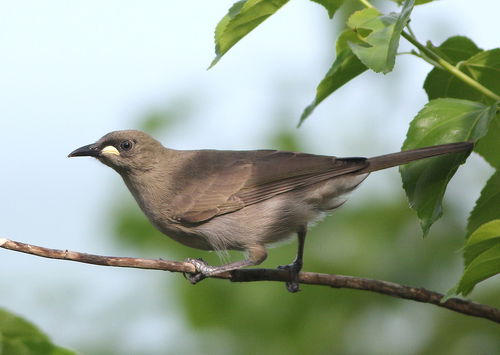
Lemon-breasted Flycatcher

Lemon-breasted Flycatcher

Microeca flavigaster

Silhouette: Sheatherius · PhyloPic

LCLeast ConcernNTVUENCR
Daily sighting probability ~50% · Likely
at Kakadu National Park

In 3 days ~80% in a week >90%

915 Verified sightings at Kakadu National Park From 2019 to 2026
1,103 In all 4 parks
October Best month
☀️ Diurnal When it's spotted

About the Lemon-breasted Flycatcher

The lemon-bellied flyrobin or lemon-bellied flycatcher (Microeca flavigaster) is a species of bird in the family Petroicidae. Found in Australia, Indonesia, and Papua New Guinea, its natural habitats are subtropical or tropical moist lowland forests and subtropical or tropical mangrove forests.

John Gould described the species in 1843 from a specimen from Port Essington in the Northern Territory. The species name is from the Latin word flavus meaning 'yellow', and Ancient Greek gaster meaning 'belly'. Four subspecies are recognised: the nominate flavigaster is found across the top of the Northern Territory, subspecies flavissima in Cape York and New Guinea, subspecies laetissima along the central-northern Queensland coast, and subspecies tormenti in the Kimberley of northwestern Australia. The two Queensland subspecies are separated by the Atherton Tableland and Burdekin-Lynd Divide, and are possibly kept apart by a population of the jacky winter (Microeca fascinans) that replaces it in some areas. Genetic analysis shows that the two Queensland subspecies are very closely related, but that there is quite a large separation from subspecies flavigaster. Subspecies tormenti... Wikipedia →

Sounds

Song0:34

Australia · 2025

© Étienne Leroy · XC1072774 · CC BY-NC-SA 4.0

Dawn song1:04

Australia · 2023

© James Lambert · XC830345 · CC BY-NC-ND 4.0

Uncertain0:16

Australia · 2022

© nick talbot · XC732549 · CC BY-NC-SA 4.0

Global Distribution

Parks Where Found

# Park Country Daily sighting probability
1 Kakadu National Park 🇦🇺 Australia
~50%
2 Litchfield National Park 🇦🇺 Australia
~30%
3 Nitmiluk National Park 🇦🇺 Australia
~20%
4 Daintree National Park 🇦🇺 Australia
<5%

Before you go

What are the chances of seeing a Lemon-breasted Flycatcher in Kakadu National Park?

Likely

About 50% of wildlife watchers report a Lemon-breasted Flycatcher sighting in Kakadu National Park on a given day, based on 915 verified sightings from GBIF citizen-science data from 2019 to 2026. It is the 23rd most-seen of the 186 birds we can rate there. Over three days the chance rises to about 80%, and over a week to over 90%, if each day is a fresh chance.

When is the best time to see a Lemon-breasted Flycatcher in Kakadu National Park?

April–August, October and December–January

In those months about 50% of wildlife watchers report a Lemon-breasted Flycatcher in Kakadu National Park on a given day, against about 30% in November, the lowest month. February has too few records to rate.

What time of day is best to see a Lemon-breasted Flycatcher?

Between 3 and 6 pm

Across all the parks we cover, that three-hour window holds the most Lemon-breasted Flycatcher sightings with a recorded time, and about 9 in 10 of them come between 6 am and 6 pm: it is a daytime animal.

Is Kakadu National Park the best place to see a Lemon-breasted Flycatcher?

Yes

Of the 4 parks where we can rate Lemon-breasted Flycatcher sightings, Kakadu National Park has the highest daily chance: about 50%. Next come Litchfield National Park (Australia, about 30%) and Nitmiluk National Park (Australia, about 20%).

Where does the Lemon-breasted Flycatcher sighting chance come from?

GBIF citizen-science records

It is estimated from how often the Lemon-breasted Flycatcher is recorded against all the birds logged in Kakadu National Park (915 verified sightings from 2019 to 2026), calibrated against known sighting rates. Figures are rounded to the nearest 10% because citizen-science data supports honest approximations, not decimals, and months with records from fewer than five people show "—". How it works.

← Back to Kakadu National Park