Black-winged Flycatcher-shrike

Black-winged Flycatcher-shrike

Hemipus hirundinaceus

Silhouette: Sheatherius · PhyloPic

LCLeast ConcernNTVUENCR
Daily sighting probability <5% · Rare
at Kerinci Seblat National Park

In 3 days ~10%

11 Verified sightings at Kerinci Seblat National Park From 2019 to 2026
1,858 In all 11 parks
July Best month
🌅 Crepuscular When it's spotted

About the Black-winged Flycatcher-shrike

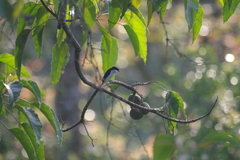
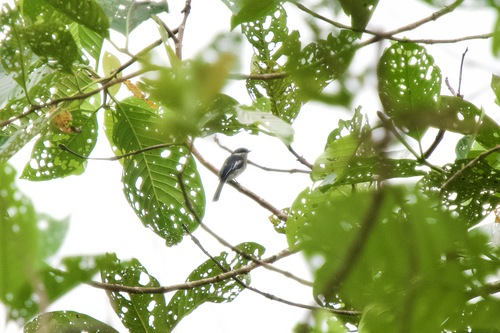
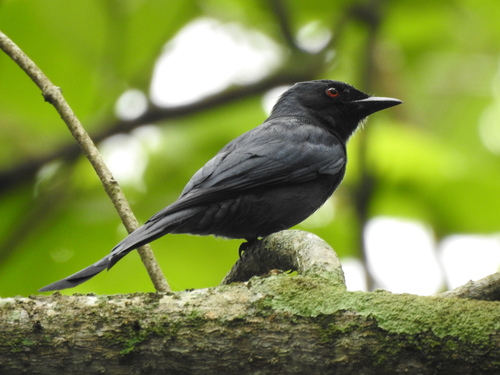
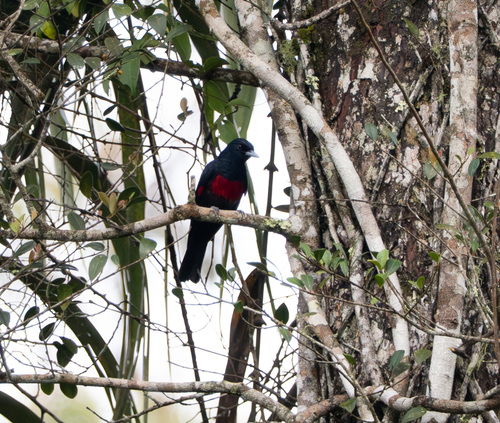
The black-winged flycatcher-shrike (Hemipus hirundinaceus) is a species of bird in the flycatcher-shrike genus, Hemipus. It is usually placed in the Vangidae. It is found in the Malay Peninsula and the Greater Sunda Islands. Its natural habitats are lowland forests and sometimes swamps and mangroves. The International Union for Conservation of Nature (IUCN) has assessed it as being of least concern.

Thomas Horsfield described this species as Muscicapa obscura in 1821, and it was later transferred to the genus Hemipus, as Hemipus obscurus. Because Muscicapa obscura was an unavailable name, the name Muscicapa hirundinacea published by Coenraad Jacob Temminck in 1822 was used, making the name Hemipus hirundinaceus. The IOC World Bird List transferred the genus Hemipus from Campephagidae, the cuckooshrikes, to Tephrodornithidae, the woodshrikes, because it was found to be closely related to Tephrodornis in 2006. The Handbook of the Birds of the World places both genera in Vangidae.

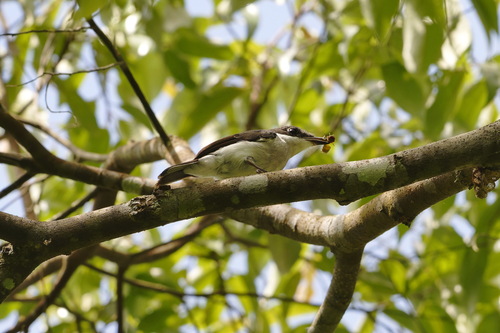
The black-winged flycatcher-shrike is about 15 cm (5.9 in) long. The male's head and upperparts are black, having a green sheen. The rump has black and white bars, and the tail... Wikipedia →
Sounds

Song0:54

Malaysia · 2025

© Ding Li Yong · XC1048584 · CC BY-NC-ND 4.0

Call1:26

Malaysia · 2017

© Peter Boesman · XC359781 · CC BY-NC-ND 4.0

Song0:26

Thailand · 2022

© Somkiat Pakapinyo (Chai) · XC753253 · CC BY-NC-SA 4.0

Global Distribution

Parks Where Found

# Park Country Daily sighting probability
1 Bako National Park 🇲🇾 Malaysia
~50%
2 Sepilok 🇲🇾 Malaysia
~30%
3 Bali Barat National Park 🇮🇩 Indonesia
~30%
4 Way Kambas National Park 🇮🇩 Indonesia
~20%
5 Tanjung Puting National Park 🇮🇩 Indonesia
~20%
6 Gunung Leuser National Park 🇮🇩 Indonesia
~10%
7 Danum Valley Conservation Area 🇲🇾 Malaysia
~10%
8 Taman Negara National Park 🇲🇾 Malaysia
~10%
9 Kinabatangan Wildlife Sanctuary 🇲🇾 Malaysia
<5%
10 Kinabalu Park 🇲🇾 Malaysia
<5%
11 Kerinci Seblat National Park 🇮🇩 Indonesia
<5%

Cities Where Found

# City Country Daily sighting probability
1 Kuala Lumpur 🇲🇾 Malaysia
~10%
2 Jakarta 🇮🇩 Indonesia
~10%
3 Kuching 🇲🇾 Malaysia
~10%

Before you go

What are the chances of seeing a Black-winged Flycatcher-shrike in Kerinci Seblat National Park?

Rare

Under 5% of wildlife watchers report a Black-winged Flycatcher-shrike sighting in Kerinci Seblat National Park on a given day, based on 11 verified sightings from GBIF citizen-science data from 2019 to 2026. It is the 148th most-seen of the 203 birds we can rate there. Over three days the chance rises to about 10%, if each day is a fresh chance.

When is the best time to see a Black-winged Flycatcher-shrike in Kerinci Seblat National Park?

Any time of year

In every month with enough records, under 5% of wildlife watchers report a Black-winged Flycatcher-shrike in Kerinci Seblat National Park on a given day, so our monthly data shows no clear season. January has too few records to rate.

What time of day is best to see a Black-winged Flycatcher-shrike?

Between 1 and 4 am

Across all the parks we cover, that three-hour window holds the most Black-winged Flycatcher-shrike sightings with a recorded time, and about 7 in 10 of them come between 6 pm and 6 am: it is most active around dawn and dusk.

Is Kerinci Seblat National Park the best place to see a Black-winged Flycatcher-shrike?

11th of 11

Of the 11 parks where we can rate Black-winged Flycatcher-shrike sightings, Kerinci Seblat National Park ranks 11th at under 5%. The best odds are in Bako National Park (Malaysia, about 50%), Sepilok (Malaysia, about 30%) and Bali Barat National Park (Indonesia, about 30%). All parks ranked.

Where does the Black-winged Flycatcher-shrike sighting chance come from?

GBIF citizen-science records

It is estimated from how often the Black-winged Flycatcher-shrike is recorded against all the birds logged in Kerinci Seblat National Park (11 verified sightings from 2019 to 2026), calibrated against known sighting rates. Figures are rounded to the nearest 10% because citizen-science data supports honest approximations, not decimals, and months with records from fewer than five people show "—". How it works.

← Back to Kerinci Seblat National Park