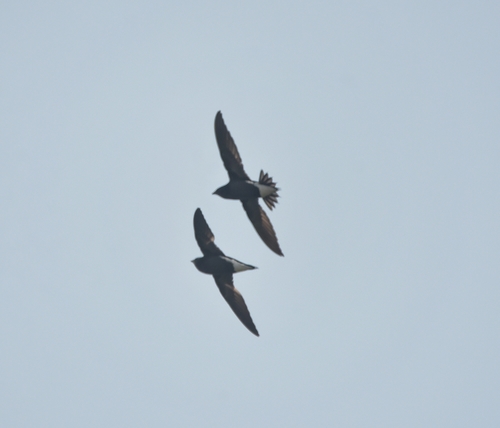
Gray-rumped Treeswift

Gray-rumped Treeswift

Hemiprocne longipennis

Silhouette: Sheatherius · PhyloPic

LCLeast ConcernNTVUENCR
Daily sighting probability <5% · Rare
at Khao Sok National Park

In 3 days ~10% in a week ~20%

28 Verified sightings at Khao Sok National Park From 2019 to 2026
2,802 In all 13 parks
June Best month
🌅 Crepuscular When it's spotted

About the Gray-rumped Treeswift

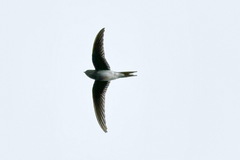
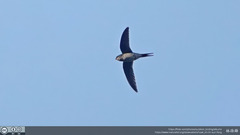
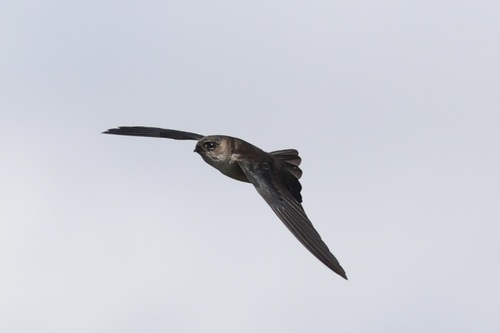
The grey-rumped treeswift (Hemiprocne longipennis) is a species of bird in the Hemiprocnidae family. Currently, four extant species are placed in the family. Like the other members of the Hemiprocnidae, this species is closely related to true swifts, but unlike true swifts, the treeswifts are arboreal, often seen perched on trees, high-tension power transmission lines, and pylons. When perched, the wing tips cross over the tail. This species is commonly found in peninsular Malaysia, but has an extremely large range; there is limited information about population trends.

Adult males have a distinct dark grey throat and chest contrasting with a white belly. Ear coverts are dull orange-red/chestnut-colored. Adult females lack the dull orange-red/chestnut coloration on the ear coverts. When perched, the wing tips cross over across the tail. Both sexes have a greenish sheen to the upper parts.

It is found in Brunei, Indonesia, Malaysia, Myanmar, the Philippines, Singapore, and Thailand. Its natural habitats are subtropical or tropical moist lowland forests, subtropical or tropical mangrove forests, and subtropical or tropical moist montane forests.

�... Wikipedia →

Sounds

Call0:04

Indonesia · 2024

© Ding Li Yong · XC926387 · CC BY-NC-ND 4.0

Flight call1:24

Indonesia · 2020

© Frank Lambert · XC598508 · CC BY-NC-ND 4.0

Call0:07

Malaysia · 2016

© Ted Floyd · XC343955 · CC BY-NC-SA 4.0

Global Distribution

Parks Where Found

# Park Country Daily sighting probability
1 Bali Barat National Park 🇮🇩 Indonesia
~30%
2 Tangkoko Nature Reserve 🇮🇩 Indonesia
~30%
3 Gunung Leuser National Park 🇮🇩 Indonesia
~30%
4 Khao Luang National Park 🇹🇭 Thailand
~30%
5 Sepilok 🇲🇾 Malaysia
~30%
6 Way Kambas National Park 🇮🇩 Indonesia
~20%
7 Danum Valley Conservation Area 🇲🇾 Malaysia
~20%
8 Taman Negara National Park 🇲🇾 Malaysia
~20%
9 Kaeng Krachan National Park 🇹🇭 Thailand
~10%
10 Tanjung Puting National Park 🇮🇩 Indonesia
~10%
11 Khao Sok National Park 🇹🇭 Thailand
<5%
12 Kinabalu Park 🇲🇾 Malaysia
<5%
13 Kinabatangan Wildlife Sanctuary 🇲🇾 Malaysia
<5%

Cities Where Found

# City Country Daily sighting probability
1 Kuching 🇲🇾 Malaysia
~10%
2 Kuala Lumpur 🇲🇾 Malaysia
~10%
3 Singapore 🇸🇬 Singapore
<5%

Before you go

What are the chances of seeing a Gray-rumped Treeswift in Khao Sok National Park?

Rare

Under 5% of wildlife watchers report a Gray-rumped Treeswift sighting in Khao Sok National Park on a given day, based on 28 verified sightings from GBIF citizen-science data from 2019 to 2026. It is the 145th most-seen of the 213 birds we can rate there. Over three days the chance rises to about 10%, and over a week to about 20%, if each day is a fresh chance.

When is the best time to see a Gray-rumped Treeswift in Khao Sok National Park?

June and December–February

In those months about 10% of wildlife watchers report a Gray-rumped Treeswift in Khao Sok National Park on a given day, against under 5% in March–May and July–November, the lowest months.

What time of day is best to see a Gray-rumped Treeswift?

Between 2 and 5 am

Across all the parks we cover, that three-hour window holds the most Gray-rumped Treeswift sightings with a recorded time, and about 6 in 10 of them come between 6 pm and 6 am: it is most active around dawn and dusk.

Where does the Gray-rumped Treeswift sighting chance come from?

GBIF citizen-science records

It is estimated from how often the Gray-rumped Treeswift is recorded against all the birds logged in Khao Sok National Park (28 verified sightings from 2019 to 2026), calibrated against known sighting rates. Figures are rounded to the nearest 10% because citizen-science data supports honest approximations, not decimals, and months with records from fewer than five people show "—". How it works.

← Back to Khao Sok National Park