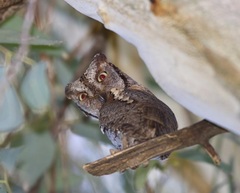
Eurasian Scops Owl

Eurasian Scops Owl

Otus scops

Silhouette: Armelle Ansart (photograph), Maxime Dahirel (digitisation) · PhyloPic

LCLeast ConcernNTVUENCR
Daily sighting probability <5% · Rare
at Kiskunság National Park

In 3 days <5% in a week ~10%

16 Verified sightings at Kiskunság National Park From 2019 to 2026
495 In all 8 parks
May Best month
🌙 Nocturnal When it's spotted

About the Eurasian Scops Owl

The Eurasian scops owl (Otus scops), also known as the European scops owl, common scops owl or just scops owl, is a small owl in the typical owl family Strigidae. Its breeding range extends from southern Europe eastwards to southern Siberia and the western Himalayas. It is migratory, wintering in Africa south of the Sahara, although it is resident year-round in parts of Mediterranean Europe.

The Eurasian scops owl was formally described by Swedish naturalist Carl Linnaeus in 1758 in the tenth edition of his Systema Naturae. Linnaeus cited the 1599 description by the Italian naturalist Ulisse Aldrovandi, placed it with all the other owls in the genus Strix and coined the binomial name Strix scops. The Eurasian scops owl is now placed in the genus Otus that was introduced in 1769 by Welsh naturalist Thomas Pennant. The genus name is derived from the Latin otus meaning "eared owl". The specific epithet scops is from the Ancient Greek word skōps for a little eared owl. The term is believed to be of Pre-Greek origin; folk etymology links it to σκώπτω (skṓptō, "to mock") or σκέπτομαι (sképtomai, "to examine").

Five subspecies are recognised: Wikipedia →

Sounds

Call0:42

France · 2026

© Thierry THOMAS · XC1170209 · CC BY-NC-SA 4.0

Song1:29

Slovenia · 2026

© Kelle Moreau · XC1158240 · CC BY-NC-SA 4.0

Duet0:42

France · 2026

© Cureau Hervé · XC1141276 · CC BY-NC-SA 4.0

Global Distribution

Parks Where Found

# Park Country Daily sighting probability
1 Cévennes National Park 🇫🇷 France
<5%
2 Sierra de Guadarrama National Park 🇪🇸 Spain
<5%
3 Monfragüe National Park 🇪🇸 Spain
<5%
4 Sierra Nevada National Park 🇪🇸 Spain
<5%
5 Ordesa y Monte Perdido National Park 🇪🇸 Spain
<5%
6 Kiskunság National Park 🇭🇺 Hungary
<5%
7 Picos de Europa National Park 🇪🇸 Spain
<5%
8 Pyrénées National Park 🇫🇷 France
<5%

Cities Where Found

# City Country Daily sighting probability
1 Tashkent 🇺🇿 Uzbekistan
~10%
2 Almaty 🇰🇿 Kazakhstan
~10%
3 Rostov-on-Don 🇷🇺 Russia
~10%
4 Karaj 🇮🇷 Iran
~10%
5 Athens 🇬🇷 Greece
~10%
6 Sofia 🇧🇬 Bulgaria
<5%
7 Tehran 🇮🇷 Iran
<5%
8 Mashhad 🇮🇷 Iran
<5%
9 Budapest 🇭🇺 Hungary
<5%
10 Dushanbe 🇹🇯 Tajikistan
<5%

Zoos & Centres Where Found

# Zoo / Centre Country
1 Barcelona Zoo 🇪🇸 Spain In captivity
2 Badoca Safari Park 🇵🇹 Portugal In captivity
3 Yaroslavl Zoo 🇷🇺 Russia In captivity
4 Kyiv Zoo 🇺🇦 Ukraine In captivity
5 Natur- und Tierpark Goldau 🇨🇭 Switzerland In captivity
6 Aquarama Barcelona 🇪🇸 Spain In captivity
7 Plock Zoo 🇵🇱 Poland In captivity
8 Tierpark Hexentanzplatz 🇩🇪 Germany In captivity
9 Zoopark Limpopo 🇷🇺 Russia In captivity
10 Odesa Zoo 🇺🇦 Ukraine In captivity
11 Small Breeds Farm Park 🇬🇧 United Kingdom In captivity
12 Alpenzoo Innsbruck 🇦🇹 Austria In captivity
13 Zoo Koki (Parque zoológico y botánico) 🇪🇸 Spain In captivity
14 Centro Volo Rapaci 🇮🇹 Italy In captivity
15 Donjon des aigles 🇫🇷 France In captivity

Before you go

What are the chances of seeing a Eurasian Scops Owl in Kiskunság National Park?

Rare

Under 5% of wildlife watchers report a Eurasian Scops Owl sighting in Kiskunság National Park on a given day, based on 16 verified sightings from GBIF citizen-science data from 2019 to 2026. It is the 199th most-seen of the 222 birds we can rate there. Over three days the chance rises to under 5%, and over a week to about 10%, if each day is a fresh chance.

When is the best time to see a Eurasian Scops Owl in Kiskunság National Park?

May

In that month about 10% of wildlife watchers report a Eurasian Scops Owl in Kiskunság National Park on a given day, against under 5% in June to April, the lowest months. That is one of Kiskunság National Park's wettest months, with about 75 mm of rain against 35 mm in April.

What time of day is best to see a Eurasian Scops Owl?

Between 9 pm and midnight

Across all the parks we cover, that three-hour window holds the most Eurasian Scops Owl sightings with a recorded time, and about 8 in 10 of them come between 6 pm and 6 am: it is mostly seen at night.

Which relatives of the Eurasian Scops Owl live in Kiskunság National Park?

Same family: Strigidae

The closest relatives of the Eurasian Scops Owl that you can see in Kiskunság National Park (family Strigidae, Typical Owls) are Little Owl (about 10%) and Long-eared Owl (about 10%), with each one's daily chance of a sighting.

Where does the Eurasian Scops Owl sighting chance come from?

GBIF citizen-science records

It is estimated from how often the Eurasian Scops Owl is recorded against all the birds logged in Kiskunság National Park (16 verified sightings from 2019 to 2026), calibrated against known sighting rates. Figures are rounded to the nearest 10% because citizen-science data supports honest approximations, not decimals, and months with records from fewer than five people show "—". How it works.

← Back to Kiskunság National Park