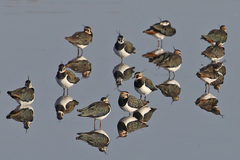
Northern Lapwing

Northern Lapwing

Vanellus vanellus

Silhouette: Nina Skinner · PhyloPic

LCNTNear ThreatenedVUENCR
Daily sighting probability ~70% · Very likely
at Kiskunság National Park

In 3 days >90%

1,088 Verified sightings at Kiskunság National Park From 2019 to 2026
13,289 In all 18 parks
March Best month
☀️ Diurnal When it's spotted

About the Northern Lapwing

The northern lapwing (Vanellus vanellus), also known as the peewit or pewit, tuit or tewit, green plover, or (in Ireland and Great Britain) pyewipe or just lapwing, is a bird in the lapwing subfamily. It is common through temperate Eurosiberia.

The northern lapwing was formally described by the Swedish naturalist Carl Linnaeus in 1758 in the tenth edition of his Systema Naturae under the binomial name Tringa vanellus. The species is now placed with the other lapwings in the genus Vanellus that was introduced by the French zoologist Mathurin Jacques Brisson in 1760. The scientific name Vanellus is Medieval Latin for the northern lapwing and derives from vannus, a winnowing fan. The species is monotypic: no subspecies are recognised.

The name lapwing has been variously attributed to the "lapping" sound its wings make in flight, to its irregular flight path due to its large wings (the Oxford English Dictionary derives this from an Old English word meaning "to totter"), or from its habit of drawing potential predators away from its nest by trailing a wing as if it were broken. The names peewit, pewit, tuit or tew-it are onomatopoeic and refer to the bird's characteristic... Wikipedia →

Sounds

Call0:05

United Kingdom · 2026

© Mark James Pearson · XC1185719 · CC BY-NC-SA 4.0

Recording0:08

Finland · 2026

© Miika Silfverberg · XC1145921 · CC BY-NC-SA 4.0

Flight call0:49

Mongolia · 2026

© Ding Li Yong · XC1142898 · CC BY-NC-ND 4.0

Global Distribution

Parks Where Found

# Park Country Daily sighting probability
1 Hortobágy National Park 🇭🇺 Hungary
~80%
2 Kiskunság National Park 🇭🇺 Hungary
~70%
3 Biebrza National Park 🇵🇱 Poland
~60%
4 Fertő-Hanság National Park 🇭🇺 Hungary
~60%
5 Wadden Sea National Park 🇩🇪 Germany
~50%
6 Kaziranga National Park 🇮🇳 India
~40%
7 Snowdonia National Park 🇬🇧 United Kingdom
~30%
8 Białowieża National Park 🇵🇱 Poland
~20%
9 Cairngorms National Park 🇬🇧 United Kingdom
~20%
10 Camargue 🇫🇷 France
~20%
11 Doñana National Park 🇪🇸 Spain
~20%
12 Bavarian Forest National Park 🇩🇪 Germany
~10%
13 Monfragüe National Park 🇪🇸 Spain
~10%
14 Gobi Gurvansaikhan National Park 🇲🇳 Mongolia
~10%
15 Gauja National Park 🇱🇻 Latvia
~10%
16 Manas National Park 🇮🇳 India
~10%
17 Royal Manas National Park 🇧🇹 Bhutan
<5%
18 Sierra de Guadarrama National Park 🇪🇸 Spain
<5%

Cities Where Found

# City Country Daily sighting probability
1 Liverpool 🇬🇧 United Kingdom
~40%
2 Helsinki 🇫🇮 Finland
~40%
3 Birmingham 🇬🇧 United Kingdom
~30%
4 Manchester 🇬🇧 United Kingdom
~20%
5 London 🇬🇧 United Kingdom
~10%
6 Leeds 🇬🇧 United Kingdom
~10%
7 Rotterdam [The Hague] 🇳🇱 Netherlands
~10%
8 Saint Petersburg 🇷🇺 Russia
~10%
9 Novosibirsk 🇷🇺 Russia
~10%
10 Amsterdam 🇳🇱 Netherlands
~10%

Zoos & Centres Where Found

# Zoo / Centre Country
1 Moscow Zoo 🇷🇺 Russia In captivity
2 Prague Zoo 🇨🇿 Czechia In captivity
3 Zoo Pilsen 🇨🇿 Czechia In captivity
4 Zoo Hluboka 🇨🇿 Czechia In captivity
5 Eekholt Wildlife Park 🇩🇪 Germany In captivity
6 Tama Zoological Park 🇯🇵 Japan In captivity
7 Luisenpark 🇩🇪 Germany In captivity
8 Budapest Zoo & Botanical Garden 🇭🇺 Hungary In captivity
9 Santillana Zoo 🇪🇸 Spain In captivity
10 Rákosův pavilon 🇨🇿 Czechia In captivity
11 Velemlokárium 🇨🇿 Czechia In captivity
12 akwarium warszawskiego ZOO 🇵🇱 Poland In captivity
13 hipopotamiarnia i akwarium morskie warszawskiego ZOO 🇵🇱 Poland In captivity

Before you go

What are the chances of seeing a Northern Lapwing in Kiskunság National Park?

Very likely

About 70% of wildlife watchers report a Northern Lapwing sighting in Kiskunság National Park on a given day, based on 1,088 verified sightings from GBIF citizen-science data from 2019 to 2026. It is the 7th most-seen of the 222 birds we can rate there. Over three days the chance rises to over 90%, if each day is a fresh chance.

When is the best time to see a Northern Lapwing in Kiskunság National Park?

March–April, June and August–September

In those months about 80% of wildlife watchers report a Northern Lapwing in Kiskunság National Park on a given day, against about 50% in December and January, the lowest months.

What time of day is best to see a Northern Lapwing?

Between 2 and 5 pm

Across all the parks we cover, that three-hour window holds the most Northern Lapwing sightings with a recorded time, and about 9 in 10 of them come between 6 am and 6 pm: it is a daytime animal.

Is Kiskunság National Park the best place to see a Northern Lapwing?

2nd of 18

Of the 18 parks where we can rate Northern Lapwing sightings, Kiskunság National Park ranks 2nd at about 70%. The best odds are in Hortobágy National Park (Hungary, about 80%). All parks ranked.

Which relatives of the Northern Lapwing live in Kiskunság National Park?

Same family: Charadriidae

The closest relatives of the Northern Lapwing that you can see in Kiskunság National Park (family Charadriidae, Plovers and Lapwings) are Common Ringed Plover (about 10%), Black-bellied Plover (about 10%) and European Golden Plover (about 10%), with each one's daily chance of a sighting.

Where does the Northern Lapwing sighting chance come from?

GBIF citizen-science records

It is estimated from how often the Northern Lapwing is recorded against all the birds logged in Kiskunság National Park (1,088 verified sightings from 2019 to 2026), calibrated against known sighting rates. Figures are rounded to the nearest 10% because citizen-science data supports honest approximations, not decimals, and months with records from fewer than five people show "—". How it works.

← Back to Kiskunság National Park