Long-eared Owl

Long-eared Owl

Asio otus

Silhouette: hedera.baltica · PhyloPic

LCLeast ConcernNTVUENCR
Daily sighting probability ~10% · With luck
at Kiskunság National Park

In 3 days ~20% in a week ~50%

80 Verified sightings at Kiskunság National Park From 2019 to 2026
452 In all 13 parks
February Best month
☀️🌙 Day & Night When it's spotted

About the Long-eared Owl

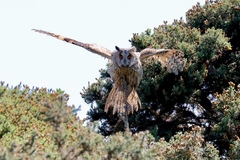
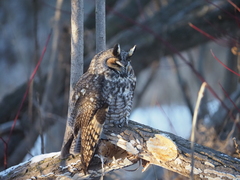
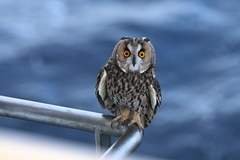
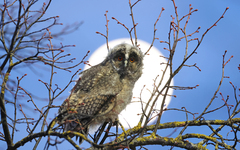
The long-eared owl (Asio otus), also known as the northern long-eared owl or informally as the lesser horned owl or cat owl, is a medium-sized typical owl with an extensive range. The genus name, Asio, is Latin for "horned owl", and the specific epithet, otus, is derived from Greek and refers to a small eared owl. It breeds in Europe and the Palearctic, as well as in North America.

This owl prefers semi-open habitats, particularly woodland edge, as they to roost and nest within dense stands of wood but prefer to hunt over open ground. The long-eared owl primarily hunts small rodents, especially voles, but during population cycles of their regular prey, or in arid, insular, or urbanized habitats, it takes diverse prey including birds and insects. The long-eared owl utilizes nests built by other animals, in particular by corvids. Breeding success in this species is correlated with prey populations and predation risks. Unlike many owls, long-eared owls are not strongly territorial or sedentary. They are partially migratory or nomadic. Another characteristic of this species is its partiality for regular roosts shared by a number of long-eared owls at once. The long-eared owl is one of the most widely distributed and most numerous owl species in the world, and due to its very broad range and numbers it is considered a least concern species by the IUCN. Nonetheless, strong declines have been detected for this owl in several parts of its range. Wikipedia →

Sounds

Call1:02

France · 2025

© Jean Pierre Sciolla · XC1085639 · CC BY-NC-SA 4.0

Begging call0:41

Sweden · 2025

© Fredrik Grahn · XC1049371 · CC BY-NC-SA 4.0

Nocturnal flight call0:47

Sweden · 2025

© Dag Österlund · XC993358 · CC BY-NC-SA 4.0

Global Distribution

Parks Where Found

# Park Country Daily sighting probability
1 Death Valley National Park 🇺🇸 United States
~10%
2 Kiskunság National Park 🇭🇺 Hungary
~10%
3 Joshua Tree National Park 🇺🇸 United States
~10%
4 Sequoia and Kings Canyon National Parks 🇺🇸 United States
~10%
5 Yosemite National Park 🇺🇸 United States
<5%
6 Hortobágy National Park 🇭🇺 Hungary
<5%
7 Fertő-Hanság National Park 🇭🇺 Hungary
<5%
8 Biebrza National Park 🇵🇱 Poland
<5%
9 Białowieża National Park 🇵🇱 Poland
<5%
10 Wadden Sea National Park 🇩🇪 Germany
<5%
11 Doñana National Park 🇪🇸 Spain
<5%
12 Monfragüe National Park 🇪🇸 Spain
<5%
13 Point Pelee National Park 🇨🇦 Canada
<5%

Cities Where Found

# City Country Daily sighting probability
1 Turin 🇮🇹 Italy
~10%
2 Rostov-on-Don 🇷🇺 Russia
~10%
3 Bishkek 🇰🇬 Kyrgyzstan
~10%
4 Novosibirsk 🇷🇺 Russia
~10%
5 Hamburg 🇩🇪 Germany
<5%
6 Almaty 🇰🇿 Kazakhstan
<5%
7 Jerusalem 🇮🇱 Israel
<5%
8 Saint Petersburg 🇷🇺 Russia
<5%
9 Berlin 🇩🇪 Germany
<5%
10 Bucharest 🇷🇴 Romania
<5%

Zoos & Centres Where Found

# Zoo / Centre Country
1 Moscow Zoo 🇷🇺 Russia In captivity
2 Lusen National Park Centre 🇩🇪 Germany In captivity
3 Beijing Wildlife Park 🇨🇳 China In captivity
4 Blair Drummond Safari and Adventure Park 🇬🇧 United Kingdom In captivity
5 Cumberland Wildpark Grünau 🇦🇹 Austria In captivity
6 Wildgehege Hellenthal 🇩🇪 Germany In captivity
7 Yaroslavl Zoo 🇷🇺 Russia In captivity
8 Shalom Wildlife Zoo 🇺🇸 United States In captivity
9 Kyiv Zoo 🇺🇦 Ukraine In captivity
10 Lüneburg Heath Wildlife Park 🇩🇪 Germany In captivity
11 Târgu Mureș Zoo 🇷🇴 Romania In captivity
12 Birds of prey 🇨🇦 Canada In captivity
13 Almaty Zoo 🇰🇿 Kazakhstan In captivity
14 Ljubljana Zoo 🇸🇮 Slovenia In captivity
15 Hogle Zoo 🇺🇸 United States In captivity
16 Kharkiv Zoo 🇺🇦 Ukraine In captivity
17 Minsk Zoo 🇧🇾 Belarus In captivity
18 Plock Zoo 🇵🇱 Poland In captivity
19 Leśny Park Niespodzianek 🇵🇱 Poland In captivity
20 John Ball Zoo 🇺🇸 United States In captivity
21 California Living Museum 🇺🇸 United States In captivity
22 Birdworld 🇬🇧 United Kingdom In captivity
23 Penza Zoo 🇷🇺 Russia In captivity
24 Paphos Zoo 🇨🇾 Cyprus In captivity
25 Oradea Zoological Garden 🇷🇴 Romania In captivity
26 Tierpark Hexentanzplatz 🇩🇪 Germany In captivity
27 Zoopark Chelyabinsk 🇷🇺 Russia In captivity
28 Zoopark Limpopo 🇷🇺 Russia In captivity
29 Odesa Zoo 🇺🇦 Ukraine In captivity
30 Bayerwald-Tierpark Lohberg 🇩🇪 Germany In captivity
31 Belgrade Zoo 🇷🇸 Serbia In captivity
32 ZooAmerica 🇺🇸 United States In captivity
33 Small Breeds Farm Park 🇬🇧 United Kingdom In captivity
34 Tilgate Nature Centre 🇬🇧 United Kingdom In captivity
35 VigoNature 🇪🇸 Spain In captivity
36 Alpenzoo Innsbruck 🇦🇹 Austria In captivity
37 Greifvogelpark Saarburg 🇩🇪 Germany In captivity
38 Parc Animalier d'Introd 🇮🇹 Italy In captivity
39 Tracy Aviary 🇺🇸 United States In captivity
40 Kecskeméti Vadaskert 🇭🇺 Hungary In captivity
41 Hortobágyi Madárpark 🇭🇺 Hungary In captivity
42 Záchranná stanice Pavlov 🇨🇿 Czechia In captivity
43 Bird of Prey and Mammal Centre 🇬🇧 United Kingdom In captivity
44 Centro Recupero Avifauna Castel Tirolo 🇮🇹 Italy In captivity
45 Gauntlet Birds of Prey 🇬🇧 United Kingdom In captivity
46 Greifvogelpark Buchs 🇨🇭 Switzerland In captivity
47 Wildlife Learning and Conservation Center 🇺🇸 United States In captivity
48 Zoo Samara 🇷🇺 Russia In captivity
49 Walton Hall Zoo 🇬🇧 United Kingdom In captivity
50 Kharkiv Dolphinarium 🇺🇦 Ukraine In captivity

Before you go

What are the chances of seeing a Long-eared Owl in Kiskunság National Park?

With luck

About 10% of wildlife watchers report a Long-eared Owl sighting in Kiskunság National Park on a given day, based on 80 verified sightings from GBIF citizen-science data from 2019 to 2026. It is the 146th most-seen of the 222 birds we can rate there. Over three days the chance rises to about 20%, and over a week to about 50%, if each day is a fresh chance.

When is the best time to see a Long-eared Owl in Kiskunság National Park?

February and April

In those months about 20% of wildlife watchers report a Long-eared Owl in Kiskunság National Park on a given day, against under 5% in June to September, the lowest months.

What time of day is best to see a Long-eared Owl?

Between 8 and 11 pm

Across all the parks we cover, that three-hour window holds the most Long-eared Owl sightings with a recorded time, and about 7 in 10 of them come between 6 pm and 6 am: it is seen both by day and at night.

Is Kiskunság National Park the best place to see a Long-eared Owl?

Among the best

Of the 13 parks where we can rate Long-eared Owl sightings, Kiskunság National Park ranks 2nd at about 10%, level with the leaders once rounded. The best odds are in Death Valley National Park (United States, about 10%).

Where does the Long-eared Owl sighting chance come from?

GBIF citizen-science records

It is estimated from how often the Long-eared Owl is recorded against all the birds logged in Kiskunság National Park (80 verified sightings from 2019 to 2026), calibrated against known sighting rates. Figures are rounded to the nearest 10% because citizen-science data supports honest approximations, not decimals, and months with records from fewer than five people show "—". How it works.

← Back to Kiskunság National Park