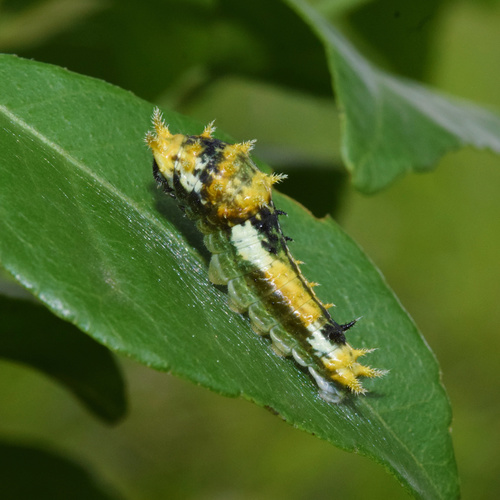
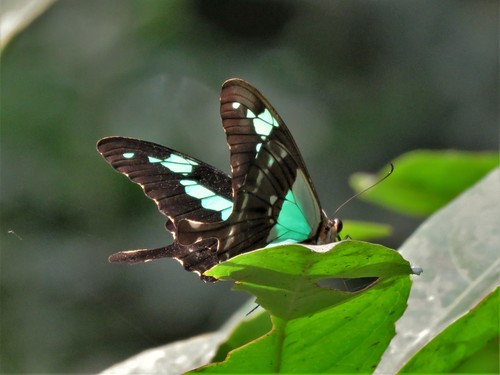
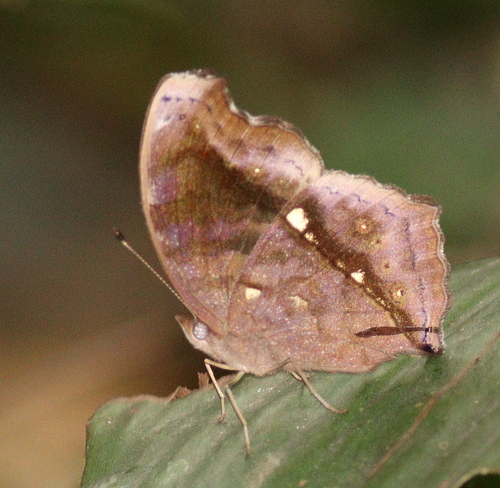
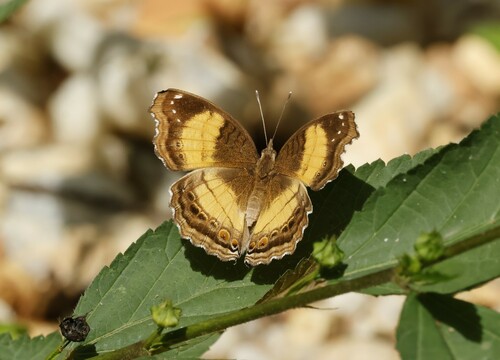
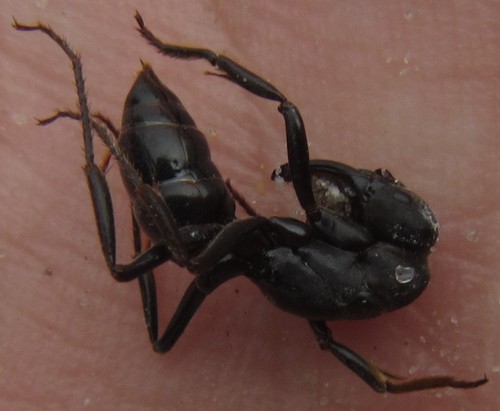
Pioneer White

Pioneer White

Belenois aurota

Daily sighting probability ~20% · Possible
at Lake Mburo National Park

In 3 days ~60% in a week ~90%

7 Verified sightings at Lake Mburo National Park From 2019 to 2026
462 In all 24 parks
November Best month
☀️ Diurnal When it's spotted

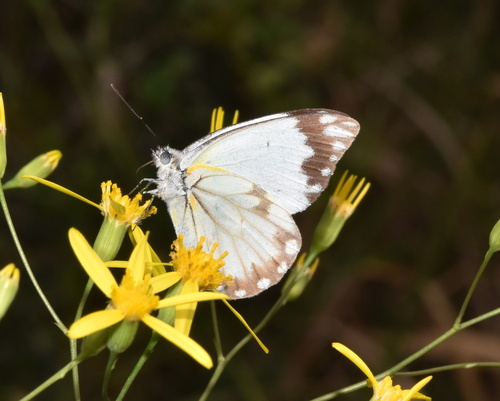
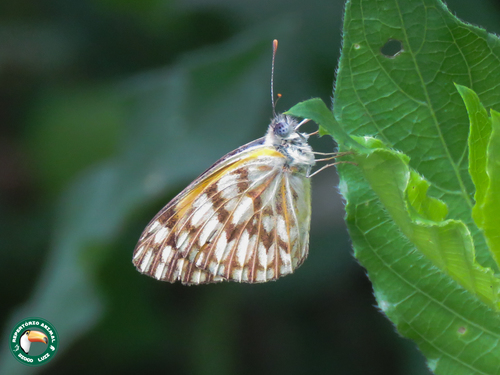
About the Pioneer White

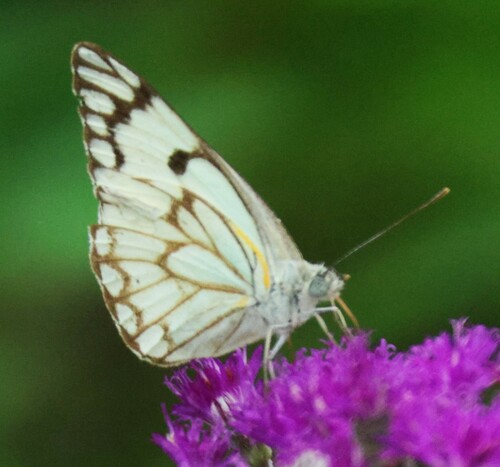
Belenois aurota, the pioneer or pioneer white or caper white, is a small to medium-sized butterfly of the family Pieridae—that is, the yellows and whites—which is found in South Asia, West Asia and Africa. In Africa, it is also known as the brown-veined white, and is well known during summer and autumn when large numbers migrate north-east over the interior.

The upperside of males is white with the forewing having the costa from base to base of vein 11 dusky black and then jet black continuing into a widened and curving short streak along the discocellulars to the lower apex of the cell; apical area diagonally with the termen black, the former with six elongate outwardly pointed spots of the ground colour enclosed one in each of the interspaces 3, 4, 5, 6, 8, and 9. Hindwing: uniform, the black along the venation on the underside seen through by transparency; termen between veins 2 and 6 somewhat broadly black, with a series of four round spots of the ground colour in the interspaces; below vein 2 and above vein 6 the termen is very narrowly black. Underside: forewing white, markings similar, more clearly defined, the white spots within the black... Wikipedia →
Global Distribution

Parks Where Found

# Park Country Daily sighting probability
1 Waterberg Plateau Park 🇳🇦 Namibia
~50%
2 Ruaha National Park 🇹🇿 Tanzania
~40%
3 Kgalagadi Transfrontier Park 🇿🇦 South Africa
~30%
4 Gonarezhou National Park 🇿🇼 Zimbabwe
~30%
5 Nairobi National Park 🇰🇪 Kenya
~30%
6 Moremi Game Reserve 🇧🇼 Botswana
~20%
7 Lake Mburo National Park 🇺🇬 Uganda
~20%
8 Golden Gate Highlands National Park 🇿🇦 South Africa
~20%
9 Tsavo East National Park 🇰🇪 Kenya
~20%
10 Keoladeo National Park 🇮🇳 India
~20%
11 Namib-Naukluft National Park 🇳🇦 Namibia
~20%
12 Etosha National Park 🇳🇦 Namibia
~20%
13 Ranthambore National Park 🇮🇳 India
~20%
14 uMkhuze Game Reserve 🇿🇦 South Africa
~20%
15 Pilanesberg National Park 🇿🇦 South Africa
~20%
16 Tarangire National Park 🇹🇿 Tanzania
~10%
17 Kruger National Park 🇿🇦 South Africa
~10%
18 Chobe National Park 🇧🇼 Botswana
~10%
19 Hluhluwe-Imfolozi Park 🇿🇦 South Africa
~10%
20 Masai Mara National Reserve 🇰🇪 Kenya
~10%
21 Serengeti National Park 🇹🇿 Tanzania
~10%
22 iSimangaliso Wetland Park 🇿🇦 South Africa
~10%
23 Addo Elephant National Park 🇿🇦 South Africa
~10%
24 Garden Route National Park 🇿🇦 South Africa
<5%

Cities Where Found

# City Country Daily sighting probability
1 Jodhpur 🇮🇳 India
~40%
2 Serrekunda 🇬🇲 Gambia
~30%
3 New Delhi 🇮🇳 India
~30%
4 Hyderabad 🇮🇳 India
~30%
5 Kanpur 🇮🇳 India
~30%
6 Agra 🇮🇳 India
~20%
7 Salem 🇮🇳 India
~20%
8 Jabalpur 🇮🇳 India
~20%
9 Pune 🇮🇳 India
~20%
10 Coimbatore 🇮🇳 India
~20%

Before you go

What are the chances of seeing a Pioneer White in Lake Mburo National Park?

Possible

About 20% of wildlife watchers report a Pioneer White sighting in Lake Mburo National Park on a given day, based on 7 verified sightings from GBIF citizen-science data from 2019 to 2026. It is the 7th most-seen of the 12 insects we can rate there. Over three days the chance rises to about 60%, and over a week to about 90%, if each day is a fresh chance.

When is the best time to see a Pioneer White in Lake Mburo National Park?

January, April and November

In those months about 40% of wildlife watchers report a Pioneer White in Lake Mburo National Park on a given day, against under 5% in March and July–August, the lowest months.

What time of day is best to see a Pioneer White?

Between 9 am and noon

Across all the parks we cover, that three-hour window holds the most Pioneer White sightings with a recorded time, and about 9 in 10 of them come between 6 am and 6 pm: it is a daytime animal.

Where does the Pioneer White sighting chance come from?

GBIF citizen-science records

It is estimated from how often the Pioneer White is recorded against all the insects logged in Lake Mburo National Park (7 verified sightings from 2019 to 2026), calibrated against known sighting rates. Figures are rounded to the nearest 10% because citizen-science data supports honest approximations, not decimals, and months with records from fewer than five people show "—". How it works.

← Back to Lake Mburo National Park