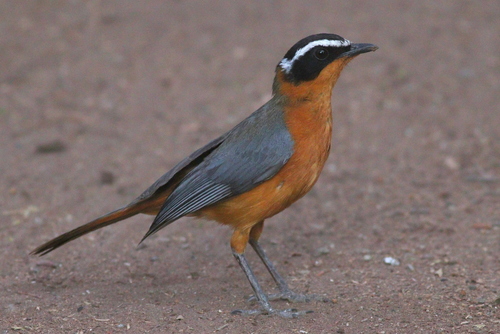
Cape Robin-Chat

Cape Robin-Chat

Dessonornis caffer

Silhouette: Martin Bulla, based on François Desbordes' illustration · PhyloPic

Daily sighting probability ~10% · With luck
at Lake Nakuru National Park

In 3 days ~20% in a week ~30%

55 Verified sightings at Lake Nakuru National Park From 2019 to 2026
9,138 In all 20 parks
February Best month
☀️ Diurnal When it's spotted

About the Cape Robin-Chat

The Cape robin-chat (Dessonornis caffer) is a small passerine bird of the Old World flycatcher family Muscicapidae. It has a disjunct range from South Sudan to South Africa. The locally familiar and confiding species has colonized and benefited from a range of man-altered habitats, including city suburbs and farmstead woodlots. It is an accomplished songster like other robin-chats, but is rather less colourful than most, and frequents either drier settings or higher altitudes. It forages in the proximity of cover, in the open or in fairly well-lit environments. Its distribution resembles that of the karoo–olive complex of thrushes, but it prefers the bracken-briar fringes of Afromontane forest, and does not enter far into forest proper. It is altitudinally segregated from the red-capped robin-chat, and is less of a skulker.

The Cape robin-chat was formally described in 1771 by the Swedish naturalist Carl Linnaeus under the binomial name Motacilla caffra. He specified the type locality as the Cape of Good Hope. The specific epithet caffra is Modern Latin for South Africa. The Cape robin-chat was formerly assigned to the genus Cossypha but is now one of four species placed... Wikipedia →

Sounds

Song0:53

Kenya · 2024

© Peter Boesman · XC948123 · CC BY-NC-ND 4.0

Call0:41

Namibia · 2019

© Meena Haribal · XC613461 · CC BY-NC-SA 4.0

Song0:40

South Africa · 2021

© Tim Cockcroft · XC667013 · CC BY-NC-SA 4.0

Global Distribution

Parks Where Found

# Park Country Daily sighting probability
1 De Hoop Nature Reserve 🇿🇦 South Africa
~60%
2 Table Mountain National Park 🇿🇦 South Africa
~60%
3 Golden Gate Highlands National Park 🇿🇦 South Africa
~50%
4 Aberdare National Park 🇰🇪 Kenya
~50%
5 Volcanoes National Park 🇷🇼 Rwanda
~50%
6 Garden Route National Park 🇿🇦 South Africa
~40%
7 West Coast National Park 🇿🇦 South Africa
~40%
8 Nairobi National Park 🇰🇪 Kenya
~40%
9 Addo Elephant National Park 🇿🇦 South Africa
~30%
10 Arusha National Park 🇹🇿 Tanzania
~30%
11 Nyungwe National Park 🇷🇼 Rwanda
~20%
12 Ngorongoro Conservation Area 🇹🇿 Tanzania
~20%
13 Virunga National Park 🇨🇩 Democratic Republic of the Congo
~20%
14 Mkomazi National Park 🇹🇿 Tanzania
~10%
15 Lake Nakuru National Park 🇰🇪 Kenya
~10%
16 Pilanesberg National Park 🇿🇦 South Africa
<5%
17 Masai Mara National Reserve 🇰🇪 Kenya
<5%
18 iSimangaliso Wetland Park 🇿🇦 South Africa
<5%
19 Kruger National Park 🇿🇦 South Africa
<5%
20 Serengeti National Park 🇹🇿 Tanzania
<5%

Cities Where Found

# City Country Daily sighting probability
1 Johannesburg 🇿🇦 South Africa
~60%
2 Pretoria 🇿🇦 South Africa
~60%
3 Cape Town 🇿🇦 South Africa
~40%
4 Nairobi 🇰🇪 Kenya
~20%
5 Durban 🇿🇦 South Africa
<5%

Zoos & Centres Where Found

# Zoo / Centre Country
1 Hong Kong Zoological and Botanical Gardens 🇨🇳 China In captivity
2 Edward Youde Aviary 🇭🇰 Hong Kong SAR China In captivity

Before you go

What are the chances of seeing a Cape Robin-Chat in Lake Nakuru National Park?

With luck

About 10% of wildlife watchers report a Cape Robin-Chat sighting in Lake Nakuru National Park on a given day, based on 55 verified sightings from GBIF citizen-science data from 2019 to 2026. It is the 196th most-seen of the 369 birds we can rate there. Over three days the chance rises to about 20%, and over a week to about 30%, if each day is a fresh chance.

When is the best time to see a Cape Robin-Chat in Lake Nakuru National Park?

July and December–March

In those months about 10% of wildlife watchers report a Cape Robin-Chat in Lake Nakuru National Park on a given day, against under 5% in April–June and August–November, the lowest months.

What time of day is best to see a Cape Robin-Chat?

Between 10 am and 1 pm

Across all the parks we cover, that three-hour window holds the most Cape Robin-Chat sightings with a recorded time, and about 9 in 10 of them come between 6 am and 6 pm: it is a daytime animal.

Where does the Cape Robin-Chat sighting chance come from?

GBIF citizen-science records

It is estimated from how often the Cape Robin-Chat is recorded against all the birds logged in Lake Nakuru National Park (55 verified sightings from 2019 to 2026), calibrated against known sighting rates. Figures are rounded to the nearest 10% because citizen-science data supports honest approximations, not decimals, and months with records from fewer than five people show "—". How it works.

← Back to Lake Nakuru National Park