
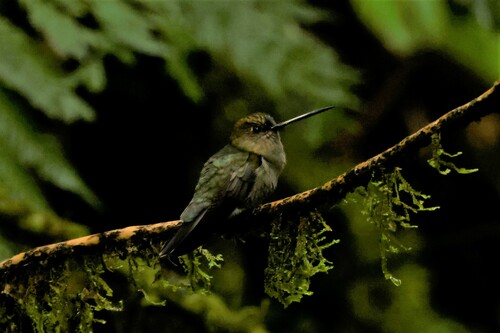
Purple-throated Mountain-gem

Purple-throated Mountain-gem

Lampornis calolaemus

Silhouette: Ferran Sayol · PhyloPic

LCLeast ConcernNTVUENCR
Daily sighting probability <5% · Rare
at Los Quetzales National Park

In 3 days <5%

8 Verified sightings at Los Quetzales National Park From 2019 to 2026
11,907 In all 11 parks
April Best month
☀️ Diurnal When it's spotted

About the Purple-throated Mountain-gem

The purple-throated mountaingem (Lampornis calolaemus) is a species of hummingbird in tribe Lampornithini of subfamily Trochilinae. It is found in Costa Rica, Nicaragua, and Panama. The purple-throated mountaingem's taxonomy is somewhat unsettled. As late as 1999 various authors have treated it, the white-throated mountaingem (L. castaneoventris) and gray-tailed mountaingem (L. cinereicauda) as a single species. Others have kept the purple-throated separate but lumped the other two as a single species. These three species form a closely related group that evolved some 3.5 million years ago and has diversified since.

The purple-throated mountaingem is 10 to 11.5 cm (3.9 to 4.5 in) long and weighs 4.5 to 6 g (0.16 to 0.21 oz). Both sexes of all subspecies have a medium-length straight black bill, a white to pale buff stripe behind the eye, and a fairly long tail.

Adult males of the nominate subspecies L. c. calolaemus have a glittering emerald green to bluish green forehead and... Wikipedia →

Sounds

Call0:12

Costa Rica · 2013

© Paul Driver · XC137807 · CC BY-NC-SA 3.0

Global Distribution

Parks Where Found

# Park Country Daily sighting probability
1 Monteverde Cloud Forest Reserve 🇨🇷 Costa Rica
~50%
2 Poás Volcano National Park 🇨🇷 Costa Rica
~20%
3 Braulio Carrillo National Park 🇨🇷 Costa Rica
~20%
4 Volcán Barú National Park 🇵🇦 Panama
~10%
5 Tapantí-Macizo de la Muerte National Park 🇨🇷 Costa Rica
~10%
6 Irazú Volcano National Park 🇨🇷 Costa Rica
~10%
7 La Amistad International Park (Panama) 🇵🇦 Panama
<5%
8 Arenal Volcano National Park 🇨🇷 Costa Rica
<5%
9 Rincón de la Vieja National Park 🇨🇷 Costa Rica
<5%
10 Tenorio Volcano National Park 🇨🇷 Costa Rica
<5%
11 Los Quetzales National Park 🇨🇷 Costa Rica
<5%

Cities Where Found

# City Country Daily sighting probability
1 San José 🇨🇷 Costa Rica
<5%

Zoos & Centres Where Found

# Zoo / Centre Country
1 La Paz Waterfall Gardens 🇨🇷 Costa Rica In captivity

Before you go

What are the chances of seeing a Purple-throated Mountain-gem in Los Quetzales National Park?

Rare

Under 5% of wildlife watchers report a Purple-throated Mountain-gem sighting in Los Quetzales National Park on a given day, based on 8 verified sightings from GBIF citizen-science data from 2019 to 2026. It is the 232nd most-seen of the 252 birds we can rate there. Over three days the chance rises to under 5%, if each day is a fresh chance.

When is the best time to see a Purple-throated Mountain-gem in Los Quetzales National Park?

Any time of year

In every month with enough records, under 5% of wildlife watchers report a Purple-throated Mountain-gem in Los Quetzales National Park on a given day, so our monthly data shows no clear season.

What time of day is best to see a Purple-throated Mountain-gem?

Between 10 am and 1 pm

Across all the parks we cover, that three-hour window holds the most Purple-throated Mountain-gem sightings with a recorded time, and about 8 in 10 of them come between 6 am and 6 pm: it is a daytime animal.

Which relatives of the Purple-throated Mountain-gem live in Los Quetzales National Park?

Same genus: Lampornis

The closest relatives of the Purple-throated Mountain-gem that you can see in Los Quetzales National Park (genus Lampornis, Mountain-gems) are White-throated Mountain-gem (about 80%) and Gray-tailed Mountain-gem (about 10%), with each one's daily chance of a sighting.

Where does the Purple-throated Mountain-gem sighting chance come from?

GBIF citizen-science records

It is estimated from how often the Purple-throated Mountain-gem is recorded against all the birds logged in Los Quetzales National Park (8 verified sightings from 2019 to 2026), calibrated against known sighting rates. Figures are rounded to the nearest 10% because citizen-science data supports honest approximations, not decimals, and months with records from fewer than five people show "—". How it works.

← Back to Los Quetzales National Park