White-fronted Bee-eater

White-fronted Bee-eater

Merops bullockoides

Silhouette: Sheatherius · PhyloPic

LCLeast ConcernNTVUENCR
Daily sighting probability ~70% · Very likely
at Lower Zambezi National Park

In 3 days >90%

272 Verified sightings at Lower Zambezi National Park From 2019 to 2026
7,315 In all 25 parks
November Best month
☀️ Diurnal When it's spotted

About the White-fronted Bee-eater

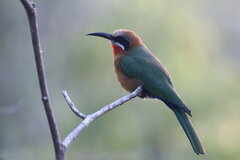
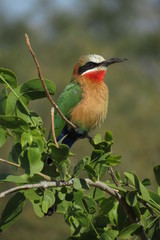
The white-fronted bee-eater (Merops bullockoides) is a species of bee-eater widely distributed in sub-equatorial Africa. The species has a distinctive white forehead, a square tail, and a bright red patch on its throat. It nests in small colonies, digging holes in cliffs or earthen banks, and can usually be seen in low trees, waiting to hunt passing insects by making quick hawking flights or gliding down before hovering briefly to catch the prey.

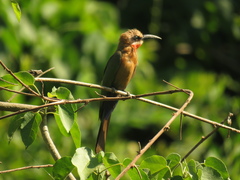
This species, like other bee-eaters, is a richly coloured, slender bird, but with a distinctive black mask, white forehead, square tail and a bright red throat. The size is 23 cm (9 in.). The upperparts are green, with cinnamon underparts. The call is a deep squeak.

White-fronted bee-eaters are found in the vast savannah regions of sub-equatorial Africa. The habitat commonly consists of open country, often near gullies, where bees, their prey, live. White-fronted bee-eaters nest in colonies averaging 200 individuals, digging, roosting, and nesting holes in cliffs or banks of earth. A population of bee-eaters may range across many square kilometres of savannah... Wikipedia →

Sounds

Call0:36

Botswana · 2023

© Marc Anderson · XC1004801 · CC BY-NC-ND 4.0

Flight call0:04

Zambia · 2020

© Dries Van de Loock · XC584722 · CC BY-NC-SA 4.0

Call0:10

Kenya · 2020

© isaac kilusu · XC607238 · CC BY-NC-SA 4.0

Global Distribution

Parks Where Found

# Park Country Daily sighting probability
1 Lower Zambezi National Park 🇿🇲 Zambia
~70%
2 Mana Pools National Park 🇿🇼 Zimbabwe
~70%
3 South Luangwa National Park 🇿🇲 Zambia
~70%
4 Gonarezhou National Park 🇿🇼 Zimbabwe
~70%
5 Selous Game Reserve 🇹🇿 Tanzania
~40%
6 Kafue National Park 🇿🇲 Zambia
~40%
7 Lake Nakuru National Park 🇰🇪 Kenya
~40%
8 Arusha National Park 🇹🇿 Tanzania
~40%
9 Kruger National Park 🇿🇦 South Africa
~40%
10 Hluhluwe-Imfolozi Park 🇿🇦 South Africa
~30%
11 Chobe National Park 🇧🇼 Botswana
~20%
12 Pilanesberg National Park 🇿🇦 South Africa
~10%
13 Hwange National Park 🇿🇼 Zimbabwe
~10%
14 Addo Elephant National Park 🇿🇦 South Africa
~10%
15 uMkhuze Game Reserve 🇿🇦 South Africa
~10%
16 Moremi Game Reserve 🇧🇼 Botswana
~10%
17 Masai Mara National Reserve 🇰🇪 Kenya
<5%
18 Gorongosa National Park 🇲🇿 Mozambique
<5%
19 iSimangaliso Wetland Park 🇿🇦 South Africa
<5%
20 Lake Manyara National Park 🇹🇿 Tanzania
<5%
21 Tarangire National Park 🇹🇿 Tanzania
<5%
22 Amboseli National Park 🇰🇪 Kenya
<5%
23 Tsavo West National Park 🇰🇪 Kenya
<5%
24 Ngorongoro Conservation Area 🇹🇿 Tanzania
<5%
25 Serengeti National Park 🇹🇿 Tanzania
<5%

Cities Where Found

# City Country Daily sighting probability
1 Pretoria 🇿🇦 South Africa
<5%

Zoos & Centres Where Found

# Zoo / Centre Country
1 San Diego Zoo 🇺🇸 United States In captivity
2 San Diego Zoo Safari Park 🇺🇸 United States In captivity
3 Bronx Zoo 🇺🇸 United States In captivity
4 Berlin Zoological Garden 🇩🇪 Germany In captivity
5 Wilhelma 🇩🇪 Germany In captivity
6 Tierpark Hagenbeck 🇩🇪 Germany In captivity
7 Cologne Zoological Garden 🇩🇪 Germany In captivity
8 Schönbrunn Zoo 🇦🇹 Austria In captivity
9 Aquarium Berlin 🇩🇪 Germany In captivity
10 Cologne Zoo Aquarium 🇩🇪 Germany In captivity

Before you go

What are the chances of seeing a White-fronted Bee-eater in Lower Zambezi National Park?

Very likely

About 70% of wildlife watchers report a White-fronted Bee-eater sighting in Lower Zambezi National Park on a given day, based on 272 verified sightings from GBIF citizen-science data from 2019 to 2026. It is the most-seen of the 241 birds we can rate there. Over three days the chance rises to over 90%, if each day is a fresh chance.

When is the best time to see a White-fronted Bee-eater in Lower Zambezi National Park?

November

In that month about 90% of wildlife watchers report a White-fronted Bee-eater in Lower Zambezi National Park on a given day, against about 60% in October and December, the lowest months. February and March have too few records to rate.

What time of day is best to see a White-fronted Bee-eater?

Between 9 am and noon

Across all the parks we cover, that three-hour window holds the most White-fronted Bee-eater sightings with a recorded time, and about 9 in 10 of them come between 6 am and 6 pm: it is a daytime animal.

Is Lower Zambezi National Park the best place to see a White-fronted Bee-eater?

Yes

Of the 25 parks where we can rate White-fronted Bee-eater sightings, Lower Zambezi National Park has the highest daily chance: about 70%. Next come Mana Pools National Park (Zimbabwe, about 70%) and South Luangwa National Park (Zambia, about 70%). All parks ranked.

Which relatives of the White-fronted Bee-eater live in Lower Zambezi National Park?

Same genus: Merops

The closest relatives of the White-fronted Bee-eater that you can see in Lower Zambezi National Park (genus Merops, Typical Bee-eaters) are Little Bee-eater (about 60%), Southern Carmine Bee-eater (about 30%) and Swallow-tailed Bee-eater (about 10%), with each one's daily chance of a sighting.

Where does the White-fronted Bee-eater sighting chance come from?

GBIF citizen-science records

It is estimated from how often the White-fronted Bee-eater is recorded against all the birds logged in Lower Zambezi National Park (272 verified sightings from 2019 to 2026), calibrated against known sighting rates. Figures are rounded to the nearest 10% because citizen-science data supports honest approximations, not decimals, and months with records from fewer than five people show "—". How it works.

← Back to Lower Zambezi National Park