Blue-winged Parrotlet

Blue-winged Parrotlet

Forpus xanthopterygius

Silhouette: Sheatherius · PhyloPic

LCLeast ConcernNTVUENCR
Daily sighting probability ~10% · With luck
at Madidi National Park

In 3 days ~30% in a week ~60%

24 Verified sightings at Madidi National Park From 2019 to 2026
1,870 In all 10 parks
October Best month
☀️ Diurnal When it's spotted

About the Blue-winged Parrotlet

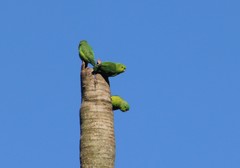
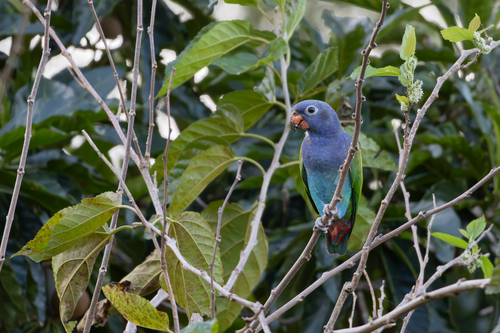
The cobalt-rumped parrotlet (Forpus xanthopterygius) or blue-winged parrotlet is a species of parrot in the family Psittacidae. Cobalt-rumped parrotlets are found in much of central and northern South America. Their range is split by each subspecies, as described above. It is generally common and widespread, though more localized in the Amazon Basin.

Cobalt-rumped parrotlets are mainly found in lowlands. They occur in dry and riparian woodlands, cerrado, caatinga, palm groves, semi-arid scrubland, savanna, and pastures. Cobalt-rumped parrotlets tend to avoid densely forested areas. They are not found at altitudes above 1,200 metres (3,900 ft).

Cobalt-rumped parrotlets are generally non-migratory; however, populations in Argentina move locally according to the flowering seasons of various plant species in their diet. Populations in the Brazilian Atlantic Forest are altitudinal migrants.

The number of cobalt-rumped parrotlets is unknown, but the population is stable. It is listed...

Wikipedia →

Sounds

Call0:25

Argentina · 2024

© Marcos E. Sosa · XC1078096 · CC BY-NC-SA 4.0

Song0:09

Brazil · 2023

© JAYRSON ARAUJO DE OLIVEIRA · XC840181 · CC BY-NC-SA 4.0

Flight call0:12

Brazil · 2019

© Fernando Igor de Godoy · XC705463 · CC BY-NC-SA 4.0

Global Distribution

Parks Where Found

# Park Country Daily sighting probability
1 Itatiaia National Park 🇧🇷 Brazil
~20%
2 Chapada dos Guimarães National Park 🇧🇷 Brazil
~20%
3 Serra da Canastra National Park 🇧🇷 Brazil
~20%
4 Madidi National Park 🇧🇴 Bolivia
~10%
5 Iguaçu National Park 🇧🇷 Brazil
~10%
6 Iguazú National Park 🇦🇷 Argentina
~10%
7 Serra dos Órgãos National Park 🇧🇷 Brazil
~10%
8 Chapada Diamantina National Park 🇧🇷 Brazil
<5%
9 Yasuní National Park 🇪🇨 Ecuador
<5%
10 Cuyabeno Wildlife Reserve 🇪🇨 Ecuador
<5%

Cities Where Found

# City Country Daily sighting probability
1 Santa Cruz de la Sierra 🇧🇴 Bolivia
~40%
2 Campinas 🇧🇷 Brazil
~30%
3 Santos 🇧🇷 Brazil
~30%
4 Asuncion 🇵🇾 Paraguay
~20%
5 João Pessoa 🇧🇷 Brazil
~20%
6 São Paulo 🇧🇷 Brazil
~20%
7 Belo Horizonte 🇧🇷 Brazil
~10%
8 Barranquilla 🇨🇴 Colombia
~10%
9 Goiânia 🇧🇷 Brazil
~10%
10 Campo Grande 🇧🇷 Brazil
~10%

Before you go

What are the chances of seeing a Blue-winged Parrotlet in Madidi National Park?

With luck

About 10% of wildlife watchers report a Blue-winged Parrotlet sighting in Madidi National Park on a given day, based on 24 verified sightings from GBIF citizen-science data from 2019 to 2026. It is the 96th most-seen of the 239 birds we can rate there. Over three days the chance rises to about 30%, and over a week to about 60%, if each day is a fresh chance.

When is the best time to see a Blue-winged Parrotlet in Madidi National Park?

January, April and September–October

In those months about 20% of wildlife watchers report a Blue-winged Parrotlet in Madidi National Park on a given day, against about 10% in February, May–August and November, the lowest months. March and December have too few records to rate.

What time of day is best to see a Blue-winged Parrotlet?

Between 8 and 11 am

Across all the parks we cover, that three-hour window holds the most Blue-winged Parrotlet sightings with a recorded time, and nearly all of them come between 6 am and 6 pm: it is a daytime animal.

Where does the Blue-winged Parrotlet sighting chance come from?

GBIF citizen-science records

It is estimated from how often the Blue-winged Parrotlet is recorded against all the birds logged in Madidi National Park (24 verified sightings from 2019 to 2026), calibrated against known sighting rates. Figures are rounded to the nearest 10% because citizen-science data supports honest approximations, not decimals, and months with records from fewer than five people show "—". How it works.

← Back to Madidi National Park