
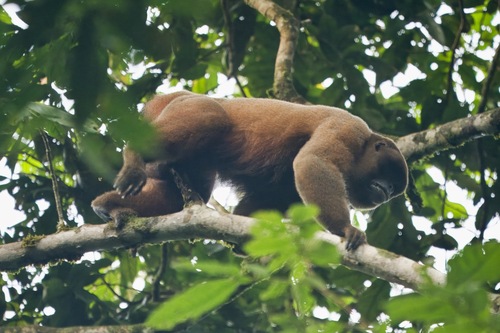
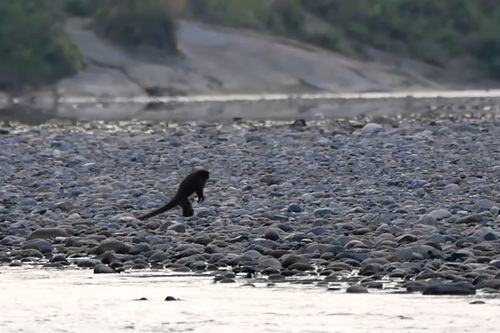
Bolivian Red Howler Monkey

Bolivian Red Howler Monkey

Alouatta sara

Silhouette: PhyloPic

LCNTNear ThreatenedVUENCR
Daily sighting probability ~20% · Possible
at Manu National Park

In 3 days ~50% in a week ~80%

32 Verified sightings at Manu National Park From 2019 to 2026
65 In all 2 parks
September Best month
☀️ Diurnal When it's spotted

About the Bolivian Red Howler Monkey

The Bolivian red howler (Alouatta sara) is a species of howler monkey, a type of New World monkey, endemic to Bolivia. It can be found in rain forests, including riverine and seasonally flooded forests. The Bolivian red howler is a part of the Atelidae; Atelidae are a subfamily of New World monkey, which includes the various spider and woolly monkeys. They are covered in reddish orange hair. The red howler are found only in neotropical South America in places like Bolivia, Brazil, Colombia, Ecuador, French Guiana, Guyana, Perú, Suriname, Trinidad and Tobago, and Venezuela. They extend from northwest Colombia east and south to the Amazon River in eastern Brazil. They can be largely found in tropical forests, as well as in riverine and seasonally swamped woodlands and in forests above 1000 meters (3280 feet) above sea level, humid and dry forest high terra firma. They stay in the high altitudes.

The adult Bolivian red howler has a well-built body that is capable of attaining a maximum body length. Red howler monkeys have a muscular, prehensile tail that enables them to grasp branches or even swing from them. The males are about 20.6 -22.4 inches... Wikipedia →

Sounds

Recording0:36

Peru · 2010

© dbeadle · iNaturalist · CC BY-NC 4.0

Recording0:27

Bolivia · 2025

© Carlos Justiniano Parada · iNaturalist · CC BY-NC 4.0

Recording0:30

Peru · 2024

© Hubert Szczygieł · iNaturalist · CC BY-NC 4.0

Global Distribution

Parks Where Found

# Park Country Daily sighting probability
1 Tambopata National Reserve 🇵🇪 Peru
~20%
2 Manu National Park 🇵🇪 Peru
~20%

Zoos & Centres Where Found

# Zoo / Centre Country
1 ZooParc de Beauval 🇫🇷 France In captivity
2 Tierpark Berlin 🇩🇪 Germany In captivity
3 Senda Verde (Wildlife Sanctuary) 🇧🇴 Bolivia In captivity
4 Zoológico de Fauna Sudamericana 🇧🇴 Bolivia In captivity

Before you go

What are the chances of seeing a Bolivian Red Howler Monkey in Manu National Park?

Possible

About 20% of wildlife watchers report a Bolivian Red Howler Monkey sighting in Manu National Park on a given day, based on 32 verified sightings from GBIF citizen-science data from 2019 to 2026. It is the 11th most-seen of the 42 mammals we can rate there. Over three days the chance rises to about 50%, and over a week to about 80%, if each day is a fresh chance.

When is the best time to see a Bolivian Red Howler Monkey in Manu National Park?

September

In that month about 40% of wildlife watchers report a Bolivian Red Howler Monkey in Manu National Park on a given day, against under 5% in May and December, the lowest months. That is one of Manu National Park's driest months, with about 90 mm of rain against 290 mm in February.

What time of day is best to see a Bolivian Red Howler Monkey?

Between 3 and 6 pm

Across all the parks we cover, that three-hour window holds the most Bolivian Red Howler Monkey sightings with a recorded time, and about 8 in 10 of them come between 6 am and 6 pm: it is a daytime animal.

Is Manu National Park the best place to see a Bolivian Red Howler Monkey?

Among the best

Of the 2 parks where we can rate Bolivian Red Howler Monkey sightings, Manu National Park ranks 2nd at about 20%, level with the leaders once rounded. The best odds are in Tambopata National Reserve (Peru, about 20%).

Where does the Bolivian Red Howler Monkey sighting chance come from?

GBIF citizen-science records

It is estimated from how often the Bolivian Red Howler Monkey is recorded against all the mammals logged in Manu National Park (32 verified sightings from 2019 to 2026), calibrated against known sighting rates. Figures are rounded to the nearest 10% because citizen-science data supports honest approximations, not decimals, and months with records from fewer than five people show "—". How it works.

← Back to Manu National Park