
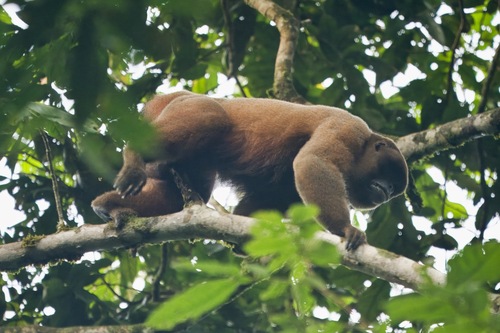
Colombian Red Howler Monkey

Colombian Red Howler Monkey

Alouatta seniculus

Silhouette: PhyloPic

LCLeast ConcernNTVUENCR
Daily sighting probability ~20% · Possible
at Manu National Park

In 3 days ~50% in a week ~80%

28 Verified sightings at Manu National Park From 2019 to 2026
386 In all 7 parks
August Best month
☀️ Diurnal When it's spotted

About the Colombian Red Howler Monkey

The Colombian red howler or Venezuelan red howler (Alouatta seniculus) is a South American species of howler monkey, a type of New World monkey, found in the western Amazon Basin in Venezuela, Colombia, Ecuador, Peru and Brazil. The population in the Santa Cruz Department in Bolivia was split off as a separate species, the Bolivian red howler, in 1986, and more recently, splitting off the population in northeastern South America and Trinidad as the Guyanan red howler has occurred. All howler monkeys belong to the family Atelidae and the infraorder Platyrrhini (New World monkeys).

Sexual dimorphism in this species is small; males range from 49 to 72 cm and females from 46 to 57 cm long. The males weigh 5.4–9 kg, while females weigh 4.2–7 kg. It has a long prehensile tail of 49–75 cm. The tail is covered with fur except for the last third of the underside, which allows it to grab branches. The color of both males and females is a deep reddish-brown, and the color shade changes with age. Their faces are surrounded by fur and they have stubby noses.

The jawbone of the red howler monkey is large, especially the body of the mandible. The position of the foramen magnum... Wikipedia →

Sounds

Call0:29

Ecuador · 2025

© Marc Anderson · XC979159 · CC BY-NC-ND 4.0

Recording0:26

Brazil · 2025

© michelepaulo · iNaturalist · CC BY-NC 4.0

Recording0:05

Colombia · 2025

© Moses J. Michelsohn · iNaturalist · CC BY-NC 4.0

Global Distribution

Parks Where Found

# Park Country Daily sighting probability
1 Tayrona National Natural Park 🇨🇴 Colombia
~70%
2 Sierra de la Macarena National Park 🇨🇴 Colombia
~50%
3 Cuyabeno Wildlife Reserve 🇪🇨 Ecuador
~50%
4 Yasuní National Park 🇪🇨 Ecuador
~50%
5 Manu National Park 🇵🇪 Peru
~20%
6 Tambopata National Reserve 🇵🇪 Peru
~20%
7 Los Nevados National Natural Park 🇨🇴 Colombia
~10%

Zoos & Centres Where Found

# Zoo / Centre Country
1 Dublin Zoo 🇮🇪 Ireland In captivity
2 Dresden Zoo 🇩🇪 Germany In captivity
3 Nanjing Hongshan Forest Zoo 🇨🇳 China In captivity
4 Yorkshire Wildlife Park 🇬🇧 United Kingdom In captivity
5 Night Safari 🇸🇬 Singapore In captivity
6 Singapore Zoo 🇸🇬 Singapore In captivity
7 Cologne Zoological Garden 🇩🇪 Germany In captivity
8 Apenheul Primate Park 🇳🇱 Netherlands In captivity
9 Vogelpark Avifauna 🇳🇱 Netherlands In captivity
10 River Wonders 🇸🇬 Singapore In captivity
11 Parque de la Conservación 🇨🇴 Colombia In captivity
12 Arequipa zoo 🇵🇪 Peru In captivity
13 zoologico de barranquilla 🇨🇴 Colombia In captivity
14 Cologne Zoo Aquarium 🇩🇪 Germany In captivity

Before you go

What are the chances of seeing a Colombian Red Howler Monkey in Manu National Park?

Possible

About 20% of wildlife watchers report a Colombian Red Howler Monkey sighting in Manu National Park on a given day, based on 28 verified sightings from GBIF citizen-science data from 2019 to 2026. It is the 13th most-seen of the 42 mammals we can rate there. Over three days the chance rises to about 50%, and over a week to about 80%, if each day is a fresh chance.

When is the best time to see a Colombian Red Howler Monkey in Manu National Park?

July–August and December

In those months about 30% of wildlife watchers report a Colombian Red Howler Monkey in Manu National Park on a given day, against under 5% in February, the lowest month.

What time of day is best to see a Colombian Red Howler Monkey?

Between 8 and 11 am

Across all the parks we cover, that three-hour window holds the most Colombian Red Howler Monkey sightings with a recorded time, and about 9 in 10 of them come between 6 am and 6 pm: it is a daytime animal.

Where does the Colombian Red Howler Monkey sighting chance come from?

GBIF citizen-science records

It is estimated from how often the Colombian Red Howler Monkey is recorded against all the mammals logged in Manu National Park (28 verified sightings from 2019 to 2026), calibrated against known sighting rates. Figures are rounded to the nearest 10% because citizen-science data supports honest approximations, not decimals, and months with records from fewer than five people show "—". How it works.

← Back to Manu National Park