Black-headed Night Monkey

Black-headed Night Monkey

Aotus nigriceps

Silhouette: E. Lear, 1819 (vectorization by Yan Wong) · PhyloPic

LCLeast ConcernNTVUENCR
Daily sighting probability ~20% · Possible
at Manu National Park

In 3 days ~50% in a week ~80%

33 Verified sightings at Manu National Park From 2019 to 2026
53 In all 2 parks
July Best month
🌅 Crepuscular When it's spotted

About the Black-headed Night Monkey

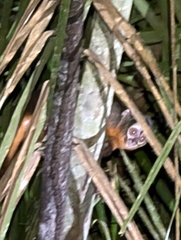
The black-headed night monkey (Aotus nigriceps) is a night monkey species from South America. It is found in Brazil, Bolivia and Peru. The A. nigriceps in Peru were notably inhabiting areas that were degraded, and often these areas were disturbed either by human activities or natural occurrences in the ecosystem. A black-headed night monkey is about the same size as a small squirrel. Black-headed night monkeys have small ears that are hidden by their fur. When they become adults they are about 750g and usually are about 14 months old. Black-headed night monkeys have three black stripes that meet on their forehead. These monkeys have white patches by their eyes, cheeks, and under their mouth. Their eyes are very large and brown.

A newborn usually weighs about 90 to 150g. Sexual maturity for males is at 2 years and for females is about 3 or 4 years. They occur in between August and February. A female only gives birth to one infant each year. The males are the primary care givers to the infants. The female starts biting the infants feet or tail about 2 weeks after so they go with the male and about 8 weeks they start to leave them.

Black-headed night monkeys... Wikipedia →

Sounds

Call1:01

Bolivia · 2021

© Jacob Wijpkema · XC998051 · CC BY-NC-SA 4.0

Global Distribution

Parks Where Found

# Park Country Daily sighting probability
1 Manu National Park 🇵🇪 Peru
~20%
2 Tambopata National Reserve 🇵🇪 Peru
~20%

Before you go

What are the chances of seeing a Black-headed Night Monkey in Manu National Park?

Possible

About 20% of wildlife watchers report a Black-headed Night Monkey sighting in Manu National Park on a given day, based on 33 verified sightings from GBIF citizen-science data from 2019 to 2026. It is the 10th most-seen of the 42 mammals we can rate there. Over three days the chance rises to about 50%, and over a week to about 80%, if each day is a fresh chance.

When is the best time to see a Black-headed Night Monkey in Manu National Park?

May–July and December

In those months about 30% of wildlife watchers report a Black-headed Night Monkey in Manu National Park on a given day, against under 5% in February and April, the lowest months.

What time of day is best to see a Black-headed Night Monkey?

Between 5 and 8 pm

Across all the parks we cover, that three-hour window holds the most Black-headed Night Monkey sightings with a recorded time, and about 6 in 10 of them come between 6 pm and 6 am: it is most active around dawn and dusk.

Is Manu National Park the best place to see a Black-headed Night Monkey?

Yes

Of the 2 parks where we can rate Black-headed Night Monkey sightings, Manu National Park has the highest daily chance: about 20%. Next come Tambopata National Reserve (Peru, about 20%).

Which relatives of the Black-headed Night Monkey live in Manu National Park?

Same order: Primates

The closest relatives of the Black-headed Night Monkey that you can see in Manu National Park (order Primates) are Black-capped Squirrel Monkey (about 50%), Brown Capuchin (about 50%) and Toppin's Titi (about 40%), with each one's daily chance of a sighting.

Where does the Black-headed Night Monkey sighting chance come from?

GBIF citizen-science records

It is estimated from how often the Black-headed Night Monkey is recorded against all the mammals logged in Manu National Park (33 verified sightings from 2019 to 2026), calibrated against known sighting rates. Figures are rounded to the nearest 10% because citizen-science data supports honest approximations, not decimals, and months with records from fewer than five people show "—". How it works.

← Back to Manu National Park