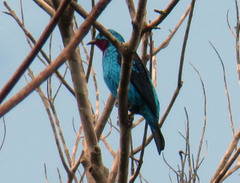
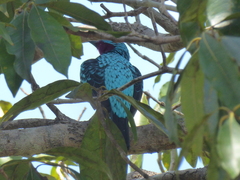
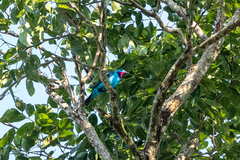
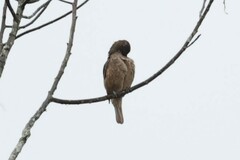
Spangled Cotinga

Spangled Cotinga

Cotinga cayana

Silhouette: Edwin Price · PhyloPic

LCLeast ConcernNTVUENCR
Daily sighting probability <5% · Rare
at Manu National Park

In 3 days <5% in a week ~10%

55 Verified sightings at Manu National Park From 2019 to 2026
655 In all 6 parks
August Best month
☀️ Diurnal When it's spotted

About the Spangled Cotinga

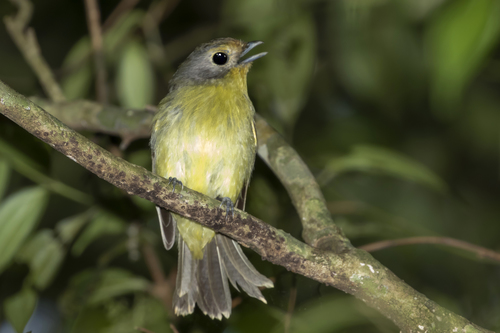
The spangled cotinga (Cotinga cayana) is a species of bird in the family Cotingidae, the cotingas. It is found in the canopy of the Amazon rainforest in South America. Because of their bright, beautiful colours, cotingas have been hunted by native and colonial peoples for their feathers, as well as for food. The feathers of some species are used in making fishing flies and lures. The beauty of these birds draws birdwatchers from around the world and so may add to the local tourist economy.

In 1760 the French zoologist Mathurin Jacques Brisson included a description of the spangled cotinga in his Ornithologie based on a specimen collected in Cayenne in French Guiana. He used the French name Le cotinga de Cayenne and the Latin Cotinga Cayanensis. Although Brisson coined Latin names, these do not conform to the binomial system and are not recognised by the International Commission on Zoological Nomenclature. When in 1766 the Swedish naturalist Carl Linnaeus updated his Systema Naturae for the twelfth edition, he added 240 species that had been previously described by Brisson. One of these was the spangled cotinga. Linnaeus included a brief description, coined the binomial... Wikipedia →

Sounds

Song0:06

Peru · 2000

© Jonas Nilsson · XC275907 · CC BY-NC-SA 4.0

Global Distribution

Parks Where Found

# Park Country Daily sighting probability
1 Yasuní National Park 🇪🇨 Ecuador
~10%
2 Cuyabeno Wildlife Reserve 🇪🇨 Ecuador
~10%
3 Anavilhanas National Park 🇧🇷 Brazil
<5%
4 Brownsberg Nature Park 🇸🇷 Suriname
<5%
5 Manu National Park 🇵🇪 Peru
<5%
6 Tambopata National Reserve 🇵🇪 Peru
<5%

Zoos & Centres Where Found

# Zoo / Centre Country
1 San Diego Zoo 🇺🇸 United States In captivity
2 Denver Zoo 🇺🇸 United States In captivity
3 Zürich Zoo 🇨🇭 Switzerland In captivity
4 Barcelona Zoo 🇪🇸 Spain In captivity
5 San Diego Zoo Safari Park 🇺🇸 United States In captivity
6 Sedgwick County Zoo 🇺🇸 United States In captivity
7 Woodland Park Zoo 🇺🇸 United States In captivity
8 Bird Paradise 🇸🇬 Singapore In captivity
9 Aquarama Barcelona 🇪🇸 Spain In captivity
10 Rainforest Wild Asia 🇸🇬 Singapore In captivity
11 Ralph Perkins II Wildlife Center and Woods Garden 🇺🇸 United States In captivity
12 Seattle Aquarium 🇺🇸 United States In captivity
13 OdySea Aquarium 🇺🇸 United States In captivity
14 Key West Butterfly and Nature Conservatory 🇺🇸 United States In captivity
15 Montreal Biodome 🇨🇦 Canada In captivity
16 Seattle Marine Aquarium 🇺🇸 United States In captivity

Before you go

What are the chances of seeing a Spangled Cotinga in Manu National Park?

Rare

Under 5% of wildlife watchers report a Spangled Cotinga sighting in Manu National Park on a given day, based on 55 verified sightings from GBIF citizen-science data from 2019 to 2026. It is the 432nd most-seen of the 641 birds we can rate there. Over three days the chance rises to under 5%, and over a week to about 10%, if each day is a fresh chance.

When is the best time to see a Spangled Cotinga in Manu National Park?

Any time of year

In every month with enough records, under 5% of wildlife watchers report a Spangled Cotinga in Manu National Park on a given day, so our monthly data shows no clear season.

What time of day is best to see a Spangled Cotinga?

Between 7 and 10 am

Across all the parks we cover, that three-hour window holds the most Spangled Cotinga sightings with a recorded time, and about 9 in 10 of them come between 6 am and 6 pm: it is a daytime animal.

Where does the Spangled Cotinga sighting chance come from?

GBIF citizen-science records

It is estimated from how often the Spangled Cotinga is recorded against all the birds logged in Manu National Park (55 verified sightings from 2019 to 2026), calibrated against known sighting rates. Figures are rounded to the nearest 10% because citizen-science data supports honest approximations, not decimals, and months with records from fewer than five people show "—". How it works.

← Back to Manu National Park