
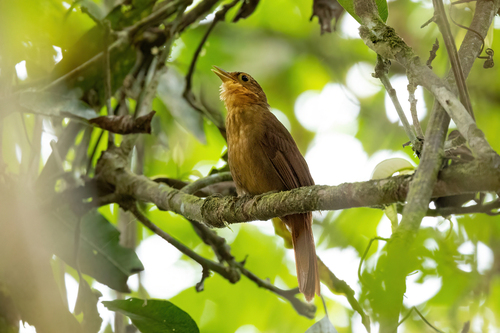
Striped Woodhaunter

Striped Woodhaunter

Hyloctistes subulatus

Silhouette: Sheatherius · PhyloPic

LCLeast ConcernNTVUENCR
Daily sighting probability <5% · Rare
at Manu National Park

In 3 days <5% in a week ~10%

53 Verified sightings at Manu National Park From 2019 to 2026
804 In all 12 parks
December Best month
☀️ Diurnal When it's spotted

About the Striped Woodhaunter

The eastern woodhaunter (Automolus subulatus), also known as the Amazonian woodhaunter, is a species of bird in the Furnariinae subfamily of the ovenbird family Furnariidae. It is found in Bolivia, Brazil, Colombia, Ecuador, Peru, and Venezuela.

At one time what is now the eastern woodhaunter was included in genus Hyloctistes but molecular phylogenetic studies showed that Hyloctistes is embedded within Automolus. Even before the generic merger, the eastern woodhaunter's taxonomy was unsettled, and it remains so. Its two subspecies were included with four others in what was then called the striped woodhaunter. In the early twenty-first century several authors split the four Central American and western South American subspecies from the striped woodhaunter and named the new species the western woodhaunter (then H. virgatus, now A. virgatus). They gave the remaining two subspecies the English name "eastern woodhaunter" and by the principle of priority retained the binomial A. subulatus. By late 2023 the International Ornithological Committee, BirdLife International's Handbook of the Birds of the World (HBW), and the Clements taxonomy had adopted the split... Wikipedia →

Sounds

Song0:57

Ecuador · 2025

© Marco Andrés Urvina Alejandro · XC972683 · CC BY-NC-SA 4.0

Call0:18

Colombia · 2018

© Jerome Fischer · XC449311 · CC BY-NC-SA 4.0

Dawn song1:03

Peru · 2013

© Jacob Socolar · XC146383 · CC BY-NC-SA 3.0

Global Distribution

Parks Where Found

# Park Country Daily sighting probability
1 Arenal Volcano National Park 🇨🇷 Costa Rica
<5%
2 Piedras Blancas National Park 🇨🇷 Costa Rica
<5%
3 Braulio Carrillo National Park 🇨🇷 Costa Rica
<5%
4 Amacayacu National Natural Park 🇨🇴 Colombia
<5%
5 Corcovado National Park 🇨🇷 Costa Rica
<5%
6 Tambopata National Reserve 🇵🇪 Peru
<5%
7 Manu National Park 🇵🇪 Peru
<5%
8 Yasuní National Park 🇪🇨 Ecuador
<5%
9 Tapantí-Macizo de la Muerte National Park 🇨🇷 Costa Rica
<5%
10 Farallones de Cali National Natural Park 🇨🇴 Colombia
<5%
11 Tenorio Volcano National Park 🇨🇷 Costa Rica
<5%
12 Monteverde Cloud Forest Reserve 🇨🇷 Costa Rica
<5%

Before you go

What are the chances of seeing a Striped Woodhaunter in Manu National Park?

Rare

Under 5% of wildlife watchers report a Striped Woodhaunter sighting in Manu National Park on a given day, based on 53 verified sightings from GBIF citizen-science data from 2019 to 2026. It is the 443rd most-seen of the 641 birds we can rate there. Over three days the chance rises to under 5%, and over a week to about 10%, if each day is a fresh chance.

When is the best time to see a Striped Woodhaunter in Manu National Park?

Any time of year

In every month with enough records, under 5% of wildlife watchers report a Striped Woodhaunter in Manu National Park on a given day, so our monthly data shows no clear season.

What time of day is best to see a Striped Woodhaunter?

Between 8 and 11 am

Across all the parks we cover, that three-hour window holds the most Striped Woodhaunter sightings with a recorded time, and about 9 in 10 of them come between 6 am and 6 pm: it is a daytime animal.

Which relatives of the Striped Woodhaunter live in Manu National Park?

Same family: Furnariidae

The closest relatives of the Striped Woodhaunter that you can see in Manu National Park (family Furnariidae, Ovenbirds and Woodcreepers) are Buff-throated Woodcreeper (about 30%), Pale-legged Hornero (about 20%) and Plain-crowned Spinetail (about 20%), with each one's daily chance of a sighting.

Where does the Striped Woodhaunter sighting chance come from?

GBIF citizen-science records

It is estimated from how often the Striped Woodhaunter is recorded against all the birds logged in Manu National Park (53 verified sightings from 2019 to 2026), calibrated against known sighting rates. Figures are rounded to the nearest 10% because citizen-science data supports honest approximations, not decimals, and months with records from fewer than five people show "—". How it works.

← Back to Manu National Park