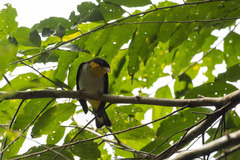
About the Yellow-backed Tanager
The yellow-backed tanager (Hemithraupis flavicollis) is a species of bird in the family Thraupidae, the tanagers and allies. It is found in Panama and every mainland South American country except Argentina, Chile, Paraguay, and Uruguay.
The yellow-backed tanager was formally described in 1818 by Louis Pierre Vieillot with the binomial Nemosia flavicollis. By 1912 it had been reassigned to its current genus Hemithraupis. The genus name Hemithraupis combines the Ancient Greek words hēmi, meaning "half" or "small" and thraupis, which refers to an unidentified small bird mentioned by Aristotle. In ornithology, it is typically used to refer to tanagers. The specific epithet flavicollis is derived from Latin, meaning "yellow-necked".
The yellow-backed tanager has these 11 subspecies: The yellow-backed tanager is about 13 cm (5.1 in) long and weighs 11 to 15 g (0.39 to 0.53 oz). It is a smallish tanager with a relatively slender bill. The species is sexually dimorphic. Adult males of the nominate subspecies H. f. flavicollis have a mostly brownish black head and upper back. Their lower back and rump are bright yellow. Their uppertail coverts... Wikipedia →