Pacific Gull

Pacific Gull

Larus pacificus

Silhouette: Sharon Wegner-Larsen · PhyloPic

LCLeast ConcernNTVUENCR Endemic
Daily sighting probability ~50% · Likely
at Maria Island National Park

In 3 days ~90% in a week >90%

250 Verified sightings at Maria Island National Park From 2019 to 2026
2,245 In all 6 parks
May Best month
☀️ Diurnal When it's spotted

About the Pacific Gull

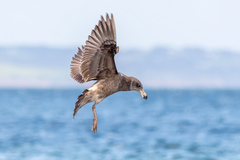
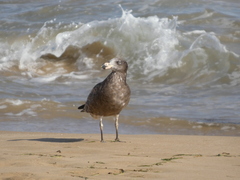
The Pacific gull (Larus pacificus) is a gull, native to the coasts of Australia. It is moderately common in a band along the coast between Carnarvon, Western Australia, in the west, and Sydney in the east, as well as Tasmania and other islands off the continent's southern coast. It has, however, become scarce in some parts of the south-east, as a result of competition from the kelp gull.

Much larger than the ubiquitous silver gull, and much less common, Pacific gulls are usually seen alone or in pairs, loafing around the shoreline, steadily patrolling high above the edge of the water, or sometimes flying high on the breeze to drop a shellfish or sea urchin onto rocks.

The gulls' diet consists of a number of various fish species and invertebrates. They frequently consume crabs, most often the species Ovalipes australiensis and Paragrapsus gaimardii. They also commonly eat Platycephalus bassensis (sand flatheads) and cephalopods, both of which are sourced from their regular consumption of waste from fish which have been cleaned on wharves and beaches. Additionally, they may eat insects, eggs, and other seabirds.

The gulls may be found scavenging abattoirs and in rubbish tips... Wikipedia →

Sounds

Call0:40

Australia · 2017

© Greg McLachlan · XC383925 · CC BY-NC-SA 4.0

Call0:23

Australia · 2015

© Pieter de Groot Boersma · XC326943 · CC BY-NC-SA 4.0

Recording0:09

Australia · 2026

© clayt_ · iNaturalist · CC BY-NC 4.0

Global Distribution

Parks Where Found

# Park Country Daily sighting probability
1 Wilsons Promontory National Park 🇦🇺 Australia
~80%
2 Freycinet National Park 🇦🇺 Australia
~60%
3 Maria Island National Park 🇦🇺 Australia
~50%
4 Flinders Chase 🇦🇺 Australia
~50%
5 Rottnest Island 🇦🇺 Australia
~30%
6 Great Otway National Park 🇦🇺 Australia
~10%

Cities Where Found

# City Country Daily sighting probability
1 Melbourne 🇦🇺 Australia
~10%
2 Hobart 🇦🇺 Australia
<5%
3 Perth 🇦🇺 Australia
<5%
4 Sydney 🇦🇺 Australia
<5%

Zoos & Centres Where Found

# Zoo / Centre Country
1 Featherdale Sydney Wildlife Park 🇦🇺 Australia In captivity

Before you go

What are the chances of seeing a Pacific Gull in Maria Island National Park?

Likely

About 50% of wildlife watchers report a Pacific Gull sighting in Maria Island National Park on a given day, based on 250 verified sightings from GBIF citizen-science data from 2019 to 2026. It is the 20th most-seen of the 81 birds we can rate there. Over three days the chance rises to about 90%, and over a week to over 90%, if each day is a fresh chance.

When is the best time to see a Pacific Gull in Maria Island National Park?

May

In that month about 70% of wildlife watchers report a Pacific Gull in Maria Island National Park on a given day, against about 30% in September, the lowest month.

What time of day is best to see a Pacific Gull?

Between noon and 3 pm

Across all the parks we cover, that three-hour window holds the most Pacific Gull sightings with a recorded time, and nearly all of them come between 6 am and 6 pm: it is a daytime animal.

Where does the Pacific Gull sighting chance come from?

GBIF citizen-science records

It is estimated from how often the Pacific Gull is recorded against all the birds logged in Maria Island National Park (250 verified sightings from 2019 to 2026), calibrated against known sighting rates. Figures are rounded to the nearest 10% because citizen-science data supports honest approximations, not decimals, and months with records from fewer than five people show "—". How it works.

← Back to Maria Island National Park