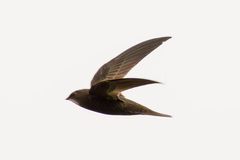
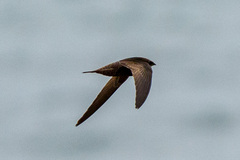
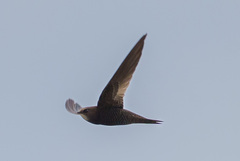
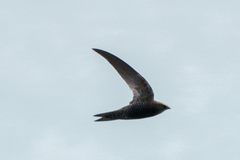
African Swift

African Swift

Apus barbatus

Silhouette: Ferran Sayol · PhyloPic

LCLeast ConcernNTVUENCR
Daily sighting probability <5% · Rare
at Masai Mara National Reserve

In 3 days <5% in a week ~10%

37 Verified sightings at Masai Mara National Reserve From 2019 to 2026
1,683 In all 31 parks
April Best month
☀️ Diurnal When it's spotted

About the African Swift

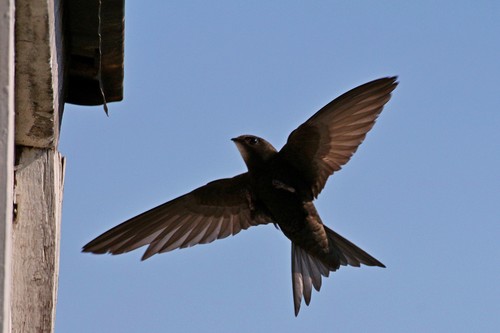
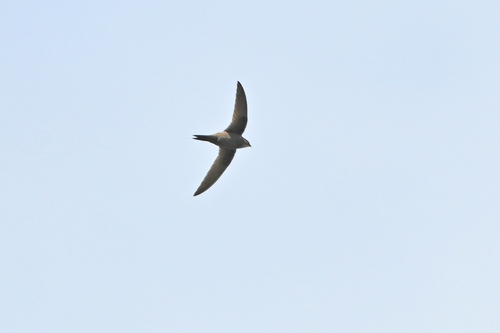
The African black swift (Apus barbatus), also known as the African swift or black swift, is a medium-sized bird in the swift family. It breeds in Africa discontinuously from Liberia, Cameroon, Zaire, Uganda and Kenya southwards to South Africa. The "black swifts" of Madagascar and the Comoros are either taken as two subspecies of the African black swift, or otherwise deemed a full species, the Malagasy black swift.

The African black swift was formally described in 1866 by the English zoologist Philip Sclater under the binomial name Cypselus barbatus based on a specimen collected in the Cape Province of South Africa. The specific epithet is Latin meaning "bearded". The African black swift is now one of sixteen species placed in the genus Apus. This species is also known as the African swift and the black swift.

Seven subspecies are recognised: Wikipedia →

Sounds

Flight call0:17

Madagascar · 2013

© Albert Lastukhin · XC983164 · CC BY-NC-ND 4.0

Call0:18

South Africa · 2017

© Peter Boesman · XC392306 · CC BY-NC-ND 4.0

Flight call0:06

South Africa · 2018

© Lynette Rudman · XC413388 · CC BY-NC-SA 4.0

Global Distribution

Parks Where Found

# Park Country Daily sighting probability
1 Golden Gate Highlands National Park 🇿🇦 South Africa
~30%
2 De Hoop Nature Reserve 🇿🇦 South Africa
~20%
3 Table Mountain National Park 🇿🇦 South Africa
~10%
4 West Coast National Park 🇿🇦 South Africa
~10%
5 Garden Route National Park 🇿🇦 South Africa
~10%
6 Mkomazi National Park 🇹🇿 Tanzania
~10%
7 Lake Nakuru National Park 🇰🇪 Kenya
~10%
8 Aberdare National Park 🇰🇪 Kenya
~10%
9 Kidepo Valley National Park 🇺🇬 Uganda
~10%
10 Akagera National Park 🇷🇼 Rwanda
<5%
11 Arusha National Park 🇹🇿 Tanzania
<5%
12 Addo Elephant National Park 🇿🇦 South Africa
<5%
13 Ruaha National Park 🇹🇿 Tanzania
<5%
14 Ngorongoro Conservation Area 🇹🇿 Tanzania
<5%
15 Kruger National Park 🇿🇦 South Africa
<5%
16 Hwange National Park 🇿🇼 Zimbabwe
<5%
17 Bwindi Impenetrable National Park 🇺🇬 Uganda
<5%
18 Pilanesberg National Park 🇿🇦 South Africa
<5%
19 Tsavo West National Park 🇰🇪 Kenya
<5%
20 Serengeti National Park 🇹🇿 Tanzania
<5%
21 Tarangire National Park 🇹🇿 Tanzania
<5%
22 Nairobi National Park 🇰🇪 Kenya
<5%
23 Semuliki National Park 🇺🇬 Uganda
<5%
24 Murchison Falls National Park 🇺🇬 Uganda
<5%
25 Samburu National Reserve 🇰🇪 Kenya
<5%
26 Masai Mara National Reserve 🇰🇪 Kenya
<5%
27 Lake Mburo National Park 🇺🇬 Uganda
<5%
28 Queen Elizabeth National Park 🇺🇬 Uganda
<5%
29 Kibale National Park 🇺🇬 Uganda
<5%
30 Moremi Game Reserve 🇧🇼 Botswana
<5%
31 Chobe National Park 🇧🇼 Botswana
<5%

Cities Where Found

# City Country Daily sighting probability
1 Cape Town 🇿🇦 South Africa
~10%
2 Durban 🇿🇦 South Africa
<5%
3 Johannesburg 🇿🇦 South Africa
<5%
4 Pretoria 🇿🇦 South Africa
<5%
5 Kigali 🇷🇼 Rwanda
<5%

Before you go

What are the chances of seeing an African Swift in Masai Mara National Reserve?

Rare

Under 5% of wildlife watchers report an African Swift sighting in Masai Mara National Reserve on a given day, based on 37 verified sightings from GBIF citizen-science data from 2019 to 2026. It is the 285th most-seen of the 398 birds we can rate there. Over three days the chance rises to under 5%, and over a week to about 10%, if each day is a fresh chance.

When is the best time to see an African Swift in Masai Mara National Reserve?

Any time of year

In every month with enough records, under 5% of wildlife watchers report an African Swift in Masai Mara National Reserve on a given day, so our monthly data shows no clear season.

What time of day is best to see an African Swift?

Between 8 and 11 am

Across all the parks we cover, that three-hour window holds the most African Swift sightings with a recorded time, and about 9 in 10 of them come between 6 am and 6 pm: it is a daytime animal.

Which relatives of the African Swift live in Masai Mara National Reserve?

Same genus: Apus

The closest relatives of the African Swift that you can see in Masai Mara National Reserve (genus Apus, Typical Swifts) are Little Swift (about 20%) and White-rumped Swift (about 10%), with each one's daily chance of a sighting.

Where does the African Swift sighting chance come from?

GBIF citizen-science records

It is estimated from how often the African Swift is recorded against all the birds logged in Masai Mara National Reserve (37 verified sightings from 2019 to 2026), calibrated against known sighting rates. Figures are rounded to the nearest 10% because citizen-science data supports honest approximations, not decimals, and months with records from fewer than five people show "—". How it works.

← Back to Masai Mara National Reserve