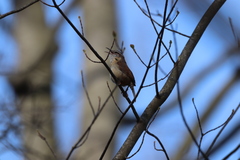
Carolina Wren

Carolina Wren

Thryothorus ludovicianus

Silhouette: Andy Wilson · PhyloPic

LCLeast ConcernNTVUENCR
Daily sighting probability ~20% · Possible
at Merritt Island National Wildlife Refuge

In 3 days ~50% in a week ~80%

2,696 Verified sightings at Merritt Island National Wildlife Refuge From 2019 to 2026
28,800 In all 14 parks
September Best month
☀️ Diurnal When it's spotted

About the Carolina Wren

The Carolina wren (Thryothorus ludovicianus) is a species of wren common in the eastern United States, the extreme south of Ontario, Canada, the northeast and southeast of Mexico, and into northern Central America. Severe winters restrict the northern limits of their range, while favorable weather conditions lead to a northward extension of their breeding range. Their preferred habitat is in dense cover in forest, farm edges, and suburban areas. This wren is the state bird of South Carolina.

Ten subspecies are recognized, occurring across the range of the species; they differ slightly in song and appearance. It is generally inconspicuous, avoiding the open for extended periods of time. When out in the open, they energetically investigate their surroundings and are rarely stationary. After finding a mate, pairs maintain a territory and stay together for several years. Both males and females give out alarm calls, but only males sing to advertise territory. Carolina wrens raise multiple broods during the summer breeding season but can fall victim to brood parasitism by brown-headed cowbirds, among other species.

The Carolina wren was first described under the name of Sylvia... Wikipedia →

Sounds

Alarm call1:14

United States · 2026

© Rory Nefdt · XC1146763 · CC BY-NC-SA 4.0

Song0:18

Mexico · 2022

© Joren van Schie · XC1080710 · CC BY-NC-SA 4.0

Begging call0:35

United States · 2024

© Sue Riffe · XC938797 · CC BY-NC-SA 4.0

Global Distribution

Parks Where Found

# Park Country Daily sighting probability
1 Congaree National Park 🇺🇸 United States
~90%
2 Great Smoky Mountains National Park 🇺🇸 United States
~70%
3 Point Pelee National Park 🇨🇦 Canada
~70%
4 Shenandoah National Park 🇺🇸 United States
~70%
5 Cumbres de Monterrey National Park 🇲🇽 Mexico
~60%
6 Big Cypress National Preserve 🇺🇸 United States
~30%
7 Calakmul Biosphere Reserve 🇲🇽 Mexico
~20%
8 Merritt Island National Wildlife Refuge 🇺🇸 United States
~20%
9 Everglades National Park 🇺🇸 United States
~10%
10 Tikal National Park 🇬🇹 Guatemala
~10%
11 Biotopo Cerro Cahuí 🇬🇹 Guatemala
<5%
12 Sian Ka'an Biosphere Reserve 🇲🇽 Mexico
<5%
13 Acadia National Park 🇺🇸 United States
<5%
14 Big Bend National Park 🇺🇸 United States
<5%

Cities Where Found

# City Country Daily sighting probability
1 Washington 🇺🇸 United States
~80%
2 Austin 🇺🇸 United States
~80%
3 San Antonio 🇺🇸 United States
~80%
4 Orlando 🇺🇸 United States
~70%
5 Philadelphia 🇺🇸 United States
~70%
6 Baltimore 🇺🇸 United States
~70%
7 Dallas 🇺🇸 United States
~60%
8 Houston 🇺🇸 United States
~60%
9 Boston 🇺🇸 United States
~40%
10 New York City 🇺🇸 United States
~30%

Zoos & Centres Where Found

# Zoo / Centre Country
1 National Zoological Park 🇺🇸 United States In captivity
2 Blue Hills Trailside Museum Habitats 🇺🇸 United States In captivity
3 Ralph Perkins II Wildlife Center and Woods Garden 🇺🇸 United States In captivity

Before you go

What are the chances of seeing a Carolina Wren in Merritt Island National Wildlife Refuge?

Possible

About 20% of wildlife watchers report a Carolina Wren sighting in Merritt Island National Wildlife Refuge on a given day, based on 2,696 verified sightings from GBIF citizen-science data from 2019 to 2026. It is the 58th most-seen of the 279 birds we can rate there. Over three days the chance rises to about 50%, and over a week to about 80%, if each day is a fresh chance.

When is the best time to see a Carolina Wren in Merritt Island National Wildlife Refuge?

September

In that month about 50% of wildlife watchers report a Carolina Wren in Merritt Island National Wildlife Refuge on a given day, against about 10% in November and December, the lowest months. That is one of Merritt Island National Wildlife Refuge's wettest months, with about 210 mm of rain against 50 mm in March.

What time of day is best to see a Carolina Wren?

Between 8 and 11 am

Across all the parks we cover, that three-hour window holds the most Carolina Wren sightings with a recorded time, and about 9 in 10 of them come between 6 am and 6 pm: it is a daytime animal.

Where does the Carolina Wren sighting chance come from?

GBIF citizen-science records

It is estimated from how often the Carolina Wren is recorded against all the birds logged in Merritt Island National Wildlife Refuge (2,696 verified sightings from 2019 to 2026), calibrated against known sighting rates. Figures are rounded to the nearest 10% because citizen-science data supports honest approximations, not decimals, and months with records from fewer than five people show "—". How it works.

← Back to Merritt Island National Wildlife Refuge