African Cuckoo

African Cuckoo

Cuculus gularis

Silhouette: Nicolas Huet le Jeune and Jean-Gabriel Prêtre (vectorized by T. Michael Keesey) · PhyloPic

LCLeast ConcernNTVUENCR
Daily sighting probability ~10% · With luck
at Meru National Park

In 3 days ~30% in a week ~60%

14 Verified sightings at Meru National Park From 2019 to 2026
1,369 In all 28 parks
November Best month
☀️ Diurnal When it's spotted

About the African Cuckoo

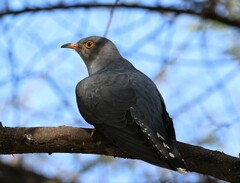
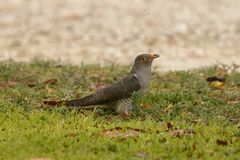
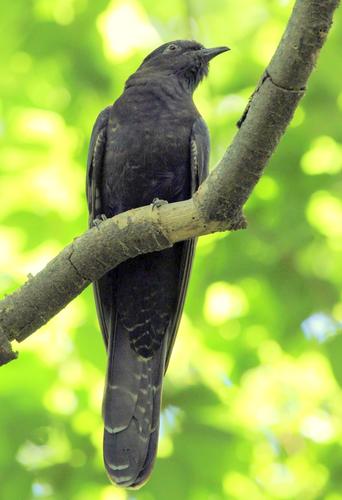
The African cuckoo or African grey cuckoo (Cuculus gularis) is a species of cuckoo in the family Cuculidae. It is found in Sub-Saharan Africa where it migrates within the continent, generally arriving and breeding in any one locality during the rainy season. A fairly common bird, the International Union for Conservation of Nature has rated its conservation status as being of "least concern".

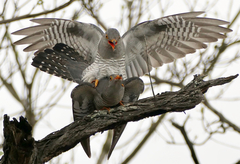
This is a medium-sized species with a long tail, with a total length of 32 cm (13 in). Its dashing flight makes it resemble a bird of prey. The sexes are similar, the head, upper parts and wings being dark grey, the throat and breast pale grey and the belly white barred with dark grey. The tail is dark grey with dark barring and a white tip. The eye is yellow in the male and light brown in the female. The beak is yellow, tipped with black or horn. The legs and feet are yellowish. The juvenile has two colour forms; the grey morph is greyer than the adult with white barring, the underparts being creamy-white with dense dark barring; the hepatic morph is brown rather than grey, the white being replaced by buff or a tawny hue. The call of the male is a "coo-coo" with the second note... Wikipedia →

Sounds

Song0:18

Ghana · 2022

© Peter Boesman · XC719075 · CC BY-NC-ND 4.0

Call0:25

Botswana · 2016

© Lynette Rudman · XC348916 · CC BY-NC-SA 4.0

Recording0:28

Nigeria · 2020

© Sun Madakan · XC590109 · CC BY-NC-SA 4.0

Global Distribution

Parks Where Found

# Park Country Daily sighting probability
1 Lake Mburo National Park 🇺🇬 Uganda
~10%
2 Meru National Park 🇰🇪 Kenya
~10%
3 Tarangire National Park 🇹🇿 Tanzania
~10%
4 Serengeti National Park 🇹🇿 Tanzania
~10%
5 Ngorongoro Conservation Area 🇹🇿 Tanzania
~10%
6 Liwonde National Park 🇲🇼 Malawi
~10%
7 Lake Manyara National Park 🇹🇿 Tanzania
~10%
8 Etosha National Park 🇳🇦 Namibia
<5%
9 Ruaha National Park 🇹🇿 Tanzania
<5%
10 Samburu National Reserve 🇰🇪 Kenya
<5%
11 Kruger National Park 🇿🇦 South Africa
<5%
12 Arusha National Park 🇹🇿 Tanzania
<5%
13 Mikumi National Park 🇹🇿 Tanzania
<5%
14 Kafue National Park 🇿🇲 Zambia
<5%
15 Tsavo West National Park 🇰🇪 Kenya
<5%
16 Hwange National Park 🇿🇼 Zimbabwe
<5%
17 Kidepo Valley National Park 🇺🇬 Uganda
<5%
18 Akagera National Park 🇷🇼 Rwanda
<5%
19 Lake Nakuru National Park 🇰🇪 Kenya
<5%
20 Queen Elizabeth National Park 🇺🇬 Uganda
<5%
21 Tsavo East National Park 🇰🇪 Kenya
<5%
22 Moremi Game Reserve 🇧🇼 Botswana
<5%
23 Murchison Falls National Park 🇺🇬 Uganda
<5%
24 South Luangwa National Park 🇿🇲 Zambia
<5%
25 Masai Mara National Reserve 🇰🇪 Kenya
<5%
26 Chobe National Park 🇧🇼 Botswana
<5%
27 Amboseli National Park 🇰🇪 Kenya
<5%
28 Bwindi Impenetrable National Park 🇺🇬 Uganda
<5%

Cities Where Found

# City Country Daily sighting probability
1 Accra 🇬🇭 Ghana
<5%
2 Kampala 🇺🇬 Uganda
<5%

Before you go

What are the chances of seeing an African Cuckoo in Meru National Park?

With luck

About 10% of wildlife watchers report an African Cuckoo sighting in Meru National Park on a given day, based on 14 verified sightings from GBIF citizen-science data from 2019 to 2026. It is the 166th most-seen of the 243 birds we can rate there. Over three days the chance rises to about 30%, and over a week to about 60%, if each day is a fresh chance.

When is the best time to see an African Cuckoo in Meru National Park?

April, June and November

In those months about 20% of wildlife watchers report an African Cuckoo in Meru National Park on a given day, against under 5% in October, the lowest month. Those are among Meru National Park's wettest months, with about 130 mm of rain a month against almost none in July. May and July–August have too few records to rate.

What time of day is best to see an African Cuckoo?

Between 7 and 10 am

Across all the parks we cover, that three-hour window holds the most African Cuckoo sightings with a recorded time, and about 9 in 10 of them come between 6 am and 6 pm: it is a daytime animal.

Is Meru National Park the best place to see an African Cuckoo?

Among the best

Of the 28 parks where we can rate African Cuckoo sightings, Meru National Park ranks 2nd at about 10%, level with the leaders once rounded. The best odds are in Lake Mburo National Park (Uganda, about 10%).

Which relatives of the African Cuckoo live in Meru National Park?

Same genus: Cuculus

The closest relatives of the African Cuckoo that you can see in Meru National Park (genus Cuculus, Typical Old World Cuckoos) are Common Cuckoo (about 30%), Red-chested Cuckoo (about 10%) and Black Cuckoo (about 10%), with each one's daily chance of a sighting.

Where does the African Cuckoo sighting chance come from?

GBIF citizen-science records

It is estimated from how often the African Cuckoo is recorded against all the birds logged in Meru National Park (14 verified sightings from 2019 to 2026), calibrated against known sighting rates. Figures are rounded to the nearest 10% because citizen-science data supports honest approximations, not decimals, and months with records from fewer than five people show "—". How it works.

← Back to Meru National Park